
Nobility and directory
Nobility of Austria
History and Register of the Nobility of Austria
- Jurisdiction
- Austria
- Entry type
- Directory
- Editorial status
- Reviewed - Verified
Nobility of the World
Volume VIII – Austria

The History and Register of The Nobility of Austria
Historically, the Austrian nobility (German: österreichischer Adel) was a privileged social class in Austria. The nobility was officially abolished in 1919 after the fall of the Austro-Hungarian Empire. Former noble families and their descendants are still a part of Austrian society today, but they no longer retain any specific privileges. Austria’s system of nobility is very similar to Germany’s system, as both countries were previously part of the Holy Roman Empire.
Any noble living in the Habsburg-ruled lands, and who owed their allegiance to the dynasty and the Emperor of Austria, were also considered part of the Austrian aristocracy. This applied to any member of the Bohemian, Hungarian, Polish, Croatian, Dalmatian and other nobilities in the Habsburg dominion. Attempting to differentiate between ethnicities can be quite confusing, especially for nobles during the time of the Austro-Hungarian Empire. A noble from Galicia, for example, could call himself a Polish noble, but he also rightfully belonged to the Austrian nobility.
Religion, just like ethnicity, was also not used for any categorisation purpose. Austrian nobility could belong to any of the religions within the Habsburg empire, such as Roman Catholic nobles in Austria, Hungary, Croatia, Dalmatia, Slovenia and Poland, Protestants in Bohemia and Transylvania, Greek Catholics in eastern Galicia, Orthodox Serbs in Vojvodina, as well as nobles of Jewish faith.
When speaking of “Austrian nobility”, two categories can be made: 1) the historic nobility that lived in the territories of the Habsburg empire and who swore allegiance to the dynasty, which included everyone until 1918; 2) the present, post-1918 Austrian nobility, specifically those who today retain Austrian citizenship, whose family originally come from Austria proper, South Tyrol (Italy) and Burgenland, or who were ennobled at any point under Austrian rule and identify themselves as belonging to that class.
The History of Austrian Nobility
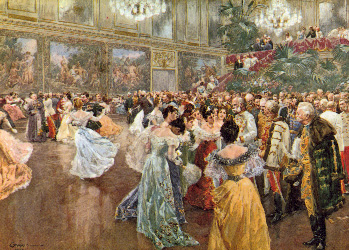
From 1453 onwards, the Archduke of Austria had the right to grant nobility to non-nobles, as did the Archbishop of Salzburg, as Salzburg remained an independent territory. Besides the Holy Roman Emperor (an office which was almost uninterruptedly held by the Archduke of Austria from 1438 to 1806 anyway), only a few territorial rulers within the Empire had this right. In an era of Absolutism, the nobility residing in the cities slowly turned itself into the court-nobility (Hofadel). Service at the court became the primary goal of the nobility. This in turn initiated an interest in education and the interests of the court. Within the court, a close inner circle, called the 100 Familien (100 families), possessed enormous riches and lands. They also had great influence at the court and thus played an important role in politics and diplomacy.
After the end of the Holy Roman Empire in 1806, the Habsburg rulers, who were Austrian Emperors from 1804 onwards, continued to elevate deserving individuals to nobility until the end of the monarchy in 1918. Some of the noble families even earned themselves the right to be hereditary peers in the House of Lords (Herrenhaus) in the Imperial Council (Reichsrat) of the Austro-Hungarian Empire. Nobles from previously sovereign states such as those in northern Italy (Venice, Mantua, Milan) also had their noble rights confirmed and were allowed to keep their titles.
The Jewish Nobility of Austria
Because of the Toleranzpatent, which was decreed in 1782 by Emperor Joseph II, Jewish bankers and later entrepreneurs and industrialists could also be ennobled for their services and loyalty. Jews who were elevated into the aristocracy were allowed to keep their religion. Although the elevation into the aristocracy meant recognition for the work and services and a rise in social status, it could not hide the fact that Jews were for the most part still only being “tolerated”. Jews could not freely choose the place and duration of their stay and had to regularly ask for permission from the authorities. This placed a huge burden on Jewish families. If the head of the family died, all his relatives had to leave the city. The right to purchase real estate was forbidden to Jews, even if they belonged to the nobility. This regulation stayed in place until 1860, when it was abolished by Emperor Franz Joseph I and Jewish citizens were given equal rights. But almost a century before the banker and protector of arts, Karl Wetzler [or Wetzlar] von Plankenstern was created a Freiherr by Empress Maria Theresia, he converted to Catholicism.
Despite these difficulties, by 1821 there were at least nine ennobled Jewish families living in Vienna. Their elevation was due to their industrial and economic contributions. Some of the very wealthy included the Rothschilds, Arnstein, Eskeles, Gomperz, Kuffner, Lieben, Auspitz, Schey von Koromla, Todesco and Wertheimstein, von Wiernes families. For example, in the case of the Rothschilds and Todescos, the secret of their personal economic success was their quick ability to adjust and innovate to the changing global economic situation. They founded banks that financed companies and infrastructure projects in a time of great economic and industrial growth in the late 19th century. Their contributions made it possible for Austria-Hungary to keep up with the international economic developments. The elevation into nobility also hastened the process of assimilation of Jewish families into the higher society. Some converted to Christianity in order to become fully accepted, but many kept their Jewish religion.
The Burgenland
On the former status of nobility in Burgenland, which was part of the Kingdom of Hungary until 1921, see Hungarian Nobility.
The Abolition of Nobility in 1919
The Adelsaufhebungsgesetz of 1919 (Law on the Abolition of Nobility) abolished nobility as well as all noble privileges and, other than those in Germany, noble titles and names. Thus, no citizen of Austria can have any noble titles or even particles such as von and zu in his or her name. For example, the name of the grandson of the last Austrian emperor is simply Karl Habsburg. Similarly, Friedrich von Hayek became Friedrich Hayek and Kurt von Schuschnigg became Kurt Schuschnigg.
This may sometimes be confusing, as descendants of nobles are sometimes referred to with noble names abroad, even though this is not legally accurate with respect to Austrian citizens. Also, different members of noble families often hold different citizenships, such as in the case of Otto von Habsburg (the son of the last Austrian emperor and father of the Karl Habsburg mentioned above), who is also a citizen of Germany, where this Austrian law does not apply to him. The law does not apply to artistic, performer’s, or “stage names,” where the von is sometimes used, as in the case of conductor Herbert von Karajan or the musician Hubert von Goisern. However, stage names are never recognized for official purposes.
Members of the lower nobility especially (such as the civil servants) found this radical step of abolition degrading and humiliating, since working towards and finally earning a nobility title was a way for them and their families to rise within society. Members of the higher nobility were able to absorb the formal abolition more easily. They lost their titles and their privileges, but they still kept their social manners and standing and were allowed to keep their riches. Federal President Michael Hainisch called the official abolition
” …childish, because it did not hit those that it was supposed to hit. I once talked to the very fine and very intelligent Princess Fanny Starhemberg about this. ‘To us’, she said, ‘the official abolition is quite irrelevant, because with or without the titles, we will always remain the Starhembergs. ” The law was never repealed, even during the period of Austrofascism (1934-1938). Following the Anschluss to Nazi Germany (1938-1945), this law remained active, although it was not enforced, allowing Austrian nobles to use titles freely again.
Although the noble titles and the particles von and zu are not officially kept any more, some persons are still referred to with their titles in a private function. For example, Karl Schwarzenberg will occasionally still be referred to as FürstSchwarzenberg (Prince Schwarzenberg) in the media; he holds Czech and Swiss citizenship, not Austrian. As opposed to nobility in Bohemia, Poland, Russia, or the former Prussian territories, the Austrian nobility never had its lands and riches confiscated. Social measures were introduced by the republican government in order to create more equality amongst the citizens and finance public projects, which put a strain on the traditional land-holding gentry and aristocracy, resulting in the forced sale of many palaces and lands, due to the expense of their upkeep. However, there was no measure by the government specifically to target nobility and take away their possessions.
To many Austrians, the abolition of nobility, its privileges and titles was and still is an important element of a democratic and republican state, where individuals are treated equally and thus should hold any titles of honour solely by their individual merit. Noble titles have been replaced with an almost obsessive usage of and fascination with academic titles and titles of office. Regardless, the nobility today are sometimes still treated slightly differently from ordinary citizens. Austrian nobility still plays a large part in movies made after World War II (for example Sissi and Sound of Music), and is still featured regularly in the media and literature. The social events of nobles are still spread far and wide in tabloids. Besides, the law is gladly broken on many occasions when members of the nobility are addressed at various events. Especially at the annual birthday celebration of Emperor Francis Joseph in Bad Ischl, present members of the Habsburg family are addressed as “Imperial and Royal Highnesses”.
Apart from the loss of their titles, which hit the lower nobility harder than the higher nobility, most have fared remarkably well in modern Austria and still make up some of the richest families, such as the Esterházy, Mayr-Melnhof and Mautner-Markhof. Many members of the Austrian nobility today work in the traditional fields of diplomacy, politics, have business and financial interests, or are philanthropists or socialites.
It was estimated that there were about 20,000 Austrian nobles in 2005. That year, an association was founded, the Vereinigung der Edelleute in Österreich (Association of Austrian Nobles, or V.E.Ö.). It sees itself as the successor of the Vereinigung katholischer Edelleute in Österreich, which was founded in 1922 and banned under the Nazis in 1938. Until recently, all of the various attempts at revival were blocked by Austrian authorities.
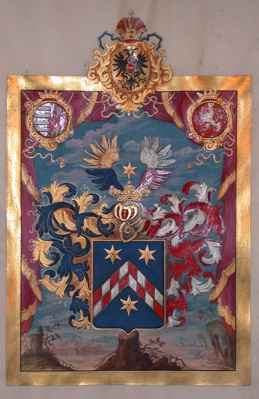
The Noble Titles of Austria
The Austrian nobility was divided up into two categories, the higher nobility (hoher Adel), and the lower nobility (niederer Adel). To the higher nobility belonged the princes and counts, the lower nobility was made up of the rest:
English titles with German equivalents
- Duke/Duchess (Herzog/Herzogin)
- Prince/Princess (Fürst/Fürstin)
- Count/Countess (Graf/Gräfin)
- Baron/Baroness (Freiherr/Freifrau and Freiin)
- Knight (Ritter) (no female version existed)
- Edler/Edle (roughly equivalent in meaning to “Sir” or “Dame”, but not a common translation)
- Non-ruling members of the imperial family were given the title of Archduke/Archduchess (Erzherzog/Erzherzogin) and styled Imperial and Royal Highness (Kaiserliche und königliche Hoheit). The wife of the emperor bore the title of Empress (Kaiserin) and was styled Her Imperial Majesty.
Agnates of the imperial family, who were excluded from the line of succession, were created dukes and duchesses or princes and princess and addressed as Highness (Hoheit) or Serene Highness (Durchlaucht).
Below is an incomplete list of Austrian noble families, listed by rank of title. Note that some members of a family were sometimes given higher titles by the emperor because of merit. Titles, styles, and rights could only be conferred by the monarch. In some cases, they could even be revoked because of fall from favour.
Note 1: For a Countess not being married, the title Komtesse was used, borrowed from the French language Comtesse.
Note 2: In German, a distinction between baronesses exists, a Freifrau being a baroness by marriage and Freiin being a baroness by birth.
The Title of Erzherzog / Erzherzogin (Archduke / Archduchess) of Austria (House of Habsburg-Lorraine) of Austria-Este (House of Habsburg-Lorraine, dukes of Modena & Este) The Title of Großherzog / Großherzogin (Grand Duke / Grand Duchess) of Tuscany (House of Habsburg-Lothringen, archdukes of Austria) The Title of Herzog / Herzogin (Duke / Duchess) of Babenberg extinct 1246 of Hohenberg (Wife and children of Successor to the Throne Archduke Franz Ferdinand) of Modena & Este (House of Habsburg-Lothringen, Archdukes of Austria-Este of Reichstadt (see Napoleon II) of Teschen (House of Habsburg-Lothringen, archdukes of Austria)
Because of the abolition of the prepositions, many families were forced to reinvent their family names completely. This brought in many complications. The following list of the non-Habsburg nobles shows the pre-1919 family names or preposition in brackets, followed by the standard appearance today. Noble families could have the preposition “von”, “zu” or a combination of it (“von und zu”). Non-German-speaking nobility, however, preferred to use “de”, such as those in Bohemia, Hungary, and Galicia, as they felt that it was less Germanic-sounding. Since Austria-Hungary was a multiethnic empire, both versions could be officially used and were recognised by the government.
Conversely, family names using prepositions like “de” and “de la” could not replace the preposition with the Germanic “von”. For example, the family “Sanchez de la Cerda” originally came from Spain, therefore the preposition remained as in the original. The same exception applies to other families such as “Schönburg-de Laserna” and “de la Fontaine und d´Harnoncourt-Unverzagt”. The latter is an interesting combination of French- and German-language prepositions, which again is a reflection of the colourful multiethnic history of the Austrian Empire. Often, family names with a predicate were written “von X-Y”, even though the correct form is “X von Y”.
Countess Draskovich accompanied by Prince Ferdinand of Auersperg at
the horse-races in Freudenau, close to Vienna. Horse racings were
popular and played a similar role like Ascot in the United Kingdom.
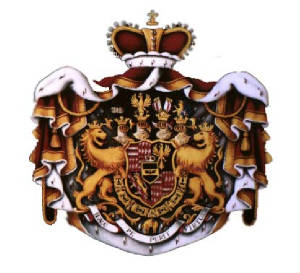
The Title of Fürst / Fürstin – Prince / Princess
The style of address is Durchlaucht (Serene Highness). Also used was Fürstliche Gnaden (Princely Grace).
- Preposition Original name Current name Notes
- von Auersperg Auersperg-Schönfeldscher
- Batthyány-Strattmann junior members were counts
- Barth von Barthenheim de Bart also used the preposition de and raised from comital to princely rank in 1917 by Emperor Charles
- von Clary und Aldringen Clary-Aldringen junior members were counts
- von Collalto und San Salvatore Collalto junior members were counts
- von Colloredo-Mansfeld Colloredo-Mansfeld junior members were counts; eldest son of the prince was titled Count of Mansfeld; See also House of Mansfeld
- von Croÿ Croÿ(-subline) Also known as Croÿ-Dülmen, three branches exist. Lines of this family were dukes; also used the preposition de.
- von Dietrichstein Became extinct firstly in male line, recreated for husband of heiress; junior members of this family were counts of Dietrichstein & Proskau-Leslie (first family) then Dietrichstein-Mensdorff-Pouilly (second family)
- Esterházy von Galántha Esterházy also comital; also used the preposition de
- Festetics von Tolna Festetics also comital; also used the preposition de
- zu Fürstenberg Fürstenberg members use titles outside of Austria; some use the preposition von
- von Grassalkovics Grassalkovics became extinct
- zu Hohenlohe Hohenlohe this family had multiple branches
- von Khevenhüller-Metsch Khevenhüller-Metsch junior members were counts
- Kinsky von Wchinitz und Tettau Kinsky junior members were counts; also comital
- von Lichnowsky Lichnowsky
- von Lobkowicz Lobkowicz
- von und zu Liechtenstein von und zu Liechtenstein sovereign since 1719
- von Metternich-Winneburg Metternich also used the preposition de
- zu Oettingen-Oettingen this family had multiple branches (Oettingen, Wallerstein & Spielberg)
- von Orsini und Rosenberg Orsini-Rosenberg junior members were counts
- von Rohan Rohan a female line of this family was ducal; also used the preposition de
- zu Sayn-Wittgenstein Sayn-Wittgenstein-(subline) this family had multiple branches
- von Schönburg-HartensteinSchönburg-Waldenburg Schönburg(-subline) this family had multiple branches; also comital
- von Starhemberg Starhemberg junior members were counts
- zu Schwarzenberg Schwarzenberg Head of the house is also Count of Sulz, Princely Landgrave in Klettgau and Duke of Krumlov.
- von Thun-Hohenstein Thun-Hohenstein also comital
- von und zu Trauttmansdorff-Weinsberg Trauttmansdorff-Weinsberg also comital
- von Waldburg Waldburg-(subline) this family had multiple branches; junior members were counts
- zu Windisch-Graetz Windisch-Graetz also Windisch-Grät
The Title of Graf / Gräfin – Count / Countess
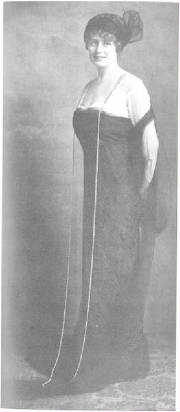
A young countess of the Schönborn family posing for an artistic photo.
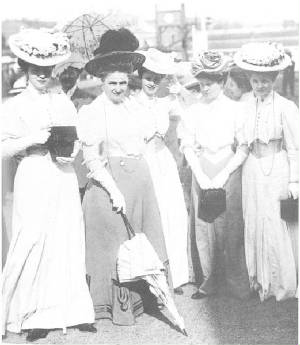
Countess Marietta Silva-Tarouca with her daughters at the horse races in Prague.
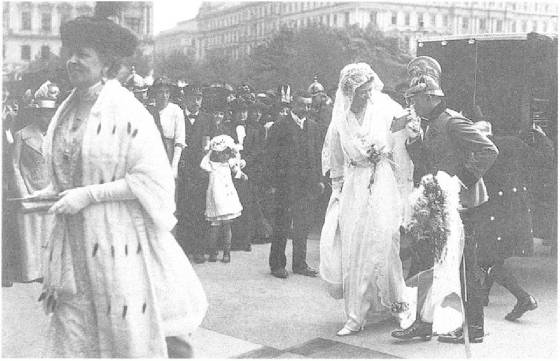
The Countess Clam-Gallas (left, wearing an ermine coat) arriving at the Votivkirche in Vienna for the wedding of one of her seven daughters, (right couple) Countess Gabrielle Clam-Gallas to Adolf, Prince of Auersperg. The high aristocracy tended to intermarry, making weddings a spectacular social event for all.
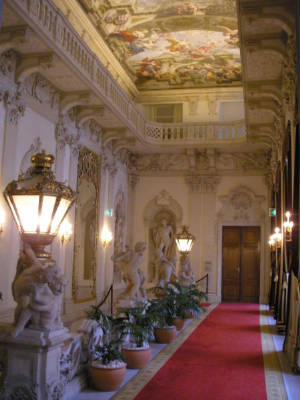
During the baroque era, the nobility started to move into the cities and built themselves lavish residences called Palais. The Palais Kinsky in Vienna, belonging to the princely Kinsky family, is one of the most outstanding pieces.
The Style of Address is, in most cases
Erlaucht – Illustrious Highness
Also used was Gräfliche Gnaden (Comital Grace).
- (von Abensberg und Traun) Abensberg-Traun
- Aichelburg (or Aichelburg-Zassenegg)
- (Alberti von Enno)
- Almásy
- Almeida
- (von) Althann
- (von Andechs-Meranien) extinct 1248
- Andrassy
- Apponyi
- Arco
- Arz-Vasegg
- (von) Attems (or Attems-Gilleis)
- (Bartolotti von Partenfeld)
- (Barth von Barthenheim), or de Bart(-Barthenheim), with title Reichsgraf since December 2, 1802
- Badeni
- Baillet (de Latour)
- Bánffy (von Losontz)
- Bakowski/Bonkowski (von Sachsenhof und Lampersdorf)
- Barbo (von Waxenstein)
- Beck (or Beck-Rzikowsy)
- Belcredi
- Béldi
- Bellegarde
- Belrupt-Tissac
- Berchtold
- Berenyi
- Bethlen
- Blanckenstein
- Bolza
- Bona (House of Bona)
- Bonda (House of Bonda)
- Borkowski
- Bossi-Fedrigotti
- Bozen (see Maurer)
- Braida
- Brandis
- (von Breuner-Asparn) extinct 1894
- (von Breuner-Nußdorf) extinct 1862
- Breunner
- Bubna-Litic
- Bucquoi (von Longueval)
- (Bukuwky von Bukuwka)
- Bulgarini
- (von) Buol-Schauenstein
- Butler (von Clonebough)
- (von) Caboga (House of Caboga)
- (von Caprara)
- Cassis-Faraone
- (von) Cavriani
- (Ceschi a Santa Croce)
- (von) Chorinsky
- Chotek (von Chotkova (Chotkowa) und Wognin)
- Christalnigg
- Clam-Gallas
- Clam-Martinic
- (von) Clary-Aldringen
- (von) Cobenzl
- (von Collalto und San Salvatore) Collalto
- (von) Colloredo-Mannsfeld
- Consolati (Consolati von und zu Heiligenbrunn)
- Coreth (zu Coredo und Starkenberg)
- Coronini-Cronberg
- (von) Coudenhove-Kalergi
- Csák (von Köröszegh)
- Csáky (von Köröszegh und Adorján)-(von) Pallavicini also with the title Margrave (Markgraf, Őrgróf)
- Cseszneky de Milvány
- Czernin (von und zu Chudenitz)
- Cziraky
- D’Alton
- Daun
- Décsey (de Maros-Décse et Nagy-Doba)
- Degenfeld-Schonburg
- Des Fours
- Deym-Stritez
- Dezasse (de Petit-Verneuil)
- (von Dietrichstein)
- Dobrzensky (von Dobrzenicz)
- Dohalsky (von Dohalitz)
- Drašković (von Trakostjan (Trakošćan), or Draskovich de Trakostjan)
- Dubsky (von Trebomislyc)
- Edelsheim-Gyulai
- Eltz (zu Eltz)
- Emo (-Capodilista)
- (von) Enzenberg
- (von) Erdödy
- (von Eppan) extinct 1248
- (von Eppensteiner) extinct 1122
- (von Eyczing) extinct 1620
- (Vrints zu Falkenstein)
- Falkenhayn
- Ferrari(s)-Ochieppo
- Finck von Finckenstein
- (von) Firmian
- Folliot de Crenneville-(Poutet)
- Forni
- Francken-Sierstorpff
- Fredro
- Fries
- Fünfkirchen
- Gallenberg
- Galler
- Gatterburg
- (von) Ghetaldi-Gondola
- Gleispach
- (von) Goëss
- Gorcey
- Grabowki-Kruska
- Grimani-Giustinian
- Grundemann-Falkenberg
- (von Grünne), also carried title Graf von Pinchard
- (von) Gudenus
- Hadik (von Futak)
- (zu) Hardegg
- (de la Fontaine und d’Harnoncourt-Unverzagt) Harnoncourt
- (von Harrach zu Rohrau und Thannhausen) Harrach
- Hartenau
- Hartig
- Haslingen
- (von Henckel zu Donnersmarck) Henckel-Donnersmarck
- (von) Herberstein
- Hohenberg
- (von) Hohenems
- (von) Hoyos
- Hunyady-Kethely
- Kálnoky
- Károlyi
- (von Kaszongi)
- (von) Kaunitz
- (von) Kellersberg
- (von) Keyserling
- (von) Khevenhüller or Khevenhüller-Metsch
- Kinsky (von Wchinitz und Tettau), also princely with the title of Fürst
- (von) Kuefstein
- (von) Kollonitsch
- (von) Kolowrat
- (von) Kolowrat-Krakowsky
- (von Kolowrat-Liebsteinsky) extinct 1861
- (Königsegg zu Aulendorf)
- Kornis
- Kottulinsky (von Kottulin)
- (von) Krane
- (von)Kruska-Grabowski
- Khuen-Belasi
- (von) Kuefstein
- Küenburg
- Künigl
- Kulmer (zum Rosenpichl und Hohenstein)
- (von) Kurzberg
- (von) Lamberg
- Lanckoronski
- Lanthieri
- Larisch (zu Moennich)
- Lazanski (von Bukowa)
- Ledóchowski (a.k.a. Halka von Ledóchow-Ledóchowski)
- Lexa (von Aehrenthal)
- Lodron-Laterano
- Lodron-Löwenstein
- Ludwigstorff
- (MacCaffry of Kean More)
- Magnis
- Mailáth
- Mamming
- Marenzi, also with title Margrave (Markgraf)
- Marzani
- Matuschka
- Maurer (1919: Mauriello)
- Mels-Colloredo
- (von) Mensdorff-Pouilly, also princely with the title of Fürst (Mensdorff-Pouilly-Dietrichstein)
- Meran
- Meraviglia-Crivelli
- Migazzi
- (von Mir)
- Mittrowsky
- Montecuccoli
- (von Montfort) extinct 1787
- (von) Neipperg
- Neuhaus
- (von Norman und von Audenhove) de Norman et d’Audenhove)
- Nostitz-Rieneck
- Nyary (von Bedegh und Berench)
- Oeynhausen
- O’Donnell von Tyrconnell
- Oppersdorff
- (Orsini und Rosenberg) Orsini-Rosenberg, also princely with the title of Fürst
- Orssich (de Slatevich)
- Osiecimski-Hutten-Csapski
- Ostrowski
- Paar
- Pace
- Pacata
- (Pálffy von Erdöd) Pálffy
- (von) Pallavicini, also with title Margrave (Markgraf)
- Paumgarten
- Piatti
- Pilati
- Podstatzky-Lichtenstein
- (von) Pola (de Castropola)
- Pötting und Persing
- Potulicki
- Pozza Von Zagorien (House of Pozza)
- Praschma
- Prokesch-Osten
- Puppi
- Radetzky
- Rességuier
- Revertera (or Revertera-Salandra)
- (von) Rohrbacher
- (Jordan)Rozwadowski (a Polish/Galician title)
- Rumerskirch
- Salburg
- Salis
- (Sanchez) de la Cerda
- Saurma
- Scapinelli-Lèguigno
- Schallenberg (or Schallenberg-Krassl)
- Schirndinger (von Schirnding)
- Schnitzer
- Schmettow
- (von) Schönborn (or Schönborn-Bucheim)
- Schönfeld(t)
- Sedlnitzky-Odrowaz (cf. Sedlnitzky)
- Ségur-Cabanac
- Seilern-Aspang
- Serényi
- Sermage
- Siemienski-Lewicki
- Sierakowski
- (de Sylva von Tarouca, or de Silva-Tarouca) Silva-Tarouca
- Sizzo-Noris
- Skarbek
- Somogyi (von Medgyes)
- Spangen von Uyternesse
- Spannocchi
- Spaur
- Spee
- (Matz von) Spiegelfeld
- Sprinzenstein
- Stainach
- Starhemberg
- Sternberg
- Stolberg
- Stras(s)oldo
- (von) Strozzi
- (von Stubenberg) extinct 1868
- Stubick
- Stürgkh
- Széchényi
- Taaffe
- Taczanowski (or Dassanowsky; Prussian title but long present in Galicia and Vienna)
- Tarnowski
- Tattenbach
- Taxis-Bordogna
- Teleki (von Szek)
- Terlago
- (von) Teuffenbach
- (von Thonradel) fled 1620
- (von) Thürheim
- (von) Thun-Hohenstein, also princely with the title of Fürst
- Thurn-Valsassina
- Tisza (de Boros-Jenö et Szeged)
- Török (de Szendrö)
- Trapp
- Traun
- (von und zu) Trauttmansdorff-Weinsberg, carried title Erbgraf
- (von) Trautson
- (von der) Trenck
- Treuberg
- Ueberacker
- (Ungnad von Weißenwolff)
- Vay (von Vaja), Hungarian: Vajai Vay
- (Vetter von der Lilie)
- Wagensperg
- Waldburg(-Zeil-Trauchberg)
- Walderdorff
- Waldstein (or Waldstein-Wartenberg)
- (von Wallis), also carried title Freiherr auf Carighmain
- Walterskirchen, also carried title Freiherr zu Wolfsthal
- (von) Wédler
- Weikersheim
- Welczeck
- (Welser von) Welsersheimb
- Welsperg
- Wenckheim
- Wengersky
- Wickenburg
- Widmann-Sedlnitzky
- (von) Wilczek
- (von) Wimpffen
- (von) Wodzicki
- Wolanski
- Wolkenstein
- Wratislaw von Mitrowitz
- (von) Wurmbrand(-Stuppach)
- Wydenbruck
- Zaleski
- Zamoyski
- (von) Zichy(-Ferraris)
- Zerotin
- (von) Zinzendorf
The Title of Freiherr / Freifrau / Freiin – Baron / Baroness
There was no official style, but “Gnädiger Herr”, “Gnädige Frau”, or “Gnädiges Fräulein” were common forms of address. Although strictly speaking the title was “Freiherr”, the usage of “Baron” in written and verbal communication was very common, even if incorrect. The title “Freiin” was also often replaced for “geborene (née) Baronin”, which was strictly speaking also incorrect since a “Baronin” would have been wed already.
- Abele von Lilienberg
- Adamovich (de Csepin)
- (von) Arnstein
- Apfaltern
- (Arz von Straussenburg)
- (von) Augustin
- (von) Auspitz
- (von) Bach
- Bakonyi
- (von) Baselli
- (Berger-Waldenegg)
- Berlakovich
- (von) Bibra
- (von Bienerth)
- Blomberg
- (von) Blumencron
- Chledowski (von) Pfaffenhofen
- (von Columbus)
- (von) Cornaro
- Cseszneky de Milvány
- (von) Drasche-Wartinberg
- Eötvös de Vásárosnamény
- (von) Eskeles
- (von) Ferstl
- Fraydt (von) Fraydenegg
- (von Fries)
- (von) Froelichsthal (or von Frölichsthal)
- (von Gagern)
- (von) Gomperz
- (von Ghetaldi-Gondola)
- (von) Haas
- (von) Hagenauer
- (von) Helfert
- (von) Hess
- (von Hofkirchen) extinct 1692
- (von Isbary)
- (Jörger von Tollet) extinct 1772
- (von Marguti)
- (Kalchegger von Kalchberg)
- (Kay von Bebenburg)
- (Kiß von Ittebe)
- (von) Kubinzky
- (von) Klimburg
- (von) Kuffner
- (von) Laudon
- (von) Leitenberger
- (Leonhardi)
- (von) Lieben
- (von) Ludwigstorff
- (von) Lütgendorff
- Matz von Spiegelfeld
- (Mayr von Melnhof) Mayr-Melnhof
- (von) Mensshengen
- (von Miller zu Aichholz) Miller-Aichholz, also carried title
- Milutinovich-Milovski
- (Nadherny von Borutin)
- (Nagy von Töbör-Ethe)
- Obenaus von Felsöház
- (von) Oppenheimer
- (von) Pereira-Arnstein (cf. Pereira, Arnstein)
- (von) Pfanzelter
- Anton von Poljak (Croatia)
- (von Prandau)
- (von) Quiqueran-Beaujeu
- Reitzes (von Marienwerth), sometimes also “de Reitzes-Marienwerth”
- (von) Riefel
- (von) Rona
- (von or de) Rothschild, normally used the title Baron
- (von) Ringhoffer
- (von) Schey
- Schmeltzern (von) Wildmannsek (See Die Gothaischen Genalogischen Taschenbucher des Adels)
- (Schey von Koromla)
- (Sebottendorf von der Ronse)
- (von) Seiller
- (von) Silber
- (von) Sina
- (von Skrbensky)
- (von Schnehen)
- (von) Schmeltzern
- (von) Smeltzern zu Wildemannsek
- (von) Smeltzern Wildemannsek
- (von) Spaun
- (von) Stipsicz de Ternova
- (zu) Stübing
- Sypniewski, Ritter von Odrowaz (1480)
- Thavonat-Thavon
- (von) Todesco
- (von) Turkovich
- Wadenstierna
- (Jäger von) Waldau
- (von) Waechter
- Wetzler von Plankenstern
- (von Widmann)
- (von) Wiernes
- (von) Wildmannsek, Schmeltzern
- (von Weigelsperg)
- (von) Wertheimstein
- (von) Westenholz
- (Zeidler-Daublebsky von Sterneck)
The Title of Ritter – Knight
There was no official style, but “Gnädiger Herr” was a common form of address. The title was for males only; no female version exists. Female members of a family with the title Ritter however were often addressed as “Edle von”, which was totally incorrect, unless the family already carried the “Edle” honour before being raised as into the “Ritter” class.
- Bloch (von Brodnegg), ennobled in 1915
- (von Brasseur)
- (von) Ephrussi
- (von) Epstein
- (von) Doderer
- (Friedmann, Ritter von) Prawy
- (von) Ghega
- (von Grumpenberger)
- (von Hauslab)
- (Hanisch, Ritter von Reyl)
- (von) Karajan
- (von) Klinkosch
- (Korybut de Ostoja)
- (von Kriegelstein), carried the title Reichsritter as well as Edler von Sternfeld
- (La Rénotiere, Ritter von Kriegsfeld)
- (von Klaudy)
- (von Kriehuber)
- Launsky (von Tieffenthal)
- (von) Leeb
- (von) Mallmann
- (von) Wildemannsek, Schmeltzern
- (von) Maurer (also Mauerer)
- (Mautner von Markhof) Mautner-Markhof
- (von) Merkl
- (von Miller zu Aichholz) Miller-Aichholz, also carried title Baron
- (von) Mulwerth
- (von) Nadherny, Czech: Nádherný
- (von Nahujowski)
- (von Neumann)
- (von) Pellendorf
- (von Premerstein)
- (von) Ponteuxin
- (von Rumpler)
- (de) Schneider de Zajol (Zajoli Schneider/Zajoli Snajder)
- (Schönwies von) Schönowsky
- (von Schwarz)
- (Skrebeciowicz de Sielecki, or von Sielecki) Sielecki
- (Stermich von Valcrociata or von Kreuzenthal) de Stermich di Valcrociata: also carries the title of Edler von Valrociata or von Kreuzenthal
- (von) Trapp
- (von) Trautenegg
- (von) Wertheim
- de Weryha-Wysoczański
- (von) Winiwarter
- (von) Wessely, later Freiherr
Edler / Edle (Sir / Dame
There was no official style, but “Gnädiger Herr” or “Gnädige Frau” were common forms of address.
- (Fedrigoni von Etschthal)
- (von Günner)
- (Hanisch von Greifenthal)
- Hofmann von Hofmannsthal
- (von) Holzmeister
- (von) Khol
- (von Korbuss)
- (Milutinowits von Gottesheim)
- (von) Mises
- (von Nespern)
- (Schallber von Schalberg)
- (von Schuppler)
- (Sepp von Seppenburg)
- (von Sternfeld), also carried the title Reichsritter von Kriegelstein
- (von) Sypniewski, also carried the title “Baron Sypniewski”
- (von) Thurneyssen
- (von) Webenau
- (von) Weingartner
- Tarbuk von Sensenhorst
The Title of Erbsälzer
This title belonged to the patricians of the free city of Werl, in Germany, who had the hereditary (erb-) right to exploit the nearby salt mines (Salz]]). Thus this title was not granted in Austria, but merely recognized there.
- (von) Lilien
- (von) Papen
Untitled noble families or status unknown
- The Title of Adel
- (Anthony von Siegenfeld)
- (von) Adlgasser
- (von) Benda
- Bielka-Karlstreu
- (von Brenner)
- (von or de) Chledowski
- (von) Doblhoff
- (Dobner von Dobenau)
- (von) Eidlitz
- (von) Einem
- (von Ernst)
- (von Fischer)
- (Fischer von See)
- (Froschmayr von Scheiblenhof)
- (von Fürstenmühl)
- (von) Gaupp
- (von) Gauster-Filek
- (Gelb von Siegesstern)
- (von) Gera
- (von Göhausen)
- (von Greschke)
- (Grognet d’Orleans)
- (von Hellenau)
- (von) Holbein
- (von) Hornbostel
- Jakabffy (von Nemeshetes und Zaguzsen)
- (Korper von Marienwert)
- (von Lambort)
- (von) Lennkh
- (Levasori della Motta)
- (Lippich von Lindburg)
- (von) Lónyay (Hungarian Count Elémer Lónyay married Archduchess Stephanie, widow of Crown Prince Rudolf, and was elevated to Prince (Fürst))
- (von Löwenthal-Linau)
- (von) Mendelssohn
- Müller-Hartburg
- (von) Neumann
- (von) Ofenheim
- (von Pechmann)
- (von) Prausnitz
- (von Praxenthaler)
- (von Preradovic), Croatian: Preradović
- (von) Radak
- (von Remenyik), Hungarian: Reményik
- (von) Rigel
- (von) Rottal
- (von) Saar
- (de) Saeger (since 1731)
- Schiff (von Suvero)
- (von) Scholten
- (Schönburg-de Laserna)
- Schumacher (von Marienfrid)
- (von) Strachwitz (the German Franz Graf (Count) Strachwitz von Groß-Zauche und Camminetz gained Austrian citizenship without having to eliminate his title or the “von”)
- (von Stremnitzberg)
- (Suchy von Weißenfeld)
- (Toscano dell Banner)
- (Tuschner von Hirschberg)
- (von Ürmenyi), Hungarian: Ürményi
- (von Zepharovich, Zepharovich)
- (von) Zumbusch
- (Zeßner-Spitzenberg)
The Title of Marquis
- Gozeni di S. Giorgio (coming from the Austrian territories in northern Italy)
Literature
- Binder-Krieglstein, Reinhard. Österreichisches Adelsrecht 1868-1918/19. Peter Lang, Vienna 2000, ISBN 978-3-631-34833-8
- Coudenhove-Kalergi, Richard. Adel. Vienna. 1923.
- Frank-Döfering, Peter. Adelslexikon des österreichischen Kaisertums 1804-1918. Herder, Vienna 1989. ISBN 3-210-24925-3
- Lieven, Dominic. The aristocracy in Europe. London 1992.
- Siegert, Heinz. Adel in Österreich. Vienna 1971.
- Stekl, Hannes. Adel und Bürgertum in der Habsburgermonarchie 18. bis 20. Jahrhundert. Oldenbourg, Vienna 2004. ISBN 3-486-56846-9
- Walterskirchen, Gudula. Blaues Blut für Österreich. Amalthea, Vienna 2000. ISBN 3-85002-452-0
- Walterskirchen, Gudula. Der verborgene Stand. Adel in Österreich heute. Amalthea, Vienna 2007. ISBN 3-85002-428-8
- Der Gotha. Supplement. Der “Österreich-Gotha”. Mit Ergänzungswerken zum deutschen Adel. Saur, Munich 1997. ISBN 3-598-30359-9