Reference and historical essay
Chivalric Orders of Knighthood
Chivalric Orders of Knighthood
- Jurisdiction
- International
- Entry type
- Reference
- Editorial status
- Reviewed - Verified
Listing of the Chivalric Orders of Knighthood
Chivalric orders are societies and fellowships of knights that have been created by European monarchs in imitation of the military orders of the Crusades. After the crusades, the memory of these crusading military orders became idealised and romanticised, resulting in the late medieval notion of chivalry, and is reflected in the Arthurian romances of the time. Modern historiography tends to take the fall of Acre in 1291 as the final end of the age of the crusades. But in contemporary understanding, many further crusades against the Turks were planned and partly executed throughout the 14th century and well into the 15th century. The late medieval chivalric orders thus very much understood themselves as reflecting an ongoing military effort against Islam, even though such an effort with the rise of the Ottoman Empire and the Fall of Constantinople in the 1450s was without realistic hope of success. During the 15th century, orders of chivalry became more and more a mere courtly fashion and could be created ad-hoc, some of them purely honorific, consisting of nothing but the badge. These institutions in turn gave rise to the modern-day orders of merit.
Distinction
Heraldist D’Arcy Boulton (1987) classifies chivalric orders in the following manner:
- Monarchical or dynastical orders
- Confraternal orders
- Fraternal orders
- Votive Orders
- Cliental pseudo-orders
- Honorific orders
Based on Boulton, this article distinguishes:
- Chivalric orders by time of foundation:
- Medieval chivalric orders: foundation of the order during the middle ages or renaissance
- Modern chivalric orders: foundation after 1789
- Chivalric orders by religion:
- Catholic chivalric orders: membership exclusively for members of the Catholic Church
- Protestant chivalric orders: blessed by the heads of Protestant churches
- Orthodox chivalric orders: blessed by the heads of Orthodox churches
- Chivalric orders by purpose:
- Monarchical and dynastical chivalric orders: foundation by a monarch who is a fount of honour; either ruling or not ruling
- Confraternal chivalric orders: foundation by a nobleman, either high nobility or low nobility
- Fraternal chivalric orders: founded for a specific purpose only
- Votive chivalric orders: founded for a limited period of time only by members who take a vow
- Honorific chivalric orders: consist only of honorific insignia bestowed on knights on festive occasions, consisting of nothing but the badge
- Pseudo-chivalric orders: self proclaimed imitation-orders without statutes or restricted memberships
Medieval Orders
- Late medieval monarchical orders (14th and 15th centuries) are orders of chivalry with the presidency attached to a monarch:
- Order of Saint George, founded by Charles I of Hungary in 1325
- Order of the Garter, founded by Edward III of England in ca. 1348
- Order of the Most Holy Annunciation, founded by Amadeus VI, Count of Savoy in 1362.
- Order of the Ermine, founded by John V, Duke of Brittany in 1381: First order to accept Women.
- Order of the Dragon, founded by Sigismund of Hungary in 1408.
- Order of the Golden Fleece, founded by Philip III, Duke of Burgundy in 1430
- Order of St Michel, founded by Louis XI of France in 1469
- Post-medieval foundations of chivalric orders:
- Order of Saint Stephen (1561)
- Order of the Holy Spirit (1578)
- Blood of Jesus Christ (military order) (1608)
- Order of the Thistle (1687)
- Order of Saint Louis (1694)
- Order of Saint Stephen of Hungary (1764)
- Order of St. Patrick (1783)
- Order of Saint Joseph (1807)
- Monarchical orders whose monarch no longer reigns but continue to be bestowed, are called dynastical orders:
- Order of the Golden Fleece (Austrian branch)
- Order of the Holy Spirit
- Order of Prince Danilo I of Montenegro
- Order of Saint Peter of Cetinje
- Royal Order of Saint George for the Defense of the Immaculate Conception (Bavaria)
- Order of the Crown (Romania)
- Order of Carol I (Romania)
- Order of the Immaculate Conception of Vila Vicosa (Portugal)
- Sacred Military Constantinian Order of Saint George (Two Sicilies)
- Order of the Eagle of Georgia (Georgia)
Confraternal Orders
Confraternal orders are orders of chivalry with the presidency attached to a nobleman:
- Princely orders were founded by noblemen of higher rank. Most of these were founded in imitation of the Order of the Golden Fleece, after 1430:
- Order of Saint Catherine, founded by Humbert II, Dauphin du Viennois in ca. 1335
- Order of Saint Anthony, founded by Albrecht I of Bavaria in 1384
- Society of the Eagle, founded by Albrecht II von Habsburg in 1433
- Society of Our Lady (Order of the Swan), founded by Frederick II, Elector of Brandenburg in 1440
- Order of Saint Hubert, founded by Gerhard V of Jülich and Berg in 1444
- Order of the Crescent, founded by René d’Anjou in 1448
- Society of Saint Jerome, founded by Friedrich II of Wettin in 1450
- Baronial orders, founded by noblemen of lower rank:
- Order of Saint Hubert (Barrois, (1422)
- Noble Order of Saint George of Rougemont, also called Confraternity of Saint-Georges of Burgundy (Franche-Comté, 1440)
Fraternal Orders
Fraternal orders are orders of chivalry that were formed off a vow & for a certain enterprise:
- Compagnie of the Black Swan, founded by 3 princes and 11 knights in Savoy (1350)
- Corps et Ordre du Tiercelet, founded by the vicomte de Thouars and 17 barons in Poitou (1377-1385)
- Ordre de la Pomme d’Or, founded by 14 knights in Auvergne (1394)
- Alliance et Compagnie du Levrier, founded by 44 knights in the Barrois (1416-1422), subsequently converted into the Confraternal order of Saint Hubert (see above)
Votive orders
Votive orders are orders of chivalry, temporarily formed on the basis of a vow. These were courtly chivalric games rather than actual pledges as in the case of the fraternal orders. Three are known from their statutes:
- Emprise de l’Escu vert à la Dame Blanche (Enterprise of the green shield with the white lady), founded by Jean Le Maingre dit Boucicaut and 12 knights in 1399 for the duration of 5 years
- Emprise du Fer de Prisonnier (Enterprise of the Prisoner’s Iron), founded by Jean de Bourbon and 16 knights in 1415 for the duration of 2 years
- Emprise de la gueule de dragon (Enterprise of the Dragon’s Mouth), founded by Jean comte de Foix in 1446 for 1 year.
Cliental pseudo-Orders
Cliental pseudo-orders are not orders of chivalry and were princes’ retinues fashionably termed orders. They are without statutes or restricted memberships:
- Ordre de la Cosse de Genêt (Order of the Broom-Pod), founded by Charles VI of France ca. 1388
- Order of the camail or Porcupine, created by Louis d’Orléans in 1394
- Order of the Dove, Castile, 1390
- Order of the Scale of Castile, ca. 1430
Honorific Orders
Honorific orders were honorific insignia consisting of nothing but the badge:
- Order of the Stoat and the Ear, founded by Francis I, Duke of Brittany in 1448
- Order of the Golden Spur, a papal order (since the 14th century, flourishes in the 16th century)
Together with the monarchical and dynastical chivalric orders (see above) these honorific orders are the prime ancestors of the modern-day orders of knighthood (see below) which are orders of merit in character. The distinction between these orders and decorations is somewhat vague, except that these honorific orders still implied a membership in a group. Decorations have no such limitations, and are awarded purely to recognize the merit or accomplishments of the recipient. Both orders and decorations often come in multiple classes.
Modern orders
Most orders created since the late 17th century were no longer societies and fellowships of knights who followed a common mission, but were established by dynastic houses or governments with the specific purpose of bestowing honours on deserving individuals. In most European monarchies, these new orders retained some outward forms from the medieval orders of chivalry (such as rituals and structure) but were in essence orders of merit, mainly distinguished from their republican counterparts by the fact that members were entitled to a title of nobility. While some orders required noble birth (such as the Order of Saint Stephen of Hungary, established in 1764), others would confer a title upon appointment (such as the Military Order of Max Joseph, established in 1806) while in yet other orders only the top classes were considered knights (such as in the Order of St Michael and St George, established in 1818). Orders of merit which still confer privileges of knighthood are sometimes referred to as orders of knighthood. As a consequence of being not an order of chivalry but orders of merit or decorations, some republican honours have thus avoided the traditional structure found in medieval orders of chivalry and created new ones instead, e.g. the Order of Merit of the Federal Republic of Germany, the Decoration for Services to the Republic of Austria, or the Legion of Merit of the United States.
Current Orders
- Sovereign Military Order of Malta, one of the original military orders and the world’s oldest surviving order of chivalry, founded as the Order of St. John of Jerusalem in the eleventh century (both 1099 and 1048 have been given as the year of founding), sanctioned by Pope Paschal II February 15, 1113, currently recognized as sovereign by the majority of nations; the other legitimate successors to the mediaeval Knights Hospitaller, the Bailiwick of Brandenburg of the Order of Saint John (often called the Johanniterorden) and its associated orders in the Netherlands (the Johanniter Orde in Nederland) and Sweden (the Johanniterorden i Sverige), remain chivalric but are not sovereign
- Order of the Garter, founded by Edward III of England ca. 1348
- Order of the Most Holy Annunciation, founded by Amadeus VI, Count of Savoy in 1362, ceased to be a national order of Italy when the kingdom became a republic in 1946, but continues as a dynastic order.
- Order of the Golden Fleece, founded by Philip III, Duke of Burgundy in 1430
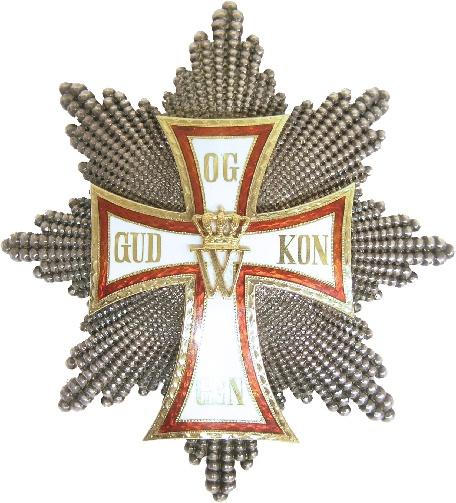
- Order of the Dannebrog, founded by King Christian V of Denmark in 1671
- Order of the Thistle, founded by King James VII of Scotland in 1687
- Order of the Elephant, founded by King Christian V of Denmark in 1693
- Order of St. Andrew, founded by Tsar Peter the Great of Russia in 1698
- Order of the White Eagle, founded by King Augustus II of Poland in 1705
- Order of the Bath,[7] founded by King George I of Great Britain on 18 May 1725[8]
- Order of the Seraphim, founded by Frederick I of Sweden in 1748
- Order of the Sword, founded by Frederick I of Sweden in 1748.
- Order of the Polar Star, founded by Frederick I of Sweden in 1748. [Not awarded since 1975]
- Order of St. George the Triumphant, founded by Catherine the Great of the Russian Empire in 1769
- Royal and Distinguished Spanish Order of Carlos III, founded by Charles III of Spain on 19 September 1771 (became a Spanish order)
- Order of Vasa, founded by Gustav III of Sweden in 1772 [Not awarded since 1974]
- Military William Order, founded by King William I of the Netherlands on 30 April 1815
- Order of the Southern Cross, founded by Emperor Pedro I of Brazil on December 1, 1822
- Order of Leopold, founded by King Leopold I of the Belgians on 11 July 1832
- Royal Norwegian Order of St Olav, founded by King Oscar I of Norway on 21 August 1847
- Order of the Gold Lion of the House of Nassau, founded by King-Grand Duke William III of Luxembourg in 1858
- Order of the Crown, founded by King Leopold II of the Congo Free State on 15 October 1897 (became a Belgian order in 1908)
- Order of Leopold II, founded by King Leopold II of the Congo Free State on 24 August 1900 (became a Belgian order in 1908)
- Order of Michael the Brave, founded by King Ferdinand I of Romania on 26 September 1916
- Order of the British Empire, founded by King George V of the United Kingdom on 4 June 1917
- Knightly Order of Vitéz, founded by Miklós Horthy the Regent of Hungary in 1921
- Order of Canada, founded by Queen Elizabeth II of Canada in 1967 [the Order of Canada is a national Order of Merit]
- Order of Australia, founded by the Queen of Australia Elizabeth II in 1975
- Royal Norwegian Order of Merit, founded by King Olav V of Norway in 1985

Former Orders
- Order of St. Stanislaus, founded by King Stanislaus II Augustus Poniatowski of Poland in 1765.
- Order of the Iron Helmet of Hesse-Kassel (or Hesse-Cassel) (in present-day Germany), founded 1814, abolished …
- Wilhelmsorden (Order of Wilhelm) of Hesse-Kassel, founded 1851, abolished 1875
- Order of the African Star, founded by King Leopold II of the Congo Free State on 30 December 1888, which became a Belgian order in 1908 and has not been awarded since the independence of Congo in 1960
- Royal Order of the Lion, founded by King Leopold II of the Congo Free State on 9 April 1891, which became a Belgian order in 1908 and has not been awarded since the independence of Congo in 1960
- Ludewigsorden (Order of Louis) of the Grand Duchy of Hesse, founded 1807, abolished 1918
- Order of the Norwegian Lion, founded 1904, abolished 1952
- Order of Pahlavi, founded 1928 by Reza Shah, abolished 1979 after the Iranian Revolution. There were two classes. The first class, the Grand Collar was worn by the Shah, crown prince, and awarded to heads of state. The second class, the Grand Cordon was worn by princes and princesses.
Papal Orders of Chivalry
Papal Orders of Chivalry are awarded in the name of the Supreme Pontiff and are given both as awards of His Holiness as Head of the Catholic Church and as the head of state of the Holy See. Membership was conferred by Papal bull (not signed by the Pope), or by Apostolic Letter, signed by the Pope himself. Since the reforms made in the structure of these Orders at the beginning of the 20th century, the diplomas have been signed by the Cardinal Secretary of State, a post held since 15 September 2006 by Tarcisio Bertone. The Papal Orders may be divided into two main categories. The first are those Orders awarded directly by the Supreme Pontiff as head of the Catholic Church and the Holy See. These are generally called the Papal Orders. The second category are Orders of Chivalry directly under Papal protection. These are today the Sovereign Military Hospitaller Order of Malta, the Equestrian Order of the Holy Sepulcher and the Teutonic Order. These Orders are under the protection of His Holiness as Supreme Pontiff and are not considered to be awards of the Vatican State.
Papal Orders
Of the Papal Orders the highest, and most infrequently awarded, is the Supreme Order of Christ. The second Order is the equally rare Order of the Golden Spur, the third is the Order of Pius IX, the fourth is the Order of Saint Gregory the Great, and the fifth is the Order of Saint Sylvester Pope and Martyr. The awards of the Orders of Christ and the Golden Spur are made at the express wish of His Holiness the Pope, in consultation with the Cardinal Secretary of State. Awards of the Order of Pius are made to Heads of State and senior members of their household at time of official visits to the Holy See, to senior members of the Diplomatic Missions accredited to the Holy See and, exceptionally, to those who have particularly served the Holy Father personally or the Holy See, at the discretion of the Cardinal Secretary of State. Awards of the latter two Orders are generally made on the recommendation of Diocesan Bishops, with the support of the Apostolic Nuncio.
Supreme Order of Christ
Tracing its origins to the dissolution of the Knights Templar, the Military Order of Our Lord Jesus Christ was established in 1319 in the Kingdom of Portugal. Its founding was confirmed by the Papal Bull Ad ea ex quibus on 15 March 1319, given by Pope John XXII. Some historians claim that under the terms of the Bull the Popes created the right to award the Order themselves, though the text of the Bull does not explicitly cover this right. The view of the Catholic Church is that the Pope is the head of every religious order and can grant admission to these orders without the permission of the superior general. The Pope’s awarding of the Order of Christ motu proprio brought the Papacy and the Crown of Portugal into conflict on several occasions. The King of Portugal believing himself to be the legitimate only fons honorum. Protests were made to Rome as late as 1825. During a reorganization of the Papal Orders in 1905 Pope Pius X made the Supreme Order of Christ the most senior Papal Honour. On 15 April 1966, in the Papal Bull Equestres Ordinis, Pope Paul VI limited the award to Roman Catholic heads of state in commemoration of significant events where the Pope himself was in attendance. The most recent presentation of the Order was to Frà Angelo de Mojana, 77th Prince and Grand Master of the Sovereign Military Order of Malta in 1987. The last living holder of the Order was King Baudouin I who died in 1993.
Order of the Golden Spur
The second highest Papal Order is the Order of the Golden Spur, also known as the Order of the Golden Militia. There is a lack of clear historic evidence of the order’s founding, but it is clear it is the oldest of the Papal Orders. Broad authority to grant the order diminished its prestige and led Pope Gregory XVI to place the order under the patronage of the Order of St. Sylvester in 1841. As part of this reorganization the pope limited the ability to grant the order and revoked the appointments of those who were not granted by papal brief. In 1905, Pope Pius X again separated the order from the Order of St. Sylvester establishing it as the Order of the Golden Militia. These 1905 reforms limited the number of knights to 100. A papal bull in 1966, further limited it to Christian Sovereigns and Heads of State. This bull also called it the Order of the Golden Militia, but the Annuario Pontificio lists it under two names, as the Order of the Golden Spur (the Golden Militia). HRH Jean, Grand Duke of Luxembourg is the only living knight.
Order of Pius IX
The third highest Papal Order, is the Order of Pius IX, founded 17 June 1847, by Pope Pius IX. The Order of Pius IX is the highest Papal Order currently awarded. There previously existed an Order of Pian knights founded in the 16th century, which later fell into abeyance and are not related to this order. It is the first of the Papal Orders, by order of precedence, to be presented in different grades. The highest grade is the Collar, followed by the Grand Cross, Commander with Star, Commander, and Knight. The order may be presented to Catholic, non-Catholic Christians, and non-Christians.
Order of St. Gregory the Great
The fourth Papal Order is the Equestrian Order of St. Gregory the Great. Pope Gregory XVI established the order on 1 September 1831 by the papal brief Quod Summis. It is awarded in four classes with a military and civil division. It was initially founded to reward meritorious civic or military service to the Papal States. Through the reforms of 1905, the Order was modified so that the classes paralleled those of the Order of Pius IX, excluding the Collar. The Order is currently awarded for conspicuous service to the Catholic Church, without regard to religious affiliation. These awards are typically made based on recommendations from Diocesan bishops or Nuncios for specific services rendered to the church. Membership in the Order of St. Gregory does not carry the religious obligations of the Military Orders making it the preferred award of merit for individual service to the Church. Since 1994, women have been appointed as Dames in the same classes as men.
Order of St. Sylvester Pope and Martyr
The fifth Papal Order is the Order of St. Sylvester Pope and Martyr. In 1841 Pope Gregory XVI reformed the Order of the Golden Spur as an order of merit with recipients appointed by Papal Brief. This reformed order was known as the Order of St. Sylvester and the Golden Militia. The reforms of 1905 resulted in the separation of the order into the Order of St. Sylvester and the Order of the Golden Spur. The Order of St. Sylvester is presented in the same classes and grades as the Order of St. Gregory. It is typically used to recognize and reward members of the laity for active service to the Apostolates. It may also be presented to non-Catholics.
Orders associated with the Holy See
In addition to these Papal Orders of Chivalry, given by the Pope as temporal sovereign and font of honours (similar to the orders given by other heads of state) there also remain several Military Religious Orders from the time of the Crusades. These combine the Chivalric Order with a Religious Order, and are a type of monk-knight. They are under the protection of the Holy See.
Order of the Holy Sepulchre
The Equestrian Order of the Holy Sepulchre of Jerusalem traces its founding to the First Crusade. After the fall of Jerusalem in 1182, the order ceased to exist as a crusading order. In 1847, Pope Pius IX reorganized the order and placed it under the protection of the Holy See. In 1949, Pope Pius XII decreed that the Grand Master of the Order be a Cardinal, directly by the Pope and serves at his pleasure or until such time as he may wish to lay down this office. The Latin Patriarch of Jerusalem is, ex officio, Grand Prior of the Order, while the lay head is the Governor-General. The present Cardinal Grand Master is His Eminence Edwin Frederick O’Brien who was appointed on 15 March 2012.
Sovereign Military Order of Malta
The Order of Malta traces its history to the late 11th century but became a Religious Military Order by a Bull of Pope Paschal II of 1113. The Grand Master, presently His Most Eminent Highness Fra’ Matthew Festing, is elected by the professed, religious members of the Order, and serves for life, or until his abdication. Elections of the Grand Master must be approved by the Supreme Pontiff as the religious superior of the Order, who also appoints a Cardinal patron and a Prelate of the Order.
Teutonic Knights
Teutonic Knights The Teutonic Order was founded as a hospital brotherhood in 1190 at Acre. In 1198, the order became a Religious Military Order of Chivalry. Since 1929, it has been a purely Religious Order of priests, brothers and sisters, with a category of twelve honorary knights and an unlimited number of associates, known as Marianer Knights.