
About the project

New Gotha

A continuously maintained reference work devoted to the dynastic, genealogical, heraldic, and institutional history of the world’s sovereign and noble houses brought into the modern age. The Almanach de Gotha’s rich heritage lives on through the Neue Gotha.

Our purpose

A modern reference tradition

Built for careful research, public access, and long-term preservation.

Neue Gotha connects records that are too often scattered across family histories, archives, historic publications, and changing political jurisdictions.

A rare annual book sustains the living digital archive.

Neue Gotha is funded through sales of its annual hardbound limited edition. Each year, only 500 copies are produced. Each copy is offered at €4,000, and distribution is deliberately restricted.

Demand exceeds the number of available volumes, and prospective purchasers must join a waiting list. Placement on the waiting list records an expression of interest; it does not guarantee that a copy will be available in a particular year.

Proceeds from the limited edition support the continuing work of research, editorial review, digitisation, preservation, technical maintenance, and public presentation. This model allows the online Register to develop without making editorial inclusion dependent on advertising or routine access fees.

Purchase of a hardbound volume does not confer a title, recognition, editorial preference, or guaranteed inclusion in the Register. The publication’s funding and its editorial judgments remain separate.

The annual hardbound edition

500 copies produced each year
€4,000 price per copy
Waiting list required before allocation
Limited international distribution
Availability is restricted. Joining the waiting list does not guarantee allocation.

Request waiting-list information

A specialist archive with a public purpose.

  • Historians and scholarsTracing dynastic, diplomatic, institutional, and political relationships.
  • Genealogists and familiesLocating lineages within wider historical and jurisdictional contexts.
  • Libraries and archivesConnecting publications, collections, images, and reference records.
  • Students and general readersExploring a complex subject through structured and accessible entries.

Rooted in Gotha

The Neue Gotha emblem draws upon one of the city’s most recognizable landmarks: the historic Town Hall and its striking clock tower overlooking the Hauptmarkt. Its distinctive silhouette places Neue Gotha firmly within the city where the original Almanach de Gotha first took shape.

More than a decorative symbol, the tower represents continuity between place, publication, and historical memory. By incorporating it into its identity, Neue Gotha honors the intellectual and publishing heritage of Gotha while carrying that tradition forward as a modern, accessible record of dynastic and genealogical history.
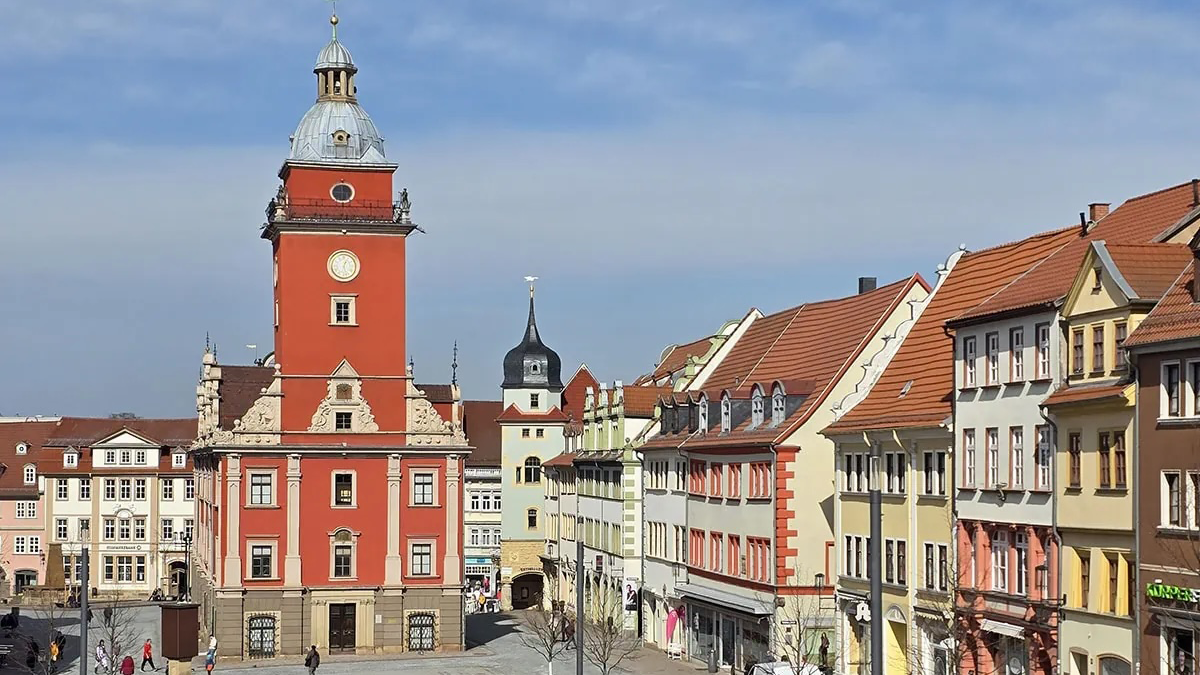
To make dynastic history legible, connected, and durable.

Neue Gotha is a living historical register. It brings together houses, people, titles, jurisdictions, orders, institutions, and source material within a single interconnected reference system.

The project is inspired by the organising ambition of the original Almanach de Gotha: to present complex relationships with consistency and precision. Neue Gotha adapts that reference tradition to a digital environment in which records can be searched, linked, corrected, expanded, and preserved over time.

Our purpose is not to recreate the social world of an earlier age, but to document it responsibly. Dynastic history intersects with diplomacy, law, political geography, inheritance, religion, art, property, and the formation of modern states. Understanding those connections requires both genealogical detail and historical context.

1763 → 2026From an annual printed snapshot to a continuously revised network.Historic Gotha is the point of departure—not the limit of the modern archive.

Continuity of method, not a claim of inherited authority.

Neue Gotha was established in 2016 as an independent digital reference project for a body of history that remains remarkably dispersed. Genealogies may survive in family publications, official notices, state archives, church registers, specialist handbooks, portrait collections, auction catalogues, and the footnotes of political history. Each source preserves a fragment; few make the relationships between those fragments visible.

In calling the project a modern revival, Neue Gotha revives a documentary ambition: to gather complex dynastic information, organise it consistently, and revise it as the evidence changes. It does not claim institutional or legal succession to the historic publisher, nor does it replace the authority of archives, civil records, courts, or scholarly editions.

The digital format changes what a Gotha-inspired reference work can be. A house can be connected to people, places, jurisdictions, titles, orders, objects, publications, and source images. A correction need not wait for the next printing. An uncertain statement can be marked as uncertain, and a familiar claim can be placed beside the evidence needed to evaluate it.

A network of records—not a collection of isolated biographies.

01

Houses and dynasties

Reigning, formerly reigning, mediatized, princely, ducal, and other historically significant houses, presented within their familial and political relationships.

02

People and succession

Genealogies, marriages, descent, succession, disputed claims, cadet branches, and the individuals through whom institutions and inheritances changed.

03

Places and institutions

Kingdoms, principalities, duchies, jurisdictions, courts, orders of knighthood, and the constitutional settings in which titles and houses existed.

04

Sources and interpretation

Historic publications, archival references, images, heraldry, and editorial explanations that allow readers to understand both evidence and uncertainty.

A modern analogue to a historic method of organising dynastic knowledge.

Inspired by the Almanach; designed for the present

The historic Almanach de Gotha combined genealogy with diplomatic, governmental, and statistical information. Its annual structure made dynastic Europe readable across borders and generations. Its classifications also reflected the assumptions and hierarchies of the societies that produced it.

Neue Gotha draws from the Almanach’s disciplined reference method without treating any historical classification as beyond examination. Digital records allow broader coverage, clearer connections, fuller explanations, and visible editorial review.

Neue Gotha is an independent project. It should not be understood as a governmental authority, a court of nobiliary law, or an automatic grant of recognition. Inclusion records and contextualises evidence; it does not itself create a title, legal status, precedence, or right of succession.

The archive is designed as a system of relationships.

A modern reference work should do more than reproduce printed pages on a screen. Neue Gotha treats each record as part of a connected documentary environment.

01

Identity and context

Names, dates, styles, titles, houses, and jurisdictions are distinguished carefully so that similar people and changing entities are not collapsed together.

02

Provenance and review

Sources, media credits, editorial status, and qualifying notes show how a record was assembled and where further verification is needed.

03

Connections through time

Relationships allow readers to move between people, dynasties, territories, institutions, and historical periods instead of encountering isolated entries.

One archive Many jurisdictions, languages, calendars, and documentary traditions.

The structure is intended to reveal connections without erasing meaningful differences.

Records are built through evidence, context, and revision.

Historical reference work is cumulative. A strong entry makes its evidence discoverable, distinguishes fact from interpretation, and remains open to responsible correction.

  1. 01

    Gather

    Relevant publications, archival references, genealogies, institutional records, historic images, and existing scholarly work are identified and preserved.

  2. 02

    Structure

    Names, dates, houses, jurisdictions, classifications, titles, and relationships are normalised so that related records can be connected and searched.

  3. 03

    Review

    Entries are checked for internal consistency, source support, historical context, and formatting. Editorial statuses communicate the state of that review.

  4. 04

    Maintain

    New evidence, corrections, and changes are incorporated without erasing the record’s historical development. The digital Register is treated as a maintained publication rather than a finished monument.

The publication tradition

A historic cover is shown here as a reference to the Almanach’s material heritage, not as a representation of the present annual edition.

A living digital register and a deliberate annual object.

The online Register is the project’s working environment: searchable, interconnected, and capable of revision. It can preserve long source notes, display related images, distinguish editorial status, and lead readers from a single name to the wider historical system around it.

The annual hardbound edition serves a different purpose. It is a selective record of the project at a moment in time—an edited physical object designed for libraries, collections, and long-term retention. It is not a complete mirror of the website, and the website is not merely promotional material for the book.

Together, the two forms balance continuity and change. The digital archive remains responsive to new evidence; the annual edition creates a durable checkpoint that can be cited, collected, and compared with later years.

Serious reference work depends on visible boundaries.

Evidence before assertion

Where evidence is incomplete or contested, the record should say so. Confidence should follow documentation rather than reputation or repetition.

Context before rank

Titles and classifications are presented within the legal, political, cultural, and historical systems that gave them meaning.

Revision without concealment

Corrections strengthen a reference work. Neue Gotha welcomes documented amendments and treats editorial review as an ongoing responsibility.

A reference work earns trust over years, not at launch.

Neue Gotha is intentionally presented as a developing archive. Coverage will grow unevenly as sources become available and records are reviewed.

  1. 01

    Broaden the record

    Extend coverage beyond the best-known European dynasties to the people, cadet branches, courts, institutions, and transnational relationships that made their histories possible.

  2. 02

    Strengthen provenance

    Add fuller citations, edition-level references, image credits, archival locations, and transparent notes where claims remain disputed or incomplete.

  3. 03

    Preserve durable access

    Develop stable identifiers, responsible exports, multilingual presentation, accessibility improvements, and preservation copies that reduce dependence on any single platform.

  4. 04

    Invite informed correction

    Create practical routes for scholars, archivists, families, and readers to contribute sources without turning documented history into a competition of unsupported claims.

Corrections, sources, and responsible additions are welcome.

If you can document a correction, identify a missing source, or provide material that strengthens an existing entry, contact the editorial office.

Contact the editorial office
We use cookies to personalise content and ads, to provide social media features and to analyse our traffic. We also share information about your use of our site with our social media, advertising and analytics partners. View more
Cookies settings
Accept
Decline
Privacy & Cookie policy
Privacy & Cookies policy
Cookie name Active

Privacy and Cookie Policy Last updated: 11 August 2026

Neue Gotha respects your privacy and is committed to handling personal data lawfully, fairly, and transparently. This Privacy and Cookie Policy explains who is responsible for personal data, what information we process, why we process it, how long we retain it, who may receive it, and the rights available to individuals under the General Data Protection Regulation (EU) 2016/679 (“GDPR”) and applicable national data-protection and electronic-communications law.

1. Who is responsible for your personal data?

The controller responsible for the processing described in this policy is:

  • Legal name: Neue Gotha Historical Register gUG
  • Trading or project name: Neue Gotha
  • Postal address: Musterstraße 12, 10115 Berlin, Germany
  • Email: editor@neuegotha.de
  • EU/EEA representative: Not applicable (the controller is established in Germany).
  • Data Protection Officer: No Data Protection Officer has been appointed. Privacy enquiries are handled through editor@neuegotha.de.

Questions about this policy or requests concerning personal data may be sent to the email or postal address above.

2. Scope of this policy

This policy applies to personal data processed through https://neuegotha.com, correspondence with the Neue Gotha editorial office, material submitted for editorial consideration, and editorial or archival records concerning identifiable living individuals.

It does not govern independent third-party websites or services linked from this website. Those providers are responsible for their own privacy practices.

3. Personal data we process and why

Processing activity Personal data Purpose Legal basis Retention
Website delivery, logging, and security IP address; date and time of access; requested page or file; referring page; browser, operating-system, and device information; error and security-event data Deliver the website, maintain availability, diagnose faults, prevent abuse, and protect the website and its users Article 6(1)(f) GDPR — our legitimate interests in operating a secure and reliable website. Where processing is required by law, Article 6(1)(c) GDPR may also apply. Routine access and error logs are retained for 14 days. Records isolated for investigation of a suspected security incident may be retained for up to 90 days after the incident is resolved, or longer where required for legal claims.
Editorial correspondence and enquiries Name, contact details, message content, correspondence history, and any documents or other information voluntarily provided Respond to enquiries, assess corrections or submissions, maintain editorial records, and protect legal rights Article 6(1)(f) GDPR — our legitimate interests in conducting editorial work and responding to correspondence; Article 6(1)(b) GDPR where processing is necessary to take steps at an individual’s request before entering into a contract; Article 6(1)(c) GDPR where retention or disclosure is legally required Correspondence is ordinarily retained for 24 months after the matter closes. Material required to document an editorial decision, resolve a dispute, meet a legal obligation, or establish, exercise, or defend a legal claim may be retained for the applicable limitation period.
Editorial, genealogical, and archival records Names; titles and styles; dates and places associated with public or genealogical events; family relationships; jurisdictions, offices, and public roles; images; biographical information; source and citation information; and correspondence relating to accuracy or provenance Research, document, preserve, verify, correct, and publish material concerning dynastic, genealogical, heraldic, and institutional history Article 6(1)(f) GDPR — our legitimate interests and those of readers, researchers, and institutions in maintaining an accurate historical and genealogical reference work, subject to a documented necessity and balancing assessment. Applicable national rules implementing Article 85 GDPR concerning freedom of expression and information may also apply. For as long as the information remains relevant to the legitimate editorial or archival purpose, subject to accuracy review, correction, restriction, erasure, and applicable archiving or legal requirements
Cookie-consent and language preferences Consent choice, language preference, cookie identifiers, and related technical information Remember privacy choices, demonstrate consent where required, and provide the language selected by the visitor Article 6(1)(f) GDPR for strictly necessary preference and consent-management functions; Article 6(1)(a) GDPR for optional storage, access, or associated processing based on consent As stated in the cookie table below
Optional external services IP address, page URL, device and browser information, language choice, and service-interaction data, depending on the provider Provide optional translation, embedded content, analytics, or similar features actually enabled on the website Article 6(1)(a) GDPR — consent. Non-essential services remain disabled until consent is given. As described for each service and by the relevant provider

We do not use personal data for solely automated decisions that produce legal effects or similarly significant effects concerning individuals.

4. Editorial and archival information obtained from other sources

Neue Gotha is an editorial and historical reference project. Some information in the register may concern identifiable living individuals and may not have been collected directly from those individuals.

Depending on the record, information may be obtained from official gazettes and public registers; archives and libraries; published books and scholarly works; institutional publications; reputable news sources; publicly accessible websites; submissions from the individual concerned or their authorised representative; family representatives; and other documented sources.

The categories of information may include the categories listed under “Editorial, genealogical, and archival records” above. The material may be made available to website visitors and may be indexed by search engines. Neue Gotha seeks to use relevant, proportionate, and appropriately sourced information and to distinguish documented fact from uncertainty or editorial interpretation.

Individuals may contact the editorial office to request access, correction, contextualisation, restriction, or erasure. Requests are assessed under the GDPR and applicable national law, taking into account accuracy, source integrity, the public interest, freedom of expression and information, archival considerations, and the rights and freedoms of other people. No provision of this policy removes a right granted by applicable law.

Neue Gotha does not intentionally publish special-category personal data or information concerning criminal convictions about living individuals unless a specific lawful basis and any additional legal condition have been identified and documented.

5. Cookies and similar technologies

Cookies are small text files stored on, or read from, a visitor’s device. Similar technologies may perform comparable functions. Some are strictly necessary for a website or a service expressly requested by the visitor. Others, including many analytics, advertising, social-media, translation, or embedded-content technologies, require prior consent under applicable EU electronic-communications rules.

Neue Gotha does not place or access non-essential cookies, or activate non-essential external services, before valid consent has been given. Visitors may accept or reject optional purposes separately and may withdraw consent at any time by selecting the permanently available “Cookie settings” control. Withdrawing consent does not affect processing that was lawful before withdrawal. Strictly necessary technologies cannot be disabled through the consent tool, but they may be controlled through browser settings where technically possible.

The following table reflects the technologies currently deployed on the website. It is updated whenever a plugin, host, analytics tool, embedded service, or cookie configuration changes.

Name Provider Purpose Category Duration Third-party access
_scc_session Neue Gotha / managed hosting and site-control provider Maintains a short-lived session for website security and site-control functions Strictly necessary Browser session The contracted hosting or site-control provider may access the identifier when providing technical support
_tccl_visit Neue Gotha / managed website-analytics provider Distinguishes a single website visit and reduces duplicate counting within the same session Analytics — disabled until consent 30 minutes Yes; the contracted analytics provider processes the identifier on Neue Gotha’s behalf
_tccl_visitor Neue Gotha / managed website-analytics provider Assigns a pseudonymous visitor identifier used to produce aggregated website-usage statistics Analytics — disabled until consent 12 months Yes; the contracted analytics provider processes the identifier on Neue Gotha’s behalf
googtrans Neue Gotha / Google Translate Stores or applies the visitor’s language selection for the translation feature Functional — disabled until consent 12 months Google may receive technical and service-interaction data when Google Translate is activated
ng_gt_default_applied Neue Gotha / website translation plugin Records whether the website’s default translation setting has been applied Functional — disabled until consent 24 hours No direct vendor access is assumed; Google may receive data if activation causes Google Translate to load
eu_cookies_bar_consent Neue Gotha / locally hosted EU Cookies Bar plugin Stores the visitor’s cookie choices and prevents the banner from being shown unnecessarily Strictly necessary 6 months No, provided the consent plugin remains locally hosted and does not transmit consent records to its developer
wordpress_test_cookie Neue Gotha / WordPress Checks whether the browser supports cookies when an authorised user visits the sign-in page Strictly necessary Browser session No; the cookie is processed by Neue Gotha and its contracted host

Authorised editorial users may receive WordPress authentication, security, or preference cookies when they sign in. wordpress_logged_in_[hash] maintains an authenticated session for up to two weeks when “Remember Me” is selected; wordpress_sec_[hash] protects administrative access for the session; and wp-settings-[user_id] stores an editor’s interface preferences for up to one year. These internal cookies are processed solely for editorial access and site administration.

6. Google Translate, web fonts, and other external content

Where enabled with the visitor’s consent, Neue Gotha may use Google Translate to provide machine-generated translations. Activating the service may cause the visitor’s browser to connect to Google and disclose technical information such as the IP address, requested page URL, browser or device information, and language or service-interaction data. Machine translations may contain errors and do not replace the original editorial text.

Website fonts are hosted locally by Neue Gotha and do not require a connection to Google. Google Translate remains an optional external service that is activated only after the visitor provides consent.

Information about Google’s processing is available in the Google Privacy Policy and Google’s explanation of how it uses information from sites and applications that use its services.

Embedded material from another website may allow that provider to process personal data as if the visitor had visited the provider directly. Non-essential embeds remain blocked until consent is obtained. Each enabled provider is identified in this policy and in the consent interface.

7. Recipients of personal data

Personal data may be disclosed only where necessary to:

  • hosting, content-delivery, backup, website-maintenance, email, security, and consent-management providers acting under contract;
  • translation, analytics, media, or other external-service providers selected by the visitor through the consent interface;
  • professional advisers, insurers, auditors, or other specialists where necessary to protect legal or operational interests;
  • courts, regulators, law-enforcement bodies, or public authorities where disclosure is required or permitted by law; and
  • the public and search engines where personal data form part of a lawfully published editorial or archival record.

8. International data transfers

Some service providers may process personal data outside the European Economic Area. Where the GDPR restricts such a transfer, Neue Gotha relies on an applicable European Commission adequacy decision or appropriate safeguards under Article 46 GDPR, such as the European Commission’s Standard Contractual Clauses, together with supplementary measures where required.

Cloudflare and Google may transfer limited technical information to recipients in the United States. Where the recipient is validly certified, the transfer is based on the European Commission’s adequacy decision for the EU–US Data Privacy Framework. Where that mechanism is unavailable or does not cover a transfer, the relevant provider’s European Commission Standard Contractual Clauses and supplementary technical and organisational measures are used. Information about the applicable safeguards, including how to obtain a copy, may be requested from editor@neuegotha.de.

9. How long we retain personal data

We retain personal data only for as long as necessary for the purposes described in this policy, including security, editorial integrity, source verification, dispute resolution, and compliance with legal obligations. The specific periods or criteria are stated in the processing and cookie tables above.

When a retention period ends, information is deleted or anonymised unless continued retention is required by law, is necessary for legal claims, or is justified by a documented editorial or archival purpose. Encrypted rolling backups are retained for 35 days and are then overwritten automatically, unless a backup has been isolated for incident recovery or a legal hold.

10. Security

Neue Gotha uses appropriate technical and organisational measures designed to protect personal data against accidental or unlawful destruction, loss, alteration, unauthorised disclosure, or access. No method of internet transmission or electronic storage is completely secure, and absolute security cannot be guaranteed.

11. Your data-protection rights

Subject to the conditions and limitations in the GDPR and applicable national law, an individual may have the right to:

  • obtain confirmation as to whether personal data concerning them are processed and request access to those data;
  • request correction of inaccurate or incomplete personal data;
  • request erasure of personal data;
  • request restriction of processing;
  • object, on grounds relating to their particular situation, to processing based on legitimate interests;
  • receive personal data they provided in a structured, commonly used, machine-readable format and transmit those data to another controller where the right to portability applies;
  • withdraw consent at any time, without affecting the lawfulness of processing carried out before withdrawal; and
  • lodge a complaint with a competent data-protection supervisory authority.

To exercise a right, contact editor@neuegotha.de. Please identify the information or record concerned and the nature of the request. We may request information reasonably necessary to verify identity and protect personal data from unauthorised disclosure. Requests are normally answered within one month, subject to any extension permitted by law.

Where a request concerns published editorial or archival content, applicable rights may be limited where necessary and proportionate to reconcile data protection with freedom of expression and information or other rights recognised by law. Each request will be assessed individually.

12. Complaints

We encourage individuals to contact us first so that we can try to resolve a concern. Individuals also have the right to complain to the supervisory authority in the EU or EEA country of their habitual residence, place of work, or the place of the alleged infringement.

For this Berlin-based controller the supervisory authority is the Berliner Beauftragte für Datenschutz und Informationsfreiheit, Alt-Moabit 59–61, 10555 Berlin, Germany; telephone +49 30 13889-0; email mailbox@datenschutz-berlin.de; website https://www.datenschutz-berlin.de/.

13. Children

The website is intended as a general historical and reference resource and is not directed specifically at children. We do not knowingly request personal data directly from children for an online service requiring parental consent. If you believe a child has provided personal data inappropriately, please contact us.

14. Changes to this policy

We may update this policy when our processing activities, service providers, technologies, or legal obligations change. The current version will be published on this page with a revised “Last updated” date. Where required, we will provide additional notice or request renewed consent before introducing a new processing purpose.

Decline All
Save settings Accept All
Cookies settings