Reference and historical essay
Quotations on Monarchy
Quotations on Monarchy
- Jurisdiction
- International
- Entry type
- Reference
- Editorial status
- Reviewed - Verified
Famous Quotations on Monarchy
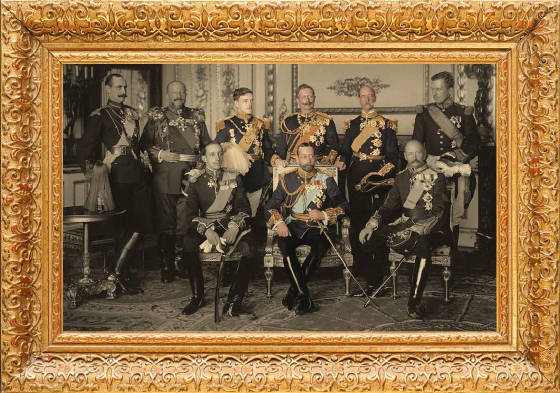
Nine Monarchs of Europe at Windsor Castle – 1910
I devote all my attentions to improving the welfare of my subjects, since I wish to save my soul and go to Heaven.
If a nation does not want a monarchy, change the nation’s mind. If a nation does not need a monarchy, change the nation’s needs.
I am a true servant of my King and country, not only as a dutiful subject but because I am a convinced monarchist, politically and intellectually. I mean by that, quite apart from myself and my relationship to my Bavarian and German fatherland, I believe monarchy to be the most successful form of government that the history of mankind has known.
If the Allies at the peace table at Versailles had allowed a Hohenzollern, a Wittelsbach and a Habsburg to return to their thrones, there would have been no Hitler. A democratic basis of society might have been preserved by a crowned Weimar in contact with the victorious Allies.”
In Italy they are already speaking about a republic, but keep in mind that there is nothing less suited to Italians…… The Italians are individualists and a republic will become the cause of confusion and disorder. Certainly of corruption. I have no doubt of it. When all this comes to pass who will profit from it?
Remember that life is made up of loyalty: loyalty to your friends; loyalty to things beautiful and good; loyalty to the country in which you live; loyalty to your King; and above all, for this holds all other loyalties together, loyalty to God.
Politicians debating the future of our monarchy resemble a poachers’ convention deliberating on the future role of the gamekeeper.
(King George VI) represented, for us, a model of character and deportment for those in high places. Our respect for him as an inspirational force was equalled by our affection for him as a gentle human being.
Impartiality and continuity are important aspects of government, and it is doubtful whether any form of democratic government yet discovered provides these to any greater extent than does constitutional monarchy
This war would never have come unless, under American and modernising pressure, we had driven the Habsburgs out of Austria and the Hohenzollerns out of Germany. By making these vacuums we gave the opening for the Hitlerite monster to crawl out of its sewer on to the vacant thrones. No doubt these views are very unfashionable….
The public are sick and tired of politics, they are sick and tired of the machinations of elected office in a media age, and I think it’s quite good having a Head of State that’s completely to one side of that.
I notice that the constitutional monarchies are the most democratic countries of Europe. I can’t understand how there could be any debate about it.
If constitutional monarchy were to come to an end in Britain, parliamentary democracy would probably not survive it. It is, after all, through the monarchy that parliamentary control over the armed forces is mediated and maintained.
I am personally still convinced that there are safeguards in the constitutional monarchy that an elected head of state just would not possess.
The Prince of Wales, as so often, has demonstrated his common sense in the words he spoke on Wednesday (during his visit to southern Africa). His demeanour is a perfect illustration of the benefits of a constitutional monarchy. In the heat of euphoria, in the midst of all the blather about a “new” this and a “new” that, his is a message of modernisation and wisdom. We would do well to heed it.”
Anyone who fears that by becoming a republic we would condemn ourselves to a presidency held by a perpetual succession of superannuated politicians – at the moment presumably a choice between Heath, Kinnock, Thatcher and Major – is an optimist. The alternative nightmare scenario looks not to the European model but to the American, where the essentials for election to the presidency appear to be ruthless ambition, access to vast wealth, reckless promises of patronage and preferment, effective control of a big slice of the media and a plausible TV manner. We don’t know when we are well off.
The Queen Mother is one who knows how to be Queen, how to preserve mystery and yet be accessible, one who knows how to epitomise the higher aspirations of a people, yet retain both humanity and humour.
I write by the light of two eternal truths: religion and monarchy, those twin essentials affirmed by contemporary events, and towards which every intelligent author should seek to direct our country.
Monarchy is the one system of government where power is exercised for the good of all.
Being a nation of hypocrites, we have for years looked to the Royal Family to embody the values we’re not prepared to embody ourselves.
The Queen’s appearances abroad do more in a day to gain goodwill for Britain than all the politicians and diplomats lumped together could achieve in years.
I owe no allegiance to the Provisional Government established by a minority of the foreign population …. nor to anyone save the will of my people and the welfare of my country.
Why has destiny willed the downfall of this Sovereign? He is endowed with every kingly quality; he is courageous, generous, and magnanimous; he has a fine intellect and a well-balanced mind; and his name bears the tradition of a thousand years of history. Who better than he to symbolise the unity of the country, and act as supreme moderator in party strife?
The Tarquins, meanwhile, had taken refuge at the court of Lars Porsena, the King of Clusium. By every means in their power they tried to win his support, now begging him not to allow fellow Etruscans, men of the same blood as himself, to continue living in penniless exile, now warning him of the dangerous consequences of letting republicanism go unavenged. The expulsion of kings they urged, once it had begun, might well become common practice; liberty was an attractive idea, and unless reigning monarchs defended their thrones as vigorously as states now seemed to be trying to destroy them, all order and subordination would collapse; nothing would be left in any country but flat equality; greatness and eminence would be gone for ever. Monarchy, the noblest thing in heaven or on earth, was nearing its end.
Those who imagine that a politician would make a better figurehead than a hereditary monarch might perhaps make the acquaintance of more politicians.
Thus the young royals are reproached for setting a bad example and failing to keep their marriages together by journalists who themselves lead Casanova-like lives.
Canadians should realise when they are well off under the Monarchy. For the vast majority of Canadians, being a Monarchy is probably the only form of government acceptable to them. I have always been for parliamentary democracy and I think the institution of Monarchy with the Queen heading it all has served Canada well.
If to be a Republican is to hold, as a matter of theory at least, that is the best government for a free and intelligent people in which merit is to be preferred to birth, then I hold it an honour to be associated with nearly all the greatest thinkers of the country and to be a Republican. But if a Republican is one who would thrust aside the opinion and affront the sentiment of a huge majority of the nation, merely to carry to a logical conclusion an abstract theory, then I am far from being a Republican as any man can be.
The State functions more easily if it can be personified. An elected President who has stepped out of politics, like the French President, is no substitute for a King who has stepped in by right of inheritance. Still less is an active politician, like the President of the United States, a substitute. We can damn the Government and cheer the King.
Modern monarchs neither have nor need executive power. Integrity and continuity are their stock in trade. These qualities are becoming more precious when European political parties, many of them in power for a decade or more, are increasingly judged arrogant or corrupt or both. Politicians could with profit learn not to treat modesty as merely a royal prerogative.
To be a King is dedication, patience and moderation, self-denial, statesmanship, national unity and, above all, having faith in one’s people.
The monarchy is a political referee, not a political player, and there is a lot of sense in choosing the referee by a different principle from the players. It lessens the danger that the referee might try to start playing.
Monarchy is first proved to be the true and rightful form of government. Men’s objects are best attained during universal peace: this is possible only under a monarch. And as he is the image of the divine unity, so man is through him made one, and brought most near to God. There must, in every system of forces, be a ‘primum mobile’; to be perfect, every organisation must have a centre, into which all is gathered, by which all is controlled. Justice is best secured by a supreme arbiter of disputes, himself untempted by ambition, since his dominion is already bounded only by ocean. Man is best and happiest when he is most free; to be free is to exist for one’s own sake. To this noblest end does the monarch and he alone guide us; other forms of government are perverted, and exist for the benefit of some class; he seeks the good of all alike, being to that very end appointed.
I think it is a misconception to imagine that the monarchy exists in the interests of the monarch. It doesn’t. It exists in the interests of the people.
The fact that the Monarchy can unify in this way – can comfort and exhilarate and embrace – remains, as Cameron (James Cameron, republican journalist) put it, its great ‘gesture to all the forces of logic’, the power before which the neat rationality of republicanism wilts.
For any country it is better to have a monarch than an elected president of the republic ….. monarchies provide the continuity of states, while prime ministers come and go. Elections are all very well for the designation of the prime minister or of the party which should take power, but not for the Head of State, who should be above party. (Unlike a president) in all probability the monarch who succeeds to the throne has been trained for this exalted post by having spent many years by the side of his predecessor. A monarch, however, cannot declare that he is ready to throw in his hand. The personal conveniences of sovereigns are of little importance. What is important is that Great Britain needs them.
Monarchy can easily be debunked, but watch the faces, mark well the debunkers. These are the men whose taproot in Eden has been cut: whom no rumour of the polyphony, the dance, can reach – men to whom pebbles laid in a row are more beautiful than an arch. Yet even if they desire mere equality they cannot reach it. Where men are forbidden to honour a king they honour millionaires, athletes or film stars instead: even famous prostitutes or gangsters. For spiritual nature, like bodily nature, will be served; deny it food and it will gobble poison.
The Royal tour (of South Africa) gives reassurance that when it comes to flying the flag nobody does it quite as well as the Queen.
A priest who is not a monarchist is not worthy to stand at the altar table. The priest who is a republican is always a man of poor faith. God himself anoints the monarch to be head of the kingdom, while the president is elected by the pride of the people. The king stays in power by implementing God’s commandments, while the president does so by pleasing those who rule. The king brings his faithful subjects to God, while the president takes them away from God.
The Queen was helpful, lively, fascinating to talk to, and very, very funny. The idea that she is out of touch is nonsense.
The monarchical principle is laughed at by vulgar and foolish people in all the suburbs of Europe. It is hated in all the gutters of the world. The reason is simple. It enshrines with a fitting dignity and elaboration the principle of authority as something independent of this or that politician. It places it above attack. It symbolises and consecrates an attitude of mind essential to the happiness of peoples.
The British love their Queen, their Queen Mother, Prince Charles, and the comforting security of their hereditary constitutional monarchy, an institution of which the characters are beyond the manipulation of man, an institution guaranteeing continuity, overriding the dissensions of politics. The best governments are constitutional monarchies, and we may yet see some restored in eastern Europe.
In republics there is not a respect for authority, but a fear of power.
Dr Samuel Johnson (Boswell’s Life, p 464).
The best reason why Monarchy is a strong government is that it is an intelligible government. The mass of mankind understand it, and they hardly anywhere in the world understand any other.
I think the family has got to streamline itself but the core members have a brand personality that a business would die for. You might say they’re the brand identity of Britain: ask any American what they’d give to have a Royal Family.
Above the ebb and flow of party strife, the rise and fall of ministries, and individuals, the changes of public opinion or public fortune, the British Monarchy presides, ancient, calm and supreme within its function, over all the treasures that have been saved from the past and all the glories we write in the annals of our country.
To be a king and wear a crown is more glorious to them that see it than it is a pleasure to them that bear it.
Parliaments and Ministers pass, but she abides in lifelong duty, and she is to them as the oak in the forest is to the annual harvest in the field.
Russia under Nicholas II, with all the survivals of feudalism, had opposition political parties, independent trade unions and newspapers, a rather radical parliament and a modern legal system. Its agriculture was on the level of the USA, with industry rapidly approaching the West European level. In the USSR there was total tyranny, no political liberties and practically no human rights. Its economy was not viable; agriculture was destroyed. The terror against the population reached a scope unprecedented in history. No wonder many Russians look back at Tsarist Russia as a paradise lost.
Americans also seem to believe that the monarchy is a kind of mediaeval hangover, encumbered by premodern notions of decorum; the reality is that the British monarchy, for good or ill, is a modern political institution – perhaps the first modern political institution.
There is nothing about which I am more anxious than my country, and for its sake I am willing to die ten deaths, if that be possible.
I consider tolerance as one of the ruler’s first duties. I have always tried to be tolerant and to respect and treat with consideration all kinds of religious beliefs. In this respect the ruler must not permit any discrimination. During my long reign in Bulgaria there was no persecution of those belonging to another faith, of Mohammedans or Jews. Had there been any I would have punished those responsible with the greatest severity.
Be the person in relation to whom …. all things in your Kingdom are ordered; the person in whom your people perceive their own nationhood; the person by whose existence and dignity the national unity is upheld”.
We should all bear carefully in mind the constitutional safeguards inherent in the monarchy: While the Queen occupies the highest office of state, no one can take over the government. While she is head of the law, no politician can take over the courts. While she is ultimately in command of the Armed Forces, no would-be dictator can take over the Army. The Queen’s only power, in short, is to deny power to anyone else. Any attempt to tamper with the royal prerogative must be firmly resisted.
Of all people on the face of the earth, the people of England are a King-loving and aristocracy-loving generation. However men may indulge in republican reveries in the closet, there is no permanent object of human sympathy but human beings, that is, no political doctrine’s constitution can retain a lasting grasp on the affections of the mass of mankind – save as they are identified with individuals.
I have always been vaguely comforted by the sense that the Crown, and therefore the nation, endures like weathered granite through whatever turpitude and buffoonery may pass in Parliament. There is also something re-assuring in the knowledge that every Prime Minister, every week, has a confidential and not necessarily comfortable conversation with a monarch: that is to say with someone who is not their dependant, not their sycophant, who has no political affiliation beyond patriotism and who has seen governments rise and fall over decades. This sense of continuity, of a nation mature enough to be able to make electoral mistakes and later recant without risk of losing its identity, is profoundly useful.
A Republic of Great Britain Bill would dominate the lifetime of a parliament to the detriment of all other economic and social affairs, and if passed would change virtually every facet of British life beyond recognition. From postage stamps to the names of warships, every area of political, social, economic, financial, religious and civil life would be transformed, and potentially unleash political forces beyond our control or comprehension.
There is no doubt that of all the institutions which have grown up among us over the centuries or sprung into being in our lifetime, the Constitutional Monarchy is the most deeply founded and dearly cherished. In the present generation it has acquired a meaning incomparably more powerful than anyone had dreamed possible in former times. The Crown has become the mysterious link, may I say the magic link, which unites our loosely bound but strongly interwoven Commonwealth of Nations, states and races. People who would never tolerate the assertions of a written Constitution which implies any diminution of their independence are the foremost to be proud of their loyalty to the Crown.
It is the merit of hereditary Royalty that its virtue as a moral force does not depend on the varying qualities of its representatives; but what a heaven-sent boon it is when those who are born into the Purple have gifts as truly royal as Prince Charles’s. Under a relentless scrutiny which gives no scope for fraud or fabrication, he has come across as what the British (no doubt with the overtones of apologetic self-parody which fashion requires) still call “a jolly good chap.” He is, to use another outmoded phrase, “a good all-rounder.” He flies, plays polo, took a creditable university degree, speaks impromptu with fluency, charm and wit, serves his country not only steadfastly but with lightness of touch and a disarming capacity for occasional uncalculated indiscretion, and he bears himself towards all who meet him with manly humility.
Royalty is a Government in which the attention of the nation is concentrated on one person doing interesting actions. A Republic is a Government in which that attention is divided between many, who are all doing uninteresting things.
The most odious and repressive regimes in the 20th century have ‘people’s’ or ‘democratic’ in their names, and that is no accident. The theoretical basis for democracy, egalitarianism, was responsible for the worst excesses of the French revolution; little blood was shed in support of liberty and fraternity. Had the hereditary principle been upheld in places as diverse as Libya, Greece, Albania, even Russia, had those monarchies not been overthrown and replaced by monstrous peoples’ regimes, the very lives, never mind prosperity, of those peoples would have been saved. It is not necessary to try to prove the superiority of the hereditary principle over mass democracy, nor to spend much time over democracy’s supposed greatest achievement – the US.
Monarchy is often criticised for being a lottery, but so is an elected presidency. Britain last had to play the regal lottery in 1952, when it won handsomely. It has not had to gamble again since then. In the past 45 years Ireland has had to vote in seven presidents, few of them memorable, most of them just grazing. We have had just one head of state, who has performed her duties superbly. Throughout a time of immense social change, indeed revolution, the centre of the British system has remained calm and outside party politics. That is an incalculable asset which no republic can come close to matching.”
Kings have advantages over democratic politicians. Although they must remain popular ….. they do not have to grub for votes. Unlike American senators, they are not obliged to start raising money for their re-election campaign days after the electorate has voted them in. Inheritance has its privileges, for both rulers and the ruled……For politicians in democracies, the business of government is all too often a great game, a chance to strut and posture their little moment on the stage, before retiring to directorships and lecture tours. No such retreat is possible for monarchs, so they are less likely to mess with the dodgy loan, or fool around with the intern.
The monarchy’s most important constitutional function is simply to be there: by occupying the constitutional high ground, it denies access to more sinister forces; to a partisan or corrupt president, divisive of the nation; or even to a dictator. The Queen’s powers are a vital safeguard of democracy and liberty.
This country suffered greatly as a result of the abolition of the monarchy in 1970. We support it, because it is an institution the country needs, for its unity and its development. There is a Cambodian proverb which says “While you are eating fruit, don’t forget who planted it”. We must not forget our King and his vital role in securing a victory for democracy in our country. If he had not remained here during the elections, or if he had not personally appealed to our citizens to vote, the population would without doubt have been afraid to participate and we would not have achieved the 90% turn out that we did. And perhaps the international observers would not have agreed to come.”
For every monarchy overthrown the sky becomes less brilliant, because it loses a star. A republic is ugliness set free.
A sovereign must constantly heed the will of his people and at the same time care for the poor and humble; he is the servant of the law, and the mainstay of social peace and security.
My grandfather was of peasant stock and I am prouder of that than of my throne. Crowns are lost, but the pure blood of those who have loved the earth does not die.
Parliamentary monarchy fulfils a role which an elected president never can. It formally limits the politicians’ thirst for power because with it the supreme office of the state is occupied once and for all.
Anyone who has walked through the deserted Palaces of Versailles or Vienna realise how much a part of the life of a nation is lost when a monarchy is abolished. If Buckingham Palace and Windsor Castle were transformed into museums, if one politician competed against another for the position of President of the Republic, Britain would be a sadder and less interesting place. Our politicians are not men such as could challenge more than a thousand years of history!
[A] king is a king, not because he is rich and powerful, not because he is a successful politician, not because he belongs to a particular creed or to a national group. He is King because he is born. And in choosing to leave the selection of their head of state to this most common denominator in the world – the accident of birth – Canadians implicitly proclaim their faith in human equality; their hope for the triumph of nature over political manoeuvre, over social and financial interest; for the victory of the human person.
It is helpful when the personality of the head of state is not disputed or contested periodically. The monarch is the incarnation of popular hope and the repository of national legitimacy.
Have a care over my people. You have my people – do you that which I ought to do. They are my people. Every man oppresseth and spoileth them without mercy. They cannot revenge their quarrel, nor help themselves. See unto them – see unto them, for they are my charge. I charge you, even as God hath charged me. I care not for myself; my life is not dear to me. My care is for my people. I pray God, whoever succeedeth me, be as careful of them as I am.”
No practising politician could possibly hope to be more deeply and widely informed about domestic, Commonwealth and international affairs than The Queen. She has sources of information available to nobody else.
Not to be a republican at 20 shows lack of heart. To be one at 30 shows lack of head.
The hereditary head of state is like the senior member of a larger household, representing the national family and its ancestral inheritance while standing above its internal disputes and intervening only if a major emergency threatens its survival.
The value of a constitutional monarchy is to provide a figurehead to embody a sense of nationhood beyond the divisions of temporal political argument. Republicans, who choose to give the impression that the British enjoy as much power as French peasants in the reign of Louis XVI, believe that in a democracy just about everything that moves has to be elected. This callow approach would result in a polarised and unpleasant society, of which the prime example is the United States.
Most Australians – contrary to what is constantly claimed – are not yet republicans. The Queen, touring the country with dignity at this slightly touchy time, says that she sees herself as the servant of the Australian Constitution and of the people. It is fair to suggest that many of Australia’s republican leaders do not quite see themselves as so answerable.
I had been told the Queen is not interested in anything political and speaks only on social issues. On the contrary, the Queen is very well informed on a number of international issues and on security matters.
Q is for the Queen who, in half a century, hasn’t put a foot wrong once. Her accumulated wisdom is extraordinary. Her charm is infinite. She is duty personified.
All of us who come here [to the UK] do so because the notion of Britishness is far more than merely ethnic – or at least we think it is. You may not go on about it as much as Americans do, but you also have a set of ideas attached to your national identity, and we admire them. We most admire, in fact, those bits of your national identity which you seem most keen on discarding: not just boring old political liberty and economic freedom, which we could get in America or lots of other places, but history, tradition, centuries of stability, tolerance of eccentricity, cars which drive on the wrong side of the road, flat green lawns and, above all, a Queen, together with her Heirs and Successors. After spending the first part of my life being a mere citizen, I am delighted to find myself a subject as well.
I don’t think I really came to appreciate what royalty meant to you Brits until I came to Wimbledon, with all its pomp and circumstance. It is tradition, it is such an important factor here and you start thinking it’s not bad when you see the effect it has on people. I suppose the monarchy is a bit like grass at Wimbledon. How long will it last? My guess is that they will both go on for many, many years to come.
I have previously observed that British republicans seem to have a blind spot about the family: they do not grasp that the Royal Family touches some chord in most of us linked with family feeling. Even as an Irishwoman, I feel a warm sense of maternal protectiveness when I pass Buckingham Palace and see the Royal Standard flying. The Queen is at home, and a benign matriarchal wisdom prevails over the land.
Mary Kenny, The Daily Telegraph, 1st July 2000.
(Kaiser Franz Josef) was especially noted for his exceptional attitude to Jewish soldiers serving in the Austrian army, concerning himself over the availability of kosher food of the highest standard, assuring them of access to the necessary religious articles and ensuring unhindered Sabbath observance. …. Many of the world’s Jews referred to him as “The King of Jerusalem.”
They tell us that all Kings are bad; that God never made a King; and that all Kings are very expensive. But, that all Kings are bad cannot be true: because God himself is one of them; he calls himself King of Kings; which not only shows us he is a King, but he has other Kings under him: he is never called King of Republics. The Scripture calls Kings, the Lord’s Anointed; but who ever heard of an anointed Republic?
Britain’s constitutional monarchy is one of its greatest strengths as well as one of its greatest attractions. The monarch is detached from party politics in a way no president could be. For years, the existence of a monarchy was the guarantee that no would-be dictator could stage a coup by deploying troops, as the monarch controls the armed services. No latter-day Cromwell could win power by force. We have had no civil war since Cromwell’s and much of that is due to having had a constitutional monarchy as a focus of loyalty.
(Europe’s monarchs are) all there to listen to the voice of the people and, without influencing politics, to protect the nation. Their example gives some credibility to those who think that restoration of King Michael of Romania might help heal recent wounds. Does the monarchy have a future? It’s a very definite reality in today’s Europe, and without it Europe would be a very different place.