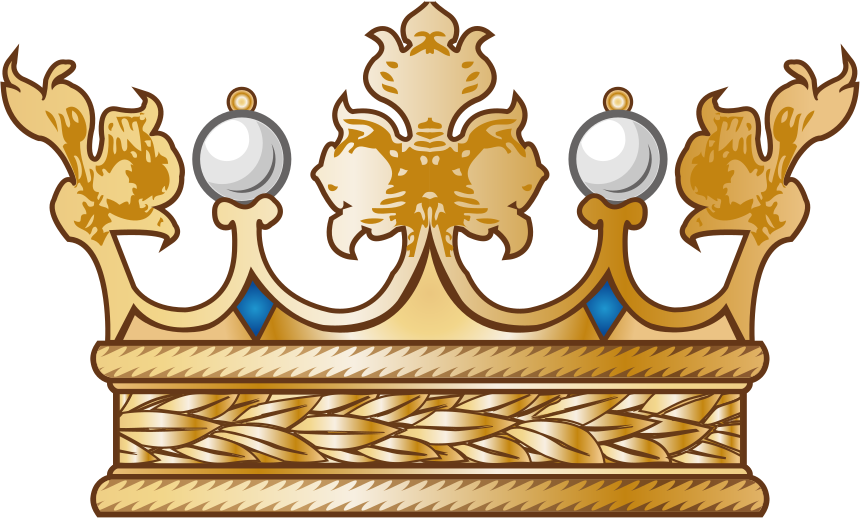
Nobility and directory

Nobility of Norway

History and Register of the Nobility of Norway

Jurisdiction
Norway
Entry type
Directory
Editorial status
Reviewed - Verified
Thumbnail for version as of 18:56, 13 May 2011

Nobility of the World

Volume VIII – Norway

Royal Arms of Norway.svg
Source: Wikimedia Commons

The Constitution of Norway abolished nobilisation in 1814, and in 1821 the remaining privileges were also abolished. Most native Norwegian noble families disappeared in the male line during the 16th century. Norway still has plenty of people who descend in female line from its indigenous medieval nobility, such as Queen Sonja of Norway herself, and own parts of their manorial and landed properties, now generally in sizes of farms and peasant manors, and a number of male-line families, mainly having Danish and foreign surnames, that descend from the official Dano-Norwegian period nobility.

Studies in Copenhagen archives by Jens Chr. Berg found that there were 120 family manors in Norway in the 16th century (a figure later research with much more sources has shown inadequate) – many of them in Bohuslän, which is now a part of Sweden. The Norwegian nobility was gradually weakened during the 16th century.

The Danish monarch repeatedly tried to give Danish noble people privileges in the Norwegian kingdom. When King Frederick I of Denmark was crowned in Copenhagen on August 5, 1523, the Norwegian Letter of Accession (håndfestingen) was not issued by the Norwegian Royal Council until November 1524. Other factors were of course the Norwegian laws that allowed foreign people who married Norwegian noble heiresses actually to hold noble land. These families fell into ignobility, whereas a law prohibiting “marrying down” would have kept lands in noble hands. In Sweden and Denmark such marriages meant loss of the right to hold noble land, and this strengthened the nobility there so it remained a strong class well into the 20th century.

During a sitting of the Danish Parliament, herredagen, in Copenhagen in 1536, the Norwegian Royal Council (Det Norske Riges Raad) was abolished, and Norway ceased to exist as a totally separate country, its administration continuing in part in native hands and in part controlled from Copenhagen. The Norwegian nation, however, did not cease to exist, and for example king Christian IV of Norway was honoured by the Norwegian nobility at Akershus Castle on June 10, 1591.

Since the Danish kings after 1534 were of agnatically German descent, a German or English style nobility rank system was introduced in Denmark-Norway. In order to strengthen royal absolutism, a new title of nobility was introduced in 1671: the Greve (count, like the German Graf – the full royal style had since long included a number of ducal and comital titles in the Holy Roman Empire; the old title Jarl, cognate of Anglo-Saxon Earl, had been of higher rank, more like a Duke). Anyone with enough land could get royal recognition as a count. He or she who owned less land, got the title of friherre (like the German Freiherr, a lesser title below Count – and below Burgrave/Viscount where that rank exists). Later, the title of friherre was replaced by the title baron, its equivalent in most European languages.

A few Danish nobles were given titles to Norwegian estates. Two countships were established; Laurvig i.e Gyldenløve in 1671 and Jarlsberg in 1673 for Peder Schumacher, better known as Griffenfeld. After he was convicted of treason in 1678, the manor was sold to Gyldenløve, who sold it to baron Gustav Wilhelm von Wedel. A barony in Rosendal was established in 1678 for Ludvig Rosenkrantz. After independence the creation of new noble titles was forbidden in the Constitution of Norway of 1814, and the last legal privileges were dissolved by Act of Parliament in 1821, to expire upon deaths of their then holders, which ultimately seems to have happened in 1893.

The Medieval Nobility of Norway

What became Norway in 11th and subsequent centuries, had a typical tribal society common to most or all Germanic peoples. From leaders of tribal entities, as well as from landholders supplying soldiers to royal troops, emerged Norwegian noble class of last medieval centuries, when also knightly culture from Western Europe penetrated to some extent to Norway. In 13th century, important lords (lendmenn) were entitled to be called “barons” in Norway. Haakon V however forbade that title in 1308, which left “knights” (riddere) as the highest strata of noble class.

The Norwegian nobility of that and the following couple of centuries can be classified into high nobility and lower nobility, in practical terms. Those families from whom, generation after generation, lords held the highest offices of the country (such as being High Councillors of the kingdom) and owned a substantial property (at least several manors), usually dispersed in more than one part of the country, are called high nobility (for examples of those personages see ancestry of the Roemer av Staarum , where much of Norway’s high nobility of 13th and 14th centuries are present). Lower nobility, local leaders who usually were known as “vaepner” (esquire), provided one or a few soldiers to the king per family, and each family owned just one or not very many manors, and were prominent usually at local level but not nationally. All nobility enjoyed exemption from general taxation. The civil war era left at least one family which almost competed in influence with the royal family, and held next-highest positions in the country. Actually, the later Sudreim claimants to the throne descnded from that lineage.

In the 14th century, Norway’s resources were decimated by plague epidemics that left the country drained of approximately half of its previous population. The king generally resided in Denmark from this time onwards. Danish and Germans, sent to Norway to represent the royal administration, got increasing role in Norway. Norwegian nobility continued, in diminished conditions, to serve in country’s administration and military as well as lording their own properties. Denmark-Norway was not an expanding kingdom (contrary to its eastern neighbor, the Swedish “empire”), but a stable and even stagnating entity. In the early modern age (such as 16th century), educational requirements to administrative positions became increased markedly, and native lower nobility was generally no longer willing or able to meet these demands, administrators for positions around Norway then being mostly chosen from Slesvig-Holsteiner educated cadres. As lower nobility has lost most or all of factors that held it among the leading class of the country, its families usually continued as wealthier peasants, farm- and/or manor-owners, all around Norway. Their landed properties continued to be divided between children, as is the Scandinavian inheritance pattern, and within centuries, they generally became part of peasant class. In 19th century romanticism, “odalbonde” was something many local descendants and heirs of Norwegian medieval nobility actually quite well were.

In 1660, Bohus province, a region historically particularly filled by tax-exempted manors and plenty of Norway’s noble families (because it had always been a borderzone and a concentration of medieval soldier families inhabited it), was lost to Sweden – and many of its inhabitants continued as Swedish subjects. Although other regions of Norway kept their families of noble ancestry, this one cessation was still significant in numbers.

In the 14th and 15th centuries, Norway (like most other Scandinavian regions) was several times under disputes over throne and/or power, which caused sometimes high nobles of rival camps (especially of the losing camp) to emigrate from Norway. For example, the neighboring Sweden received several heirs of Norway’s highest nobility, those having founded there such families later known as Roos (Hjelmsäter and Ervalla [5], Posse, and Counts of Bogesund. Through such heirs of Norwegian earlier leaders, most of Sweden’s nobility maintains the Norwegian ancestry in the female line. King Charles XVI Gustav of Sweden, Queen Margaret II of Denmark and King Harald V of Norway each also descend from such Norwegian high nobles settled in Sweden in late medieval centuries (each of them descend, for example, from Countess Sigrid Gustavsdotter of Bogesund, and also from the lady Inger of Austraat).

Within the so-called Dano-Norwegian union, Norway’s highest medieval nobility continued generally to own its remarkable properties, and intermingled with and into other Dano-Norwegian high nobility, very often moving to Copenhagen, where heirs of medieval Norwegian noble houses were sometimes high officers of the combined state (such as Jens Bjelke, the High Chancellor for Norway, and high admiral Henrik Bjelke). No Norwegian family of high nobility continued long in the male line (quite similarly as Danish medieval high noble houses have almost all gone extinct in the male line). In the female line, they continued and still continue as families such as: branches of Kaas, branches of Ahlefeldt, Moltke, Brockenhuus, Danneskiold-Samsoe, recent Dukes of Slesvig-Holstein, (Bjelke; extinct now in male line).

To many of the Norwegian-rooted families settled in the Copenhagen region, their ancestral possessions in Norway became unimportant, and geographical distance was long. Such remote properties were often sold to others, or ceded to some family members, for example as dowries. In that way, Norwegian landed properties moved largely into the hands of the peasant class and/or business people who built local businesses there, such as sawmills.

Example: From one particular Norwegian family’s descendants, its five generations; a remarkably wealthy and high-born house of high nobility) we see that their vast properties (two main lines were: Giske and Austraat) were inherited within Norway up to 16th and even to 17th centuries, but that those Norwegian owner families settled sooner or later near or in Copenhagen, and that their other, side-line descendants are found in high aristocracy of Denmark and Sweden.

The Nobility in Bahus province

In that borderzone, the old fiefs of Elfsyssel and Ranrike, had since almost constant medieval border wars a high concentration of petty nobility: those who produced mid-level militaries actually to defend areas of the continuously threatened province. In 1658, as result of a major war, the king of Denmark-Norway was compelled to cede the province to Sweden. Measures of Swedification ensued. Local nobility tended to be conservative, and remained, in much, more or less loyal to the Danish king, hoping for the return of the province to Dano-Norwegian rule. In the almost continuous wars in the latter half of the 17th century between Denmark-Norway and the Swedish empire, plenty of Bohusian nobles fought in Dano-Norwegian troops. Sweden treated them as treasonous.

Quite often, landed propeties of such noble people were confiscated. And, they either did not receive, or lost, their naturalization among Swedish nobility. Plenty of lands in Bohus province were granted or sold to Swedes. When such moved to the area, they formed a partially new upper social stratum. Sweden did not need to return the province to Denmark-Norway ever, contrary to hopes of the abovesaid nobles. After some decades, several Bohusian nobles switched loyalty to Sweden, and began serving in its military and administration. Much was however lost by an initial perception of disloyalty, and long-lasting suspicions. It can be said that no Bohusian noble rose to any very important position in Sweden for centuries, and no noble Bohusian family regained in full its earlier power. The vast majority of families were at least somewhat lowered (and some lost everything). This meant, among other things, that the earlier highest noble families found themselves as local petty nobility at best, and the earlier lower nobility were relegated almost to the level of peasantry.

The fates of different branches of the Bildt family, in the 16th century among the highest in Bohus province, display these developments. Its one branch ultimately started to serve Sweden loyally, and won naturalization in the Swedish noble estate. Its old family manor, Morlanda, had been confiscated for a period, but was ultimately returned to that branch in the early 18th century. Even that branch did not succeed in having a full position among the ruling class of Sweden (although they were known to descend from medieval Scandinavian kings) – their 18th- and 19th-century marriages, usually with gentry and even with burghers and peasantry, display some of their lowered status. Some other branches of the family emigrated to Norway and Denmark.

The Norwegian Noble Families – Original Nobility

The families Smør, Galte (later Galtung) later receiders of Rosendal, Benkestok and Kane are some of the earliest Norwegian noble families and may be considered the country’s high nobility. The ancestral father was Gaut at Ænesin Hardanger, born in 1100. He was a lendmann in the service of the King, and his son Jon Gautsson was a lendmann in the household of Magnus Erlingsson. Noble people were elevated for services to the king, and were usuallyknights during times of war. For their services to the Crown, knights were given land by royal charter, and the right of taxation in their area (len). These estates may be compared to baronies in the German and British systems of nobility.

From 1277 the lendmann was instead called a baron. The change may have been a result of frequent contacts and with England and Scotland. In 1308, King Håkon V abolished the baron title by decree. However, in Norway titles were bestowed personally and did not follow a land estate. As long as the lendmann married within his own rank, the title was inherited by the eldest son. Military power and wealth mattered more than formal noble titles, and cross-marriage and family alliances was the normal way of preserving the social position.

The Original Danish Nobility in Norway

  • Huitfeldt
  • Iuel (Juel)
  • Kaas (including Munthe-Kaas)

The Families Ennobled by Letters Patent

  • Anker – ennobled 1778 og 1798, claims to descend from Swedish nobility.
  • Falsen – ennobled 1758
  • Galtung, one branch later received a Danish Letters patent, claims to be the original nobility.
  • Heubsch – ennobled 1691 – Freiherr rank in Germany
  • Kloecker – ennobled 1760
  • Knagenhjelm – ennobled 1721
  • Løvenskiold – ennobled 1739
  • von Munthe av Morgenstierne – ennobled 1755
  • Roepstorff – ennobled 1701
  • Sundt – ennobled 1733
  • Treschow [shoe maker] – ennobled 1812
  • Werenskiold -ennobled 1717
  • Wibe (Vibe, de Vibe) – ennobled 1634
  • Wleugel – ennobled 1782

The Families Recognized as Dano-Norwegian Nobility

  • Aubert – French, ennobled 1612, naturalized
  • le Normand de Bretteville (Bretteville) – French, ennobled 1612, naturalized in Denmark in 1804
  • Lowzow – from Mecklenburg, naturalized 1777.
  • Lützow – German (unproven)
  • Staffeldt – Pomeranian, naturalized 1777
  • Trampe – Pomeranian, «Count of the Realm» 1735, Danish count rank in 1743.
  • Wadenstierna – Swedish, ennobled in 1702, naturalized in Danmark in 1795, Danish Baron in 1806.
  • Wedel-Jarlsberg (Wedel, Wedell) – Pomeranian, Dano-Norwegian Marquis rank in 1684

The Nobility of Rank – Rangadelige Slekter

  • Motzfeldt
  • Rosing
  • Sibbern

The Foreign Noble Families

  • Bülow – German
  • Coucheron – Dutch
  • De Crequi dit la Rochie – French
  • von Ditten – Mecklenburgian
  • [von] Haffner – German
  • Kaltenborn – German
  • von Koss – German
  • von Krogh – German
  • Michelet – French
  • Paus (Pauss, de Paus) – Norwegian family, with the Papal Title and Rank of Count.
  • Rokling (Roclenge) – French
  • Rughaaz – German, made Norwegian as Rugaas
  • Scheel (Skeel) – German (unproven)
  • Schlanbusch – German
  • Schaufel (Suffel, von Schuffelli) – German
  • de Seue – French
  • Stibolt – Danish
  • Tillisch
  • Weltzin (unproven)
  • Zernichow

References

  • Trætteberg, Hallvard (1933): Norske By- og Adelsvåben
We use cookies to personalise content and ads, to provide social media features and to analyse our traffic. We also share information about your use of our site with our social media, advertising and analytics partners. View more
Cookies settings
Accept
Decline
Privacy & Cookie policy
Privacy & Cookies policy
Cookie name Active

Privacy and Cookie Policy Last updated: 11 August 2026

Neue Gotha respects your privacy and is committed to handling personal data lawfully, fairly, and transparently. This Privacy and Cookie Policy explains who is responsible for personal data, what information we process, why we process it, how long we retain it, who may receive it, and the rights available to individuals under the General Data Protection Regulation (EU) 2016/679 (“GDPR”) and applicable national data-protection and electronic-communications law.

1. Who is responsible for your personal data?

The controller responsible for the processing described in this policy is:

  • Legal name: Neue Gotha Historical Register gUG
  • Trading or project name: Neue Gotha
  • Postal address: Musterstraße 12, 10115 Berlin, Germany
  • Email: editor@neuegotha.de
  • EU/EEA representative: Not applicable (the controller is established in Germany).
  • Data Protection Officer: No Data Protection Officer has been appointed. Privacy enquiries are handled through editor@neuegotha.de.

Questions about this policy or requests concerning personal data may be sent to the email or postal address above.

2. Scope of this policy

This policy applies to personal data processed through https://neuegotha.com, correspondence with the Neue Gotha editorial office, material submitted for editorial consideration, and editorial or archival records concerning identifiable living individuals.

It does not govern independent third-party websites or services linked from this website. Those providers are responsible for their own privacy practices.

3. Personal data we process and why

Processing activity Personal data Purpose Legal basis Retention
Website delivery, logging, and security IP address; date and time of access; requested page or file; referring page; browser, operating-system, and device information; error and security-event data Deliver the website, maintain availability, diagnose faults, prevent abuse, and protect the website and its users Article 6(1)(f) GDPR — our legitimate interests in operating a secure and reliable website. Where processing is required by law, Article 6(1)(c) GDPR may also apply. Routine access and error logs are retained for 14 days. Records isolated for investigation of a suspected security incident may be retained for up to 90 days after the incident is resolved, or longer where required for legal claims.
Editorial correspondence and enquiries Name, contact details, message content, correspondence history, and any documents or other information voluntarily provided Respond to enquiries, assess corrections or submissions, maintain editorial records, and protect legal rights Article 6(1)(f) GDPR — our legitimate interests in conducting editorial work and responding to correspondence; Article 6(1)(b) GDPR where processing is necessary to take steps at an individual’s request before entering into a contract; Article 6(1)(c) GDPR where retention or disclosure is legally required Correspondence is ordinarily retained for 24 months after the matter closes. Material required to document an editorial decision, resolve a dispute, meet a legal obligation, or establish, exercise, or defend a legal claim may be retained for the applicable limitation period.
Editorial, genealogical, and archival records Names; titles and styles; dates and places associated with public or genealogical events; family relationships; jurisdictions, offices, and public roles; images; biographical information; source and citation information; and correspondence relating to accuracy or provenance Research, document, preserve, verify, correct, and publish material concerning dynastic, genealogical, heraldic, and institutional history Article 6(1)(f) GDPR — our legitimate interests and those of readers, researchers, and institutions in maintaining an accurate historical and genealogical reference work, subject to a documented necessity and balancing assessment. Applicable national rules implementing Article 85 GDPR concerning freedom of expression and information may also apply. For as long as the information remains relevant to the legitimate editorial or archival purpose, subject to accuracy review, correction, restriction, erasure, and applicable archiving or legal requirements
Cookie-consent and language preferences Consent choice, language preference, cookie identifiers, and related technical information Remember privacy choices, demonstrate consent where required, and provide the language selected by the visitor Article 6(1)(f) GDPR for strictly necessary preference and consent-management functions; Article 6(1)(a) GDPR for optional storage, access, or associated processing based on consent As stated in the cookie table below
Optional external services IP address, page URL, device and browser information, language choice, and service-interaction data, depending on the provider Provide optional translation, embedded content, analytics, or similar features actually enabled on the website Article 6(1)(a) GDPR — consent. Non-essential services remain disabled until consent is given. As described for each service and by the relevant provider

We do not use personal data for solely automated decisions that produce legal effects or similarly significant effects concerning individuals.

4. Editorial and archival information obtained from other sources

Neue Gotha is an editorial and historical reference project. Some information in the register may concern identifiable living individuals and may not have been collected directly from those individuals.

Depending on the record, information may be obtained from official gazettes and public registers; archives and libraries; published books and scholarly works; institutional publications; reputable news sources; publicly accessible websites; submissions from the individual concerned or their authorised representative; family representatives; and other documented sources.

The categories of information may include the categories listed under “Editorial, genealogical, and archival records” above. The material may be made available to website visitors and may be indexed by search engines. Neue Gotha seeks to use relevant, proportionate, and appropriately sourced information and to distinguish documented fact from uncertainty or editorial interpretation.

Individuals may contact the editorial office to request access, correction, contextualisation, restriction, or erasure. Requests are assessed under the GDPR and applicable national law, taking into account accuracy, source integrity, the public interest, freedom of expression and information, archival considerations, and the rights and freedoms of other people. No provision of this policy removes a right granted by applicable law.

Neue Gotha does not intentionally publish special-category personal data or information concerning criminal convictions about living individuals unless a specific lawful basis and any additional legal condition have been identified and documented.

5. Cookies and similar technologies

Cookies are small text files stored on, or read from, a visitor’s device. Similar technologies may perform comparable functions. Some are strictly necessary for a website or a service expressly requested by the visitor. Others, including many analytics, advertising, social-media, translation, or embedded-content technologies, require prior consent under applicable EU electronic-communications rules.

Neue Gotha does not place or access non-essential cookies, or activate non-essential external services, before valid consent has been given. Visitors may accept or reject optional purposes separately and may withdraw consent at any time by selecting the permanently available “Cookie settings” control. Withdrawing consent does not affect processing that was lawful before withdrawal. Strictly necessary technologies cannot be disabled through the consent tool, but they may be controlled through browser settings where technically possible.

The following table reflects the technologies currently deployed on the website. It is updated whenever a plugin, host, analytics tool, embedded service, or cookie configuration changes.

Name Provider Purpose Category Duration Third-party access
_scc_session Neue Gotha / managed hosting and site-control provider Maintains a short-lived session for website security and site-control functions Strictly necessary Browser session The contracted hosting or site-control provider may access the identifier when providing technical support
_tccl_visit Neue Gotha / managed website-analytics provider Distinguishes a single website visit and reduces duplicate counting within the same session Analytics — disabled until consent 30 minutes Yes; the contracted analytics provider processes the identifier on Neue Gotha’s behalf
_tccl_visitor Neue Gotha / managed website-analytics provider Assigns a pseudonymous visitor identifier used to produce aggregated website-usage statistics Analytics — disabled until consent 12 months Yes; the contracted analytics provider processes the identifier on Neue Gotha’s behalf
googtrans Neue Gotha / Google Translate Stores or applies the visitor’s language selection for the translation feature Functional — disabled until consent 12 months Google may receive technical and service-interaction data when Google Translate is activated
ng_gt_default_applied Neue Gotha / website translation plugin Records whether the website’s default translation setting has been applied Functional — disabled until consent 24 hours No direct vendor access is assumed; Google may receive data if activation causes Google Translate to load
eu_cookies_bar_consent Neue Gotha / locally hosted EU Cookies Bar plugin Stores the visitor’s cookie choices and prevents the banner from being shown unnecessarily Strictly necessary 6 months No, provided the consent plugin remains locally hosted and does not transmit consent records to its developer
wordpress_test_cookie Neue Gotha / WordPress Checks whether the browser supports cookies when an authorised user visits the sign-in page Strictly necessary Browser session No; the cookie is processed by Neue Gotha and its contracted host

Authorised editorial users may receive WordPress authentication, security, or preference cookies when they sign in. wordpress_logged_in_[hash] maintains an authenticated session for up to two weeks when “Remember Me” is selected; wordpress_sec_[hash] protects administrative access for the session; and wp-settings-[user_id] stores an editor’s interface preferences for up to one year. These internal cookies are processed solely for editorial access and site administration.

6. Google Translate, web fonts, and other external content

Where enabled with the visitor’s consent, Neue Gotha may use Google Translate to provide machine-generated translations. Activating the service may cause the visitor’s browser to connect to Google and disclose technical information such as the IP address, requested page URL, browser or device information, and language or service-interaction data. Machine translations may contain errors and do not replace the original editorial text.

Website fonts are hosted locally by Neue Gotha and do not require a connection to Google. Google Translate remains an optional external service that is activated only after the visitor provides consent.

Information about Google’s processing is available in the Google Privacy Policy and Google’s explanation of how it uses information from sites and applications that use its services.

Embedded material from another website may allow that provider to process personal data as if the visitor had visited the provider directly. Non-essential embeds remain blocked until consent is obtained. Each enabled provider is identified in this policy and in the consent interface.

7. Recipients of personal data

Personal data may be disclosed only where necessary to:

  • hosting, content-delivery, backup, website-maintenance, email, security, and consent-management providers acting under contract;
  • translation, analytics, media, or other external-service providers selected by the visitor through the consent interface;
  • professional advisers, insurers, auditors, or other specialists where necessary to protect legal or operational interests;
  • courts, regulators, law-enforcement bodies, or public authorities where disclosure is required or permitted by law; and
  • the public and search engines where personal data form part of a lawfully published editorial or archival record.

8. International data transfers

Some service providers may process personal data outside the European Economic Area. Where the GDPR restricts such a transfer, Neue Gotha relies on an applicable European Commission adequacy decision or appropriate safeguards under Article 46 GDPR, such as the European Commission’s Standard Contractual Clauses, together with supplementary measures where required.

Cloudflare and Google may transfer limited technical information to recipients in the United States. Where the recipient is validly certified, the transfer is based on the European Commission’s adequacy decision for the EU–US Data Privacy Framework. Where that mechanism is unavailable or does not cover a transfer, the relevant provider’s European Commission Standard Contractual Clauses and supplementary technical and organisational measures are used. Information about the applicable safeguards, including how to obtain a copy, may be requested from editor@neuegotha.de.

9. How long we retain personal data

We retain personal data only for as long as necessary for the purposes described in this policy, including security, editorial integrity, source verification, dispute resolution, and compliance with legal obligations. The specific periods or criteria are stated in the processing and cookie tables above.

When a retention period ends, information is deleted or anonymised unless continued retention is required by law, is necessary for legal claims, or is justified by a documented editorial or archival purpose. Encrypted rolling backups are retained for 35 days and are then overwritten automatically, unless a backup has been isolated for incident recovery or a legal hold.

10. Security

Neue Gotha uses appropriate technical and organisational measures designed to protect personal data against accidental or unlawful destruction, loss, alteration, unauthorised disclosure, or access. No method of internet transmission or electronic storage is completely secure, and absolute security cannot be guaranteed.

11. Your data-protection rights

Subject to the conditions and limitations in the GDPR and applicable national law, an individual may have the right to:

  • obtain confirmation as to whether personal data concerning them are processed and request access to those data;
  • request correction of inaccurate or incomplete personal data;
  • request erasure of personal data;
  • request restriction of processing;
  • object, on grounds relating to their particular situation, to processing based on legitimate interests;
  • receive personal data they provided in a structured, commonly used, machine-readable format and transmit those data to another controller where the right to portability applies;
  • withdraw consent at any time, without affecting the lawfulness of processing carried out before withdrawal; and
  • lodge a complaint with a competent data-protection supervisory authority.

To exercise a right, contact editor@neuegotha.de. Please identify the information or record concerned and the nature of the request. We may request information reasonably necessary to verify identity and protect personal data from unauthorised disclosure. Requests are normally answered within one month, subject to any extension permitted by law.

Where a request concerns published editorial or archival content, applicable rights may be limited where necessary and proportionate to reconcile data protection with freedom of expression and information or other rights recognised by law. Each request will be assessed individually.

12. Complaints

We encourage individuals to contact us first so that we can try to resolve a concern. Individuals also have the right to complain to the supervisory authority in the EU or EEA country of their habitual residence, place of work, or the place of the alleged infringement.

For this Berlin-based controller the supervisory authority is the Berliner Beauftragte für Datenschutz und Informationsfreiheit, Alt-Moabit 59–61, 10555 Berlin, Germany; telephone +49 30 13889-0; email mailbox@datenschutz-berlin.de; website https://www.datenschutz-berlin.de/.

13. Children

The website is intended as a general historical and reference resource and is not directed specifically at children. We do not knowingly request personal data directly from children for an online service requiring parental consent. If you believe a child has provided personal data inappropriately, please contact us.

14. Changes to this policy

We may update this policy when our processing activities, service providers, technologies, or legal obligations change. The current version will be published on this page with a revised “Last updated” date. Where required, we will provide additional notice or request renewed consent before introducing a new processing purpose.

Decline All
Save settings Accept All
Cookies settings