Nobility and directory

Nobility of Lithuania

History and Register of the Nobility of Lithuania

Jurisdiction
Lithuania
Entry type
Directory
Editorial status
Reviewed - Verified
Thumbnail for version as of 18:56, 13 May 2011

Nobility of the World

Volume VIII – Lithuania
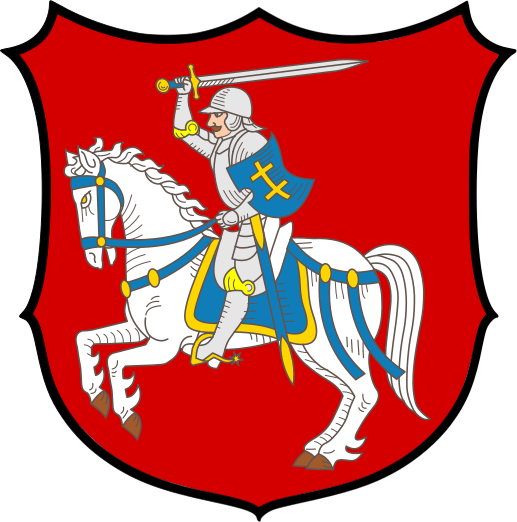
http://upload.wikimedia.org/wikipedia/commons/thumb/0/0d/Pohonia.svg/500px-Pohonia.svg.png

The History and Register of the Nobility of Lithuania

The Lithuanian nobility was historically a legally privileged class in the Grand Duchy of Lithuania consisting of Lithuanians, from the historical regions of Lithuania Proper and Samogitia, and in some cases Ruthenian noble families. Families were primarily granted privileges for their military service to the Grand Duchy. After the Union of Lublin in 1569, became less distinguishable from Polish szlachta, although preserved Lithuanian national awareness. The Polish-Lithuanian Commonwealth had one of the largest number of nobility in Europe, close to 7% of the population, in some regions, like Samogitia, it was closer to 10%.

POL COA Czartoryski.svg
Source: Wikimedia Commons

Nobility in The Grand Duchy of Lithuania

Prior to the creation of the Lithuanian state by Mindaugas, lesser members of the nobility were called bajorai (singular – bajoras) and greater nobles, kunigai (singular – kunigas), from the Old German: kunig, meaning “king”, or Lithuanian: kunigaikštis, usually translated as duke, Latin: dux. They evolved from tribal leaders, and were chiefly responsible for waging wars and organizing raids operations into enemy’s territory. After the establishment of a unified state they gradually became subordinates to greater Dukes, and later to the King of Lithuania. After Mindaugas death all Lithuanian rulers held the title Grand Duke (Lithuanian: Didysis kunigaikštis), or king (rexwhich was used in Gediminas’ title).

Ethnic Lithuanian nobility had different names than common people, as their names were made of two stems. Greater noble families generally used the Lithuanian pagan given names of their precursors as their family names; this was the case with Goštautai, Radvilos, Astikai, Kęsgailos and others. Those families acquired great wealth and evolved into magnates. Their representatives are respectively Jonas Goštautas, Radvila Astikas, Kristinas Astikasand Mykolas Kęsgaila. Those families were granted coats of arms under the Union of Horodlo in 1413.

While at the beginning the nobility was almost all Lithuanian, with territorial expansion more Ruthenian families joined Lithuanian nobility. Already in the 16th century several Ruthenian noble families began to call themselves gente Ruthenus, natione Lithuanus. A good example is the Chodkiewicz family, that claimed its ancestry from the House of Gediminas. According to a military census in 1528, ethnic Lithuanian lands had 5730 horsemen and Ruthenian lands of the Grand Duchy – 5372.

File: AKCzartoryski. JPG

The Evolution of Nobility

In the late 14th century Grand Dukes Jogaila and Skirgaila began forming professional forces. Instead of calling all men to war, a class of professional warriors – bajorai (future nobles) – was formed. In the early 15th century, Vytautas the GreatGrand Duchy of Lithuania further: as there were not enough warriors, Vytautas relieved soldiers from taxes and labour on the land by granting them veldamai, dependent peasants. At first the land was given to the serving men until death (benefice), but during the 14th and 15th centuries most of it became patrimony, granted by privileges of the monarch. Whilst during the 14th century the Grand Duke owned about ⅔ of the Duchy’s land, by 1569 he was a direct owner of only ⅓. In the 15th century, the noble social class was already formed in Lithuania; for quite a long time it remained open and anyone could be ennobled for services to the Grand Duke. In time, the influence of lesser nobles decreased and greater nobles acquired increasingly more power, especially during the interregnum fights following Vytautas’ death.

Wealthier families were distinct from other nobles because they had latifundias in different lands including Lithuanian, Ruthenian and even Polish. In the 15th century, the biggest landowners began to call themselves “lords” (ponai or didikai), and the Lithuanian Council of Lords was established to represent their interests. In time most of them received titles borrowed from the Holy Roman Empire – dukes, earls and others. Grand Duchy of Lithuania offices were held almost exclusively by magnates. In the 16th century, Lithuanian nobility stopped calling themselves bajorai; they adopted Polish term szlachta (Lithuanian: šlėkta) instead. Landlords called themselves ziemionys or ziemiane.

POL COA Hipocentaur alt.svg
Source: Wikimedia Commons

The Privileges of Nobility

The Grand Duke became dependent on powerful landowners after he distributed state land, after which time landowners demanded greater liberties and privileges. The nobles were granted administrative and judicial power in their domains and increasing rights in state politics. The legal status of the nobility was based on several privileges, granted by the Grand Dukes:

  • In 1387 Grand Duke of Lithuania Jogaila, newly crowned King of Poland, granted a privilege to nobles and soldiers. They were granted personal rights, including the right to inherit and govern land and estates inherited from ancestors or gifted by the Grand Duke. The nobles also had duties to serve in the military, safeguard castles, build and repair castles, bridges, roads, etc.
  • In 1413 Vytautas and Jogaila signed Union of Horodło. The act renewed Polish-Lithuanian union and established a common Sejm and guaranteed the right to inherit lands gifted by the Grand Duke. 43 Lithuanian noble families were granted Polish coats of arms. Most of the veldamai became serfs.
  • Jogaila’s privilege in 1432 in essence repeated previous acts. Military service remained the main way to receive land.
  • Privilege of May 6, 1434 was granted by Sigismund Kestutaitis to Catholic and Eastern Orthodox nobility. They were guaranteed freedom to dispose their land. The act prohibited persecutions without a fair trial.
  • In 1447 Casimir I Jagiellon limited positions within the Catholic Church or state institutions only to people from Lithuania. Some nobles were released from their duties to the Grand Duke. This privilege also marked the beginnings of serfdom in Lithuania as peasants were removed from the Grand Duke’s jurisdiction.
  • 1492 privilege by Alexander Jagiellon renewed the 1447 privilege and added a few more provisions, the most important of which limited the Grand Duke’s rights in regards to foreign policy. The Grand Duke became dependent on the Lithuanian Council of Lords. Without the consent of the Council no high official could be removed from his position. Lower posts had to be appointed in the presence of voivodes of Vilnius, Trakai, and other voivodeships. The privilege also prohibited selling various state and church positions to nobility. This way the Grand Duke was limited from exploiting the conflict between higher and lower nobility and profiting from selling the positions. This privilege also meant that city residents could not become officials.
  • In 1506 Sigismund I the Old confirmed the position of the Council of Lords in state politics and limited entry to the noble class.
  • On April 1, 1557 Sigismund II Augustus initiated the Wallach reform, which fully established serfdom. Peasants lost land ownership and personal rights, becoming completely dependent on the nobles.
  • Union of Lublin in 1569 created the new state, the Polish-Lithuanian Commonwealth. The nobility was granted the right to elect a common ruler for Poland and Lithuania.
  • The Third Statute of Lithuania, completed in 1588, further expanded the rights of nobility. Laws could be enacted only by the General sejm. The nobility was granted triple immunity – legal, administrative, and tax. The statute finalized the division between nobility, peasants, and city residents.

Most of the nobility rights were retained even after the third partition of the Polish-Lithuanian Commonwealth in 1795.

POL COA Chodkiewicz.svg
Source: Wikimedia Commons

The Ties to the Kingdom of Poland

After the Union of Horodło (1413) Lithuanian nobility acquired the same rights as the nobility of the Kingdom of Poland (szlachta). During following centuries Lithuanian nobility began to merge into Polish nobility[citation needed]. The process accelerated after the Union of Lublin (1569) which created the Polish-Lithuanian Commonwealth.

Lithuanian nobility self-polonised, replacing Lithuanian and Ruthenian languages with Polish although the process took centuries. In the 16th century a newly established theory amongst Lithuanian nobility was popular, claiming that Lithuanian nobility was of Roman extraction, and the Lithuanian language was just a morphed Latinlanguage. In 1595 Mikalojus Daukša addressed Lithuanian nobility calling for the Lithuanian language to play a more important role in state life. However, the usage of Lithuanian declined, and the Polish language became the rule in the offices of the Grand Duchy of Lithuania in the late 17th century.

At first only Lithuanian magnate families were affected by Polonization, although many of them like the Radziwiłłsremained loyal to the Grand Duchy of Lithuania and safeguarded its sovereignty vis-à-vis the Kingdom of Poland. Gradually Polonization spread to wider population, and for the most part Lithuanian nobility became part of both nations’ szlachta. Nonetheless the Lithuanian nobles did preserve their national awareness as members of the Grand Duchy, and in most cases recognition of their Lithuanian family roots; their leaders would continue to represent the interests of the Grand Duchy of Lithuania in the General sejm and in the royal court. Lithuanian language was used during Kościuszko Uprising in the proclamations calling to rise up For our freedom and yours. And Lithuania nobles did rise to fight for independence of their nation.

File: Grunwald bitwa.jpg

After partitions of the Polish-Lithuanian Commonwealth

The lesser Lithuanian nobility still preserving Lithuanian language suffered after the partitions of the Commonwealth left most of the former Grand Duchy under control of the Russian Empire. Situation worsened during the rule of tzar Nicholas I of Russia. After November uprising imperial officials wanted to minimize the social base for another potential uprising and thus decided to reduce the noble class. During the period of 1833-1860, 25,692 people in Vilna Governorate and 17,032 people in Kovno Governorate lost their noble status. They could not prove their status with monarchs privileges or land ownership. They did not loose personal freedom, but were assigned as one steaders Russian: однодворцы in rural areas and as citizens in towns. Following the January Uprising imperial officials announced that “Lithuanians are Russians seduced by Poles and Christianity” andbanned press in the Lithuanian language and started the Program of Restoration of Russian Beginnings.

During the 19th century a Latin formula gente Lithuanus, natione Polonus (Lithuanian people, Polish nation) was common in the Lithuania Proper and former Samogitian Eldership. With Polish culture becoming one of the primary centers of resistance to the Russian Empire, Polonization in some regions actually strengthened in response to official policies of Russification. Even larger percentage of Lithuanian nobility was Polonised and adopted Polish identity by the late 19th century. A Russian census in 1897 showed that 27.7 % of nobility living within modern Lithuania’s borders declared Lithuanian as a mother language. This number was even higher in Kovno Governorate, where 36.6 % of nobility identified the Lithuanian language as their mother language.

The processes of Polonization and Russification were partially reversed with the Lithuanian National Revival, which also began around that time. Although originating mostly from the non-noble classes, a number of nobles re-embraced their Lithuanian roots. During the interbellum years the government of Lithuania issued land reform limiting manors with 150 hectares of land, and confiscating land from those nobles who were fighting in the Polish-Lithuanian War on the Polish side. Many members of the Lithuanian nobility during the interbellum and after the World War II emigrated to Poland, many were deported to Siberia during the years 1945-53 of Soviet occupation, many manors were destroyed. Association of Lithuanian Nobility was established in 1994.
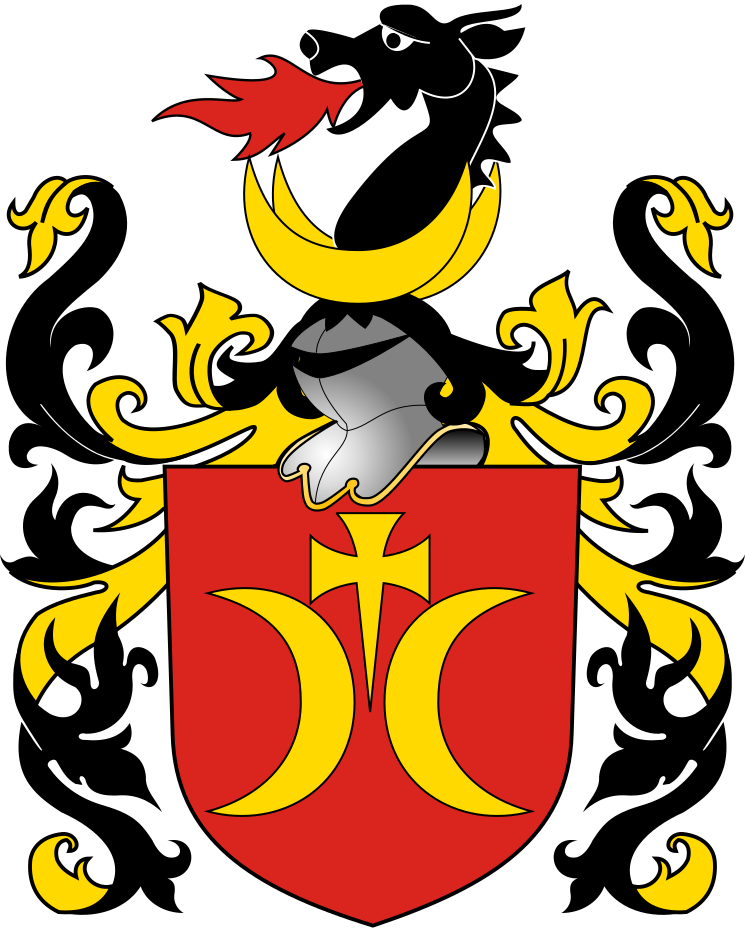
http://upload.wikimedia.org/wikipedia/commons/thumb/4/43/POL_COA_Ostoja_%C5%9Bredniowieczna.svg/193px-POL_COA_Ostoja_%C5%9Bredniowieczna.svg.png

The Heraldry of Lithuania

The most ancient heraldry has motive of crossed arrows. According to the Union of Horodło of 1413, 47 Lithuanian noble families adopted Polish nobility coat of arms. Later more families adopted more coat of arms.

The Influential Noble Lithuanian Families

  • Alelkaičiai
  • Olshanski (Alšėniškiai)
  • Astikai
  • Czartoryski
  • Gediminaičiai
  • Gedgaudai
  • Giedraičiai
  • Goštautai
  • Kęsgailos
  • Mangirdaičiai
  • Mantautaičiai
  • Pac (Pacas)
  • Radziwiłł (Radvila)
  • Sviriškiai
  • Valmantaičiai

The Noble Families from Ruthenia

  • Chodkiewicz
  • Hlebowicz
  • Ogiński
  • Ostrogski
  • Sapieha
  • Tyszkiewicz
  • Wiśniowiecki
  • Zasławski

The Noble Families from Livonia

  • Plater
  • Tyzenhaus
  • Römer

The List of Early Lithuanian Dukes

Early dukes of Lithuania (including Samogitia) reigned before Lithuanians were unified by Mindaugas into a state, the Grand Duchy of Lithuania. While the Palemonids legend provides genealogy from the 10th century, only few dukes were mentioned by contemporary historical sources. All of them were mentioned in written sources the 13th century. Data about them is extremely scarce and is usually limited to few brief sentences. The primary sources are the Chronicle of Henry of Livonia and Hypatian Codex.

Vykintas, one of the early Lithuanian dukes, as depicted by Alexander Guagnini

  • Žvelgaitis (Svelgates) – earliest known duke. In 1205, he attacked Riga and was killed in the battle, led by ruler of Semigallia, Vester.
  • Daugirutis (Dangerutis, Dangeruthe) – Livonians imprisoned this Lithuanian duke in 1213, where he killed himself.
  • Stekšys (Stakys, Steksė) – another powerful duke, killed in 1214 near Lielvārde.
  • Father of Mindaugas – several sources mention that he was a powerful duke, but do not give his name. 16th century geanelogies gave him the name of Ryngold or Ringaudas.
  • The following Lithuanian dukes signed a peace treaty with rulers of Halych-Volhynia in 1219:
    • Duke elders
      • Živinbudas (presumably the eldest duke)
      • Daujotas
      • Vilikaila (brother of Daujotas)
      • Dausprungas
      • Mindaugas (brother of Dausprungas)
    • Rulers of Samogitia
      • Erdvilas
      • Vykintas
    • Ruškaičiai family
      • Kintibutas
      • Vembutas
      • Butautas
      • Vyžeikis
      • Velžys (son of Vyžeikis)
      • Kitenis
      • Plikienė (wife of Plikys, probably a widow)
    • Bulionys family (three brothers, all of them killed by Mindaugas)
      • Vismantas (his wife was taken by Mindaugas for himself)
      • Gedvilas
      • Sprudeikis
    • Rulers of Deltuva
      • Juodikis
      • Buteikis
      • Bikšys
      • Ligeikis

Of the dukes who signed the peace treaty, only four are mentioned in other written sources: Mindaugas, who went on to become the Grand Duke of Lithuania and was crowned as King of Lithuania in 1253, Vykintas, leader of anti-Mindaugas coalition during the civil war in 1248-1251, Bikšys and Ligeikis, both identified as Mindaugas relatives and nobles, mentioned in a document, dated 1260 and sometimes considered a forgery.

POL COA Radziwiłł.svg
Source: Wikimedia Commons

References

  1. ^ Bumblauskas, Alfredas (1995). “About the Lithuanian Baroque in a Baroque Manner”. Lituanus 41 . ISSN 00245089. http://www.lituanus.org/1995_3/95_3_06.htm. Retrieved 2007-09-22. “gente Ruthenus, natione Lithuanus”.
  2. ^ Jerzy Ochmański, Dawna Litwa, Wydawnictwo Pojerzierze. Olsztyn, 1986.
  3. ^ Kiaupa, Zigmantas; Jūratė Kiaupienė, Albinas Kunevičius (2000) [1995]. The History of Lithuania Before 1795 (English ed.). Vilnius: Lithuanian Institute of History. pp. 172-174. ISBN 9986-810-13-2.
  4. ^ Jučas, M. (1995). “Gyvi istorijos puslapiai” (in Lithuanian). Lietuvos bajoras (Danielius) 1: 10-13. ISSN 1392-1304. “Tikruosius bajorus – luomą su pilietinėmis teisėmis – imta vadinti iš lenkų perimtu žodžiu „šlėktomis”, arba ziemionimis (ziemiane, szlachta). … Istoriškai neturėtume vadinti Lietuvos kilmingųjų žemvaldžių bajorais, nes jie nuo XVI a. vidurio taip savęs niekur nebevadino.”.
  5. ^ Gudmantas, Kęstutis (2004). “Vėlyvųjų Lietuvos metraščių veikėjai ir jų prototipai: „Romėnai” (The personages of the Lithuanian chronicles and their prototypes: The „Romans”)”. Ancient Lithuanian LiteratureXVII: 113-139.
  6. ^ unlikely, especially because the Romans had very little hold, if any, in the lands so far north) (see alsosarmatism
  7. ^ Aleksandravičius, p.207
  8. ^ a b Aleksandravičius, Egidijus; Antanas Kulakauskas (1996). Carų valdžioje. Vilnius: Baltos lankos. pp. 232-233. ISBN 9986-403-69-3.
  9. ^ Vėbra, Rimantas (1990). Llietuvių visuomenė XIXa. antrojoje pusėje. Mokslas. pp. 152. ISBN 9986-403-69-3.
  10. ^ (Lithuanian) Jonynas, Ignas (1933). “Alšėniškiai”. in Vaclovas Biržiška. Lietuviškoji enciklopedija. I. Kaunas: Spaudos Fondas. pp. 347-359.
  11. ^ (Lithuanian) Jonas Zinkus, et al., ed (1985). “Alšėnų kunigaikščiai”. Tarybų Lietuvos enciklopedija. I. Vilnius, Lithuania: Vyriausioji enciklopedijų redakcija. pp. 52.

    Further Reading

  • (Lithuanian) Rimvydas Petrauskas Giminaičiai ir pavaldiniai: Lietuvos bajorų grupės XIV a. pabaigoje-XV a. I pusėje in: Lietuva ir jos kaimynai: nuo Normanų iki Napoleono: prof. Broniaus Dundulio atminimui. Vilnius, 2001, p. 107-126.
  • (Lithuanian) Rimvydas Petrauskas, Lietuvos diduomenė XIV a.pabaigoje – XV a.:sudėtis-struktūra-valdžia. Aidai, Vilnius; 2003.
  • (Lithuanian) Kiaupienė, Jūratė (2003). Mes, Lietuva: Lietuvos Didžiosios Kunigaikštystės bajorija XVIa. Viešasis ir privatus gyvenimas. Vilnius: Lithuanian institute of history.
  • Aleksandravičius, Egidijus (1999). “The double fate of the Lithuanian gentry”. Lituanus 45 .http://www.lituanus.org/1999/99_3_05.htm. Retrieved 2007-09-06. Historiographical notes on the research of Lithuanian nobility.
  • Schmalstieg, William R. (1982). “Lithuanian names”. Lituanus 28 .http://www.lituanus.org/1982_3/82_3_01.htm. Retrieved 2007-09-06.
We use cookies to personalise content and ads, to provide social media features and to analyse our traffic. We also share information about your use of our site with our social media, advertising and analytics partners. View more
Cookies settings
Accept
Decline
Privacy & Cookie policy
Privacy & Cookies policy
Cookie name Active

Privacy and Cookie Policy Last updated: 11 August 2026

Neue Gotha respects your privacy and is committed to handling personal data lawfully, fairly, and transparently. This Privacy and Cookie Policy explains who is responsible for personal data, what information we process, why we process it, how long we retain it, who may receive it, and the rights available to individuals under the General Data Protection Regulation (EU) 2016/679 (“GDPR”) and applicable national data-protection and electronic-communications law.

1. Who is responsible for your personal data?

The controller responsible for the processing described in this policy is:

  • Legal name: Neue Gotha Historical Register gUG
  • Trading or project name: Neue Gotha
  • Postal address: Musterstraße 12, 10115 Berlin, Germany
  • Email: editor@neuegotha.de
  • EU/EEA representative: Not applicable (the controller is established in Germany).
  • Data Protection Officer: No Data Protection Officer has been appointed. Privacy enquiries are handled through editor@neuegotha.de.

Questions about this policy or requests concerning personal data may be sent to the email or postal address above.

2. Scope of this policy

This policy applies to personal data processed through https://neuegotha.com, correspondence with the Neue Gotha editorial office, material submitted for editorial consideration, and editorial or archival records concerning identifiable living individuals.

It does not govern independent third-party websites or services linked from this website. Those providers are responsible for their own privacy practices.

3. Personal data we process and why

Processing activity Personal data Purpose Legal basis Retention
Website delivery, logging, and security IP address; date and time of access; requested page or file; referring page; browser, operating-system, and device information; error and security-event data Deliver the website, maintain availability, diagnose faults, prevent abuse, and protect the website and its users Article 6(1)(f) GDPR — our legitimate interests in operating a secure and reliable website. Where processing is required by law, Article 6(1)(c) GDPR may also apply. Routine access and error logs are retained for 14 days. Records isolated for investigation of a suspected security incident may be retained for up to 90 days after the incident is resolved, or longer where required for legal claims.
Editorial correspondence and enquiries Name, contact details, message content, correspondence history, and any documents or other information voluntarily provided Respond to enquiries, assess corrections or submissions, maintain editorial records, and protect legal rights Article 6(1)(f) GDPR — our legitimate interests in conducting editorial work and responding to correspondence; Article 6(1)(b) GDPR where processing is necessary to take steps at an individual’s request before entering into a contract; Article 6(1)(c) GDPR where retention or disclosure is legally required Correspondence is ordinarily retained for 24 months after the matter closes. Material required to document an editorial decision, resolve a dispute, meet a legal obligation, or establish, exercise, or defend a legal claim may be retained for the applicable limitation period.
Editorial, genealogical, and archival records Names; titles and styles; dates and places associated with public or genealogical events; family relationships; jurisdictions, offices, and public roles; images; biographical information; source and citation information; and correspondence relating to accuracy or provenance Research, document, preserve, verify, correct, and publish material concerning dynastic, genealogical, heraldic, and institutional history Article 6(1)(f) GDPR — our legitimate interests and those of readers, researchers, and institutions in maintaining an accurate historical and genealogical reference work, subject to a documented necessity and balancing assessment. Applicable national rules implementing Article 85 GDPR concerning freedom of expression and information may also apply. For as long as the information remains relevant to the legitimate editorial or archival purpose, subject to accuracy review, correction, restriction, erasure, and applicable archiving or legal requirements
Cookie-consent and language preferences Consent choice, language preference, cookie identifiers, and related technical information Remember privacy choices, demonstrate consent where required, and provide the language selected by the visitor Article 6(1)(f) GDPR for strictly necessary preference and consent-management functions; Article 6(1)(a) GDPR for optional storage, access, or associated processing based on consent As stated in the cookie table below
Optional external services IP address, page URL, device and browser information, language choice, and service-interaction data, depending on the provider Provide optional translation, embedded content, analytics, or similar features actually enabled on the website Article 6(1)(a) GDPR — consent. Non-essential services remain disabled until consent is given. As described for each service and by the relevant provider

We do not use personal data for solely automated decisions that produce legal effects or similarly significant effects concerning individuals.

4. Editorial and archival information obtained from other sources

Neue Gotha is an editorial and historical reference project. Some information in the register may concern identifiable living individuals and may not have been collected directly from those individuals.

Depending on the record, information may be obtained from official gazettes and public registers; archives and libraries; published books and scholarly works; institutional publications; reputable news sources; publicly accessible websites; submissions from the individual concerned or their authorised representative; family representatives; and other documented sources.

The categories of information may include the categories listed under “Editorial, genealogical, and archival records” above. The material may be made available to website visitors and may be indexed by search engines. Neue Gotha seeks to use relevant, proportionate, and appropriately sourced information and to distinguish documented fact from uncertainty or editorial interpretation.

Individuals may contact the editorial office to request access, correction, contextualisation, restriction, or erasure. Requests are assessed under the GDPR and applicable national law, taking into account accuracy, source integrity, the public interest, freedom of expression and information, archival considerations, and the rights and freedoms of other people. No provision of this policy removes a right granted by applicable law.

Neue Gotha does not intentionally publish special-category personal data or information concerning criminal convictions about living individuals unless a specific lawful basis and any additional legal condition have been identified and documented.

5. Cookies and similar technologies

Cookies are small text files stored on, or read from, a visitor’s device. Similar technologies may perform comparable functions. Some are strictly necessary for a website or a service expressly requested by the visitor. Others, including many analytics, advertising, social-media, translation, or embedded-content technologies, require prior consent under applicable EU electronic-communications rules.

Neue Gotha does not place or access non-essential cookies, or activate non-essential external services, before valid consent has been given. Visitors may accept or reject optional purposes separately and may withdraw consent at any time by selecting the permanently available “Cookie settings” control. Withdrawing consent does not affect processing that was lawful before withdrawal. Strictly necessary technologies cannot be disabled through the consent tool, but they may be controlled through browser settings where technically possible.

The following table reflects the technologies currently deployed on the website. It is updated whenever a plugin, host, analytics tool, embedded service, or cookie configuration changes.

Name Provider Purpose Category Duration Third-party access
_scc_session Neue Gotha / managed hosting and site-control provider Maintains a short-lived session for website security and site-control functions Strictly necessary Browser session The contracted hosting or site-control provider may access the identifier when providing technical support
_tccl_visit Neue Gotha / managed website-analytics provider Distinguishes a single website visit and reduces duplicate counting within the same session Analytics — disabled until consent 30 minutes Yes; the contracted analytics provider processes the identifier on Neue Gotha’s behalf
_tccl_visitor Neue Gotha / managed website-analytics provider Assigns a pseudonymous visitor identifier used to produce aggregated website-usage statistics Analytics — disabled until consent 12 months Yes; the contracted analytics provider processes the identifier on Neue Gotha’s behalf
googtrans Neue Gotha / Google Translate Stores or applies the visitor’s language selection for the translation feature Functional — disabled until consent 12 months Google may receive technical and service-interaction data when Google Translate is activated
ng_gt_default_applied Neue Gotha / website translation plugin Records whether the website’s default translation setting has been applied Functional — disabled until consent 24 hours No direct vendor access is assumed; Google may receive data if activation causes Google Translate to load
eu_cookies_bar_consent Neue Gotha / locally hosted EU Cookies Bar plugin Stores the visitor’s cookie choices and prevents the banner from being shown unnecessarily Strictly necessary 6 months No, provided the consent plugin remains locally hosted and does not transmit consent records to its developer
wordpress_test_cookie Neue Gotha / WordPress Checks whether the browser supports cookies when an authorised user visits the sign-in page Strictly necessary Browser session No; the cookie is processed by Neue Gotha and its contracted host

Authorised editorial users may receive WordPress authentication, security, or preference cookies when they sign in. wordpress_logged_in_[hash] maintains an authenticated session for up to two weeks when “Remember Me” is selected; wordpress_sec_[hash] protects administrative access for the session; and wp-settings-[user_id] stores an editor’s interface preferences for up to one year. These internal cookies are processed solely for editorial access and site administration.

6. Google Translate, web fonts, and other external content

Where enabled with the visitor’s consent, Neue Gotha may use Google Translate to provide machine-generated translations. Activating the service may cause the visitor’s browser to connect to Google and disclose technical information such as the IP address, requested page URL, browser or device information, and language or service-interaction data. Machine translations may contain errors and do not replace the original editorial text.

Website fonts are hosted locally by Neue Gotha and do not require a connection to Google. Google Translate remains an optional external service that is activated only after the visitor provides consent.

Information about Google’s processing is available in the Google Privacy Policy and Google’s explanation of how it uses information from sites and applications that use its services.

Embedded material from another website may allow that provider to process personal data as if the visitor had visited the provider directly. Non-essential embeds remain blocked until consent is obtained. Each enabled provider is identified in this policy and in the consent interface.

7. Recipients of personal data

Personal data may be disclosed only where necessary to:

  • hosting, content-delivery, backup, website-maintenance, email, security, and consent-management providers acting under contract;
  • translation, analytics, media, or other external-service providers selected by the visitor through the consent interface;
  • professional advisers, insurers, auditors, or other specialists where necessary to protect legal or operational interests;
  • courts, regulators, law-enforcement bodies, or public authorities where disclosure is required or permitted by law; and
  • the public and search engines where personal data form part of a lawfully published editorial or archival record.

8. International data transfers

Some service providers may process personal data outside the European Economic Area. Where the GDPR restricts such a transfer, Neue Gotha relies on an applicable European Commission adequacy decision or appropriate safeguards under Article 46 GDPR, such as the European Commission’s Standard Contractual Clauses, together with supplementary measures where required.

Cloudflare and Google may transfer limited technical information to recipients in the United States. Where the recipient is validly certified, the transfer is based on the European Commission’s adequacy decision for the EU–US Data Privacy Framework. Where that mechanism is unavailable or does not cover a transfer, the relevant provider’s European Commission Standard Contractual Clauses and supplementary technical and organisational measures are used. Information about the applicable safeguards, including how to obtain a copy, may be requested from editor@neuegotha.de.

9. How long we retain personal data

We retain personal data only for as long as necessary for the purposes described in this policy, including security, editorial integrity, source verification, dispute resolution, and compliance with legal obligations. The specific periods or criteria are stated in the processing and cookie tables above.

When a retention period ends, information is deleted or anonymised unless continued retention is required by law, is necessary for legal claims, or is justified by a documented editorial or archival purpose. Encrypted rolling backups are retained for 35 days and are then overwritten automatically, unless a backup has been isolated for incident recovery or a legal hold.

10. Security

Neue Gotha uses appropriate technical and organisational measures designed to protect personal data against accidental or unlawful destruction, loss, alteration, unauthorised disclosure, or access. No method of internet transmission or electronic storage is completely secure, and absolute security cannot be guaranteed.

11. Your data-protection rights

Subject to the conditions and limitations in the GDPR and applicable national law, an individual may have the right to:

  • obtain confirmation as to whether personal data concerning them are processed and request access to those data;
  • request correction of inaccurate or incomplete personal data;
  • request erasure of personal data;
  • request restriction of processing;
  • object, on grounds relating to their particular situation, to processing based on legitimate interests;
  • receive personal data they provided in a structured, commonly used, machine-readable format and transmit those data to another controller where the right to portability applies;
  • withdraw consent at any time, without affecting the lawfulness of processing carried out before withdrawal; and
  • lodge a complaint with a competent data-protection supervisory authority.

To exercise a right, contact editor@neuegotha.de. Please identify the information or record concerned and the nature of the request. We may request information reasonably necessary to verify identity and protect personal data from unauthorised disclosure. Requests are normally answered within one month, subject to any extension permitted by law.

Where a request concerns published editorial or archival content, applicable rights may be limited where necessary and proportionate to reconcile data protection with freedom of expression and information or other rights recognised by law. Each request will be assessed individually.

12. Complaints

We encourage individuals to contact us first so that we can try to resolve a concern. Individuals also have the right to complain to the supervisory authority in the EU or EEA country of their habitual residence, place of work, or the place of the alleged infringement.

For this Berlin-based controller the supervisory authority is the Berliner Beauftragte für Datenschutz und Informationsfreiheit, Alt-Moabit 59–61, 10555 Berlin, Germany; telephone +49 30 13889-0; email mailbox@datenschutz-berlin.de; website https://www.datenschutz-berlin.de/.

13. Children

The website is intended as a general historical and reference resource and is not directed specifically at children. We do not knowingly request personal data directly from children for an online service requiring parental consent. If you believe a child has provided personal data inappropriately, please contact us.

14. Changes to this policy

We may update this policy when our processing activities, service providers, technologies, or legal obligations change. The current version will be published on this page with a revised “Last updated” date. Where required, we will provide additional notice or request renewed consent before introducing a new processing purpose.

Decline All
Save settings Accept All
Cookies settings