
Formerly Sovereign House

Grand Duchy of Mecklenburg-Schwerin – House of Mecklenburg

Grand Duchy of Mecklenburg-Schwerin – House of Mecklenburg

Jurisdiction
Mecklenburg-Schwerin
Dynasty
House of Mecklenburg
Entry type
House
Editorial status
Reviewed - Verified

Groß-Herzogtum Mecklenburg-Schwerin

The Grand Duchy of Mecklenburg-Schwerin was a territory in Northern Germany held by the House of Mecklenburg residing at Schwerin. It was a sovereign member state of the German Confederation and became a federated state of the North German Confederation and finally of the German Empire in 1871. Like its predecessor, the Duchy of Mecklenburg-Schwerin, the Schwerin lands upon the incorporation of the extinct Duchy of Mecklenburg-Güstrow in 1701 comprised the larger central and western parts of the historic Mecklenburg region. The smaller southeastern part was held by the Duchy of Mecklenburg-Strelitz branch of the grand ducal house, who also ruled over the lands of the former Bishopric of Ratzeburg in the far northwest.
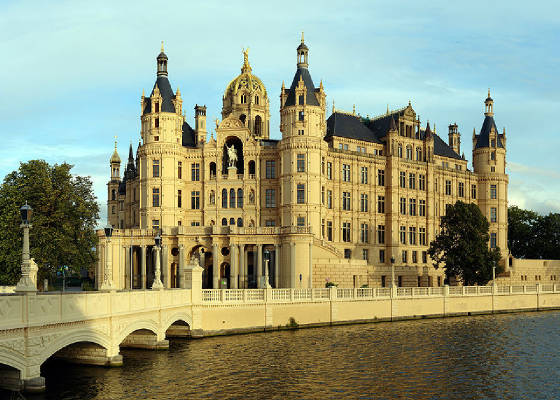
Schwerin-Schloss.jpg

The grand duchy was bounded by the Baltic coast in the north and the Prussian province of Pomerania in the northeast, where the border with the Hither Pomeranian (formerly Swedish Pomeranian) region ran along the Recknitz river, the Peene, and Kummerower See. In the south it bordered with the Prussian province of Brandenburg (with the exclaves of Rossow and Schönberg near Wittstock) and in the southwest with the Amt Neuhaus district held by the Kingdom of Hanover, which was incorporated into the Prussian province of Hanover after the Austro-Prussian War in 1866. Likewise in the west, the Duchy of Holstein was incorporated into the Schleswig-Holstein Province, after which Mecklenburg was almost entirely surrounded by Prussian territory. Beside the capital at Schwerin, Mecklenburg-Strelitz comprised the coastal cities of Rostock and Wismar, which had been held by the Swedish crown until 1803, as well as the inland towns of Parchim and Güstrow.

History of the Grand Duchy

In the early years of the French Revolutionary Wars Duke Frederick Francis I of Mecklenburg-Schwerin had remained neutral, and in 1803 he regained Wismar, which was pawned to him from Sweden. After Napoleon’s victory at the Battle of Austerlitz and the final dissolution of the Holy Roman Empire in 1806, he joined the Confederation of the Rhine by a treaty of 22 March 1808. Napoleon, in preparation for the French invasion of Russia in 1812, disregarded this alliance; he offered the duchy to the Swedish heir apparent Jean Bernadotte for his support. Duke Frederick Francis was the first member of the confederation to abandon Napoleon, to whose armies he had sent a contingent, and in the following War of the Sixth Coalition he fought against the troops of the French Empire -with the result that his new allies, Prussia and Russia, now offered his duchy to the Kingdom of Denmark. Instead, Denmark was promised the adjacent lands of Swedish Pomerania by the 1814 Peace of Kiel and the rule of the Mecklenburg dukes remained inviolate.

At the 1815 Congress of Vienna, Frederick Francis joined the newly established German Confederation, and like his Strelitz cousin Charles II, was elevated to the title of a “grand duke of Mecklenburg”. In 1819 serfdom was finally abolished in his dominions. The Mecklenburg governance was still determined by the 1755 inheritance agreement (Landesgrundgesetzlicher Erbvergleich), which upheld the medieval hierachy of the estates, which largely affected the social and economic development of both grand duchies. During the revolutions of 1848, the duchy witnessed a considerable agitation in favour of a liberal constitution. On 10 October 1849 Grand Duke Frederick Francis II (1823-1883) granted a new Basic law elaborated by his First Minister Ludwig von Lützow. In the subsequent reaction of the Mecklenburg nobility, backed by the Strelitz grand duke George, all the concessions which had been made to democracy were withdrawn and further restrictive measures were introduced in 1851 and 1852.

In the dispute over neighbouring Holstein which culminated in the 1866 Austro-Prussian War, Frederick Francis II supported the Kingdom of Prussia, whom he aided with Mecklenburg-Schwerin soldiers. His grand duchy began to pass more and more under Prussian influence. In 1867 he joined the North German Confederation and the Zollverein. In the Franco-Prussian War (1870-1871), Prussia again received valuable assistance from Grand Duke Frederick Francis II, who was an ardent advocate of German unity and held a high command in her armies. In the course of the German unification in 1871, Mecklenburg-Schwerin and Mecklenburg-Strelitz became states of the German Empire. There was now renewed agitation for a more democratic constitution, and the German Reichstag parliament gave some countenance to this movement.

In 1897 Frederick Francis IV (b. 1882) succeeded his father Frederick Francis III (1851-1897) as the last grand duke of Mecklenburg-Schwerin. In 1907 the Grand Duke promised a constitution to his subjects. The duchy had always been under a feudal system of government, the grand duke having the executive entirely in their hands (though acting through ministers). The duchy shared a diet (Landtag), which met for a short session each year. At other times theyt were represented by a committee consisting of the proprietors of knights’ estates (Rittergüter), known as the Ritterschaft, and the Landschaft, or burgomasters of certain towns. Mecklenburg-Schwerin returned six members to the Reichstag. Upon the suicide of his cousin Grand Duke Adolphus Frederick VI on 23 February 1918, Frederick Francis served as regent of Mecklenburg-Strelitz. Shortly afterwards, on 14 November, he was forced to renounce the Mecklenburg throne in the course of the German Revolution. The grand duchy turned into the Free State of Mecklenburg-Schwerin, a federated state of the Weimar Republic.

Thereby ended nearly eight centuries of continuous rule (only interrupted by Albrecht von Wallenstein from 1628 to 1630) by the originally Obotrite (West Slavic) Mecklenburg dynasty, beginning with their progenitor Prince Niklot (d. 1160). Until 1918 the grand duke was styled as “Prince of the Wends

List of the Dukes and Grand Dukes of Mecklenburg-Schwerin

Name (lived) Reign Notes
Frederick William
(28 March 1675-31 July 1713)
1692-1713 (Nephew of Christian Ludwig I)
Karl Leopold
(26 November 1678-28 November 1747)
1713-1728 (Brother of Frederick William), named in the Reichsexekution of 1717, was deposed in 1728 by the Aulic Council in Vienna in favour of his brother Christian Ludwig II.
Christian Ludwig II
(15 November 1683-30 May 1756)
1728-1756 (Brother of Karl Leopold)
Frederick II, the Pious
(9 November 1717-24 April 1785)
1756-1785 (Son of Christian Ludwig II)
Frederick Francis I
(10 December 1756-1 February 1837)
1785-1837 from 1815 Grand Duke – [Son of Archduke Friedrich Ludwig, Nephew of Friedrich II]
Paul Frederick
(15 September 1800-7 March 1842)
1837-1842 (Nephew of Frederick Francis I)
Frederick Francis II
(28 February 1823-15 April 1883)
1842-1883 (Son of Paul Frederick)
Frederick Francis III
(19 March 1851-10 April 1897)
1883-1897 (Son of Frederick Francis II)
Johann Albrecht
(8 December 1857-16 February 1920)
1897-1901 (Brother of Grand Duke Frederick Francis III), from 11 April 1897 until 9 April 1901 regent
Frederick Francis IV
(9 April 1882-17 November 1945)
1897-1918 (Son of Grand Duke Frederick Francis III), from 1918 Administrator of the Mecklenburg-Strelitz District

Titles and Styles of the Grand Ducal House

The remaining members of this family bear the title Duke or Duchess of Mecklenburg together with the formal appellation of His or Her Highness.

Genealogy of the Grand Ducal House

CHRISTIAN LUDWIG II, Duke of Mecklenburg-Schwerin 28 Nov 1747 (Grabow 15 May 1683-Schwerin 30 May 1756); m. Güstrow 13 Nov 1714 Gustave Karoline Dss of Mecklenburg-Strelitz (Neustrelitz 12 Jul 1694-Schwerin 13 Apr 1748)

  • 1a) FRIEDRICH, Duke of Mecklenburg-Schwerin (Schwerin 9 Nov 1717-Ludwigslust 24 Apr 1785); m. Schwedt 2 Mar 1746 Luise Friederike Dss of Württemberg (Stuttgart 3 Feb 1722-Hamburg 2 Aug 1791)
  • 2a) Ulrike Sophie (Grabow 1 Jul 1723-Rostock 17 Sep 1813)
  • 3a) Ludwig (Grabow 6 Aug 1725-Schwerin 12 Sep 1778); m.by proxy at Coburg 25 Apr 1755 and in person at Schwerin 14 May 1755 Charlotte Pss of Saxe-Coburg-Saalfeld (Coburg 24 Sep 1731-Schwerin 2 Aug 1810)
  • 1b) FRIEDRICH FRANZ I, Duke of Mecklenburg-Schwerin, Grand Duke of Mecklenburg-Schwerin 14 Jun 1815 (Schwerin 10 Dec 1756-Ludwigslust 1 Feb 1837); m. Gotha 1 Jun 1775 Luise Pss of Saxe-Gotha (Roda 9 Mar 1756-Ludwigslust 1 Jan 1808)

  • 1c) Friedrich Ludwig, Hereditary Grand Duke of Mecklenburg-Schwerin (Ludwigslust 13 Jun 1778-Ludwigslust 29 Nov 1819); m.1st Gatschina 23 Oct 1799 Elena Pavlovna, Grand Dss of Russia (St. Petersburg 24 Dec 1784-Ludwigslust 24 Sep 1803); m.2d Weimar 1 Jul 1810 Karoline Luise Pss of Saxe-Weimar-Eisenach (Weimar 18 Jul 1786-Ludwigslust 20 Jan 1816); m.3d Homburg 3 Apr 1818 Auguste Landgravine of Hesse-Homburg (Homburg 28 Nov 1776-Ludwigslust 1 Apr 1871)
  • 1d) PAUL FRIEDRICH, Grand Duke of Mecklenburg-Schwerin (Ludwigslust 15 Sep 1800-Schwerin 7 Mar 1842); m. Berlin 25 May 1822 Alexandrine Pss of Prussia (Berlin 23 Feb 1803-Schwerin 21 Apr 1892)
  • 1e) FRIEDRICH FRANZ II, Grand Duke of Mecklenburg-Schwerin (Ludwigslust 28 Feb 1823-Schwerin 15 Apr 1883); m.1st Ludwigslust 3 Nov 1849 Auguste Pss Reuss (Klipphausen 26 May 1822-Schwerin 3 Mar 1862); m.2d Darmstadt 12 May 1864 Anne Pss of Hesse and the Rhine (Bessungen 25 May 1843-Schwerin 16 Apr 1865); m.3d Rudolstadt 4 Jul 1868 Marie Pss von Schwarzburg-Rudolstadt (Rabensteinfeld 29 Jan 1850-The Hague 22 Apr 1922)
  • 1f) FRIEDRICH FRANZ III Paul Nikolaus Ernst Heinrich (Ludwigslust 19 Mar 1851-Cannes 10 Apr 1897); m. St. Petersburg 24 Jan 1879 Anastasia, Grand Dss of Russia (Peterhof 28 Jul 1860-Eze 11 Mar 1922)
  • 1g) Alexandrine Auguste (Schwerin 24 Dec 1879-Copenhagen 28 Dec 1952); m. Cannes 26 Apr 1898 King Christian X of Denmark (Charlottenlund 26 Sep 1870-Amalienborg 20 Apr 1947)
  • 2g) FRIEDRICH FRANZ IV, Grand Duke of Mecklenburg-Schwerin, renounced the throne 14 Nov 1918 (Palermo 9 Apr 1882-Flensburg 17 Nov 1945); m. Gmunden 7 Jun 1904 Alexandra Pss of Hannover (Gmunden 29 Sep 1882-Glücksburg 30 Aug 1963)
  • 1h) FRIEDRICH FRANZ Michael Wilhelm Nikolaus Franz-Joseph Ernst August Hans, Hereditary Grand Duke of Mecklenburg-Schwerin (Schwerin 22 Apr 1910-Hamburg-Blankenese 31 Jul 2001); m. Wiligrad 11 Jun 1941 (div 1967, remarried Glücksburg 22 Apr 1977) Karin von Schaper (b. Breslau 31 Jan 1920)
  • 2h) Christian Ludwig Ernst August Maximilian Johann Albrecht Adolf Friedrich (Ludwigslust 29 Sep 1912-Hemmelmark 18 Jul 1996); m. Schloß Glücksburg 11 Jul 1954 Barbara Pss of Prussia (Hemmelmark 2 Aug 1920-Hemmelmark 31 May 1994)
  • 1i) Donata (b. Kiel 11 Mar 1956); m. London 14 Aug 1987 (rel) Eckernförde 19 Sep 1987 Alexander von Solodkoff (b. Köln 20 Jan 1951)
  • 2i) Edwina ( b. Kiel 26 Sep 1960); m. Eckernförde 20 Sep 1995 (rel) Hemmelmark 14 Oct 1995 Konrad von Posern (b. Innsbruck 24 Jul 1964)
  • 3h) Olga (Schwerin 27 Dec 1916-Schwerin 4 Feb 1917)
  • 4h) Thyra Anastasia Alexandrine Marie-Louise Olga Cecilie Charlotte Elisabeth Emma (Sorgenfri 18 Jun 1919-Flensburg 27 Sep 1981)
  • 5h) Anastasia Alexandrine Cecile Marie-Louise Wilhelmine (Gelbansande 11 Nov 1922-Hamburg 25 Jan 1979); m. Wiligrad 1 Sep 1943 Friedrich Ferdinand Pr of Schleswig-Holstein (Gotha 14 May 1913-Glücksburg 31 May 1989)
  • 3g) Cecile Auguste Marie (Schwerin 20 Sep 1886-Bad Kissingen 6 May 1954); m. Berlin 6 Jun 1905 Wilhelm, Crown Pr of Prussia (Marmorpalais 6 May 1882-Hechingen 20 Jul 1951)
  • 2f) Paul Friedrich Wilhelm Heinrich (Ludwigslust 19 Sep 1852-Ludwigslust 17 May 1923); m. Schwerin 5 May 1881 Marie Pss zu Windisch-Grätz (Vienna 11 Dec 1856-Ludwigslust 9 Jul 1929)
  • 1g) Paul Friedrich Carl Alexander Michael Hugo (Schwerin 12 May 1882-Kiel 21 May 1904)
  • 2g) Marie Luise Auguste Alexandrine Olga (Schwerin 1 May 1883-Ludwigslust 21 Aug 1887)
  • 3g) Maria Antonia Margarete Auguste Mathilde (Venice 28 May 1884-Bled, Yugoslavia 26 Oct 1944)
  • 4g) Heinrich Borwin Albert Hugo Joseph Paul (Venice 16 Dec 1885-Sarszentmihaly, Hungary 3 Nov 1942); m.1st Dover 15 Jun 1911 (div 1913) Elizabeth Pratt (New York City 27 Jan 1860-Ponovich, Yugoslavia Nov 1928); m.2d New York City 1915 (div 1921) Natalie Oelrichs (Cheyenne, Wyoming 12 Oct 1880-San Francisco 23 Feb 1931); m.3d Rome 5 Nov 1921 Karola von Alers (Wiesbaden 3 Sep 1882-Garmisch-Partenkirchen 27 Sep 1974)
  • 3f) Marie Alexandrine Elisabeth Eleonore (Ludwigslust 14 May 1854-Contexeville, France 6 Sep 1920); m. St. Petersburg 28 Aug 1874 Vladimir, Grand Duke of Russia (St. Petersburg 22 Apr 1847-St. Petersburg 17 Feb 1909)
  • 4f) Nikolaus Alexander Friedrich Heinrich (Ludwigslust 18 Aug 1855-Ludwigslust 23 Jan 1856)
  • 5f) Johann Albrecht Ernst Konstantin Friedrich Heinrich (Schwerin 8 Dec 1857-Wiligrad 16 Feb 1920); m.1st Weimar 6 Nov 1886 Elisabeth Pss of Saxe-Weimar (Weimar 28 Feb 1854-Wiligrad 10 Jul 1908); m.2d Braunschweig 15 Dec 1909 Elisabeth Pss zu Stolberg-Rossla (Rossla 23 Jun 1885-Eutin 16 Oct 1969)
  • 6f) Alexander Theodor Georg Friedrich Heinrich (b.and d. Doberan 13 Aug 1859)
  • 7f) Anne Elisabeth Auguste Alexandrine (Schwerin 7 Apr 1865-Schwerin 8 Feb 1882)
  • 8f) Elisabeth Alexandrine Mathilde Auguste (Ludwigslust 10 Aug 1869-Schaumburg 3 Sep 1955); m. Schwerin 24 Aug 1896 Friedrich August, Grand Duke of Oldenburg (Oldenburg 16 Nov 1852-Rastede 24 Feb 1931)
  • 9f) Friedrich Wilhelm Adolf Günther (Schwerin 5 Apr 1871-d.on a ship in the Elbe nr Cuxhaven 22 Sep 1897)
  • 10f) Adolf Friedrich Albrecht Heinrich (Schwerin 10 Oct 1873-Eutin 5 Aug 1969); m.1st Gera 24 Apr 1917 Viktoria Pss Reuss (Potsdam 21 Apr 1889-Rostock 18 Dec 1918); m.2d Ludwigslust 15 Oct 1924 Elisabeth Pss zu Stolberg-Rossla (Rossla 23 Jun 1885-Eutin 16 Oct 1969)
  • 1g) Woizlawa-Feodore Elise Marie Elisabeth (b. Rostock 17 Dec 1918); m. Bad Doberan 15 Sep 1939 Heinrich I Pr Reuss (Krietern 8 Oct 1910-Büdingen 10 Mar 1982)
  • 11f) Heinrich Wladimir Albrecht Ernst, cr Pr Hendrik of the Netherlands (Royal Highness) 6 Feb 1901 (Schwerin 19 Apr 1876-The Hague 3 Jul 1934); m. The Hague 7 Feb 1901 Queen Wilhelmina of the Netherlands (The Hague 31 Aug 1880-Het Loo 28 Nov 1962); for his issue see The Netherlands
  • 2e) Luise Marie Helene (Schwerin 17 May 1824-Venice 9 Mar 1859); m. Ludwigslust 20 Oct 1849 Hugo Fst zu Windisch-Grätz (Vienna 26 May 1823-Schloß Haasberg 26 Nov 1904)
  • 3e) Friedrich Wilhelm Nikolaus (Ludwigslust 5 Mar 1827-Heidelberg 28 Jul 1879); m. Berlin 9 Dec 1865 Alexandrine Pss of Prussia (Berlin 1 Feb 1842-Schloß Marly 25 Mar 1906)
  • 1f) Friederike Wilhelmine Elisabeth Alexandrine Auguste Marianne Charlotte (Schloß Bellevue 7 Nov 1868-Partenkirchen 20 Dec 1944) m.1st Schwerin 17 Nov 1886 Heinrich XVIII Pr Reuss (Leipzig 14 May 1847-Schweinfurt 15 Aug 1911); m.2d Berlin 4 Feb 1921 Robert Schmidt (Wilmersdorf 1 Nov 1892-Bamberg 26 Dec 1971)
  • 2d) Marie Luise Friederike Alexandrine Elisabeth Catharina (Ludwigslust 31 Mar 1803-Meiningen 26 Oct 1862); m. Ludwigslust 7 Oct 1825 Duke Georg of Saxe-Altenburg (Hildburghausen 24 Jul 1796-Altenburg 3 Aug 1853)
  • 3d) Albrecht (Ludwigslust 11 Feb 1812-Ludwigslust 18 Oct 1834)
  • 4d) Helene Luise Elisabeth (Ludwigslust 24 Jan 1814-Richmond, Surrey 18 May 1858); m. Fontainebleau 30 May 1837 Ferdinand d’Orléans Duc d’Orléans (Palermo 3 Sep 1810-Sablonville 13 Jul 1842)
  • 5d) Magnus (Ludwigslust 3 May 1815-Ludwigslust 25 Apr 1816)
  • 2c) Luise Charlotte (Schwerin 19 Nov 1779-Gotha 4 Jan 1801); m. Ludwigslust 21 Oct 1797 August, Duke of Saxe-Gotha-Altenburg (Gotha 23 Nov 1772-Gotha 17 May 1822)
  • 3c) Gustav Wilhelm (Ludwigslust 31 Jan 1781-Ludwigslust 10 Jan 1851)
  • 4c) Karl (Ludwigslust 2 Jul 1782-Ludwigslust 22 May 1833)
  • 5c) Charlotte Friederike (Ludwigslust 4 Dec 1784-Rome 13 Jul 1840); m. Ludwigslust 21 Jun 1806 (div 1810) Christian, Crown Pr [King 1839] of Denmark (Christiansborg 18 Sep 1786-Amalienborg 20 Jan 1848)
  • 6c) Adolf (Ludwigslust 18 Dec 1785-Schwerin 8 May 1821)
  • 2b) Sophie Friederike (Schwerin 24 Aug 1758-Sorgenfri 29 Nov 1794); m. Copenhagen 21 Oct 1774 Frederik, Hereditary Pr of Denmark (Copenhagen 11 Oct 1753-Copenhagen 7 Dec 1805)
  • 4a) Luise (Rühn 10 Feb 1730-Neustadt 12 Jun 1730)
  • 5a) Amalie (Grabow 8 Mar 1732-23 Sep 1775)
We use cookies to personalise content and ads, to provide social media features and to analyse our traffic. We also share information about your use of our site with our social media, advertising and analytics partners. View more
Cookies settings
Accept
Decline
Privacy & Cookie policy
Privacy & Cookies policy
Cookie name Active

Privacy and Cookie Policy Last updated: 11 August 2026

Neue Gotha respects your privacy and is committed to handling personal data lawfully, fairly, and transparently. This Privacy and Cookie Policy explains who is responsible for personal data, what information we process, why we process it, how long we retain it, who may receive it, and the rights available to individuals under the General Data Protection Regulation (EU) 2016/679 (“GDPR”) and applicable national data-protection and electronic-communications law.

1. Who is responsible for your personal data?

The controller responsible for the processing described in this policy is:

  • Legal name: Neue Gotha Historical Register gUG
  • Trading or project name: Neue Gotha
  • Postal address: Musterstraße 12, 10115 Berlin, Germany
  • Email: editor@neuegotha.de
  • EU/EEA representative: Not applicable (the controller is established in Germany).
  • Data Protection Officer: No Data Protection Officer has been appointed. Privacy enquiries are handled through editor@neuegotha.de.

Questions about this policy or requests concerning personal data may be sent to the email or postal address above.

2. Scope of this policy

This policy applies to personal data processed through https://neuegotha.com, correspondence with the Neue Gotha editorial office, material submitted for editorial consideration, and editorial or archival records concerning identifiable living individuals.

It does not govern independent third-party websites or services linked from this website. Those providers are responsible for their own privacy practices.

3. Personal data we process and why

Processing activity Personal data Purpose Legal basis Retention
Website delivery, logging, and security IP address; date and time of access; requested page or file; referring page; browser, operating-system, and device information; error and security-event data Deliver the website, maintain availability, diagnose faults, prevent abuse, and protect the website and its users Article 6(1)(f) GDPR — our legitimate interests in operating a secure and reliable website. Where processing is required by law, Article 6(1)(c) GDPR may also apply. Routine access and error logs are retained for 14 days. Records isolated for investigation of a suspected security incident may be retained for up to 90 days after the incident is resolved, or longer where required for legal claims.
Editorial correspondence and enquiries Name, contact details, message content, correspondence history, and any documents or other information voluntarily provided Respond to enquiries, assess corrections or submissions, maintain editorial records, and protect legal rights Article 6(1)(f) GDPR — our legitimate interests in conducting editorial work and responding to correspondence; Article 6(1)(b) GDPR where processing is necessary to take steps at an individual’s request before entering into a contract; Article 6(1)(c) GDPR where retention or disclosure is legally required Correspondence is ordinarily retained for 24 months after the matter closes. Material required to document an editorial decision, resolve a dispute, meet a legal obligation, or establish, exercise, or defend a legal claim may be retained for the applicable limitation period.
Editorial, genealogical, and archival records Names; titles and styles; dates and places associated with public or genealogical events; family relationships; jurisdictions, offices, and public roles; images; biographical information; source and citation information; and correspondence relating to accuracy or provenance Research, document, preserve, verify, correct, and publish material concerning dynastic, genealogical, heraldic, and institutional history Article 6(1)(f) GDPR — our legitimate interests and those of readers, researchers, and institutions in maintaining an accurate historical and genealogical reference work, subject to a documented necessity and balancing assessment. Applicable national rules implementing Article 85 GDPR concerning freedom of expression and information may also apply. For as long as the information remains relevant to the legitimate editorial or archival purpose, subject to accuracy review, correction, restriction, erasure, and applicable archiving or legal requirements
Cookie-consent and language preferences Consent choice, language preference, cookie identifiers, and related technical information Remember privacy choices, demonstrate consent where required, and provide the language selected by the visitor Article 6(1)(f) GDPR for strictly necessary preference and consent-management functions; Article 6(1)(a) GDPR for optional storage, access, or associated processing based on consent As stated in the cookie table below
Optional external services IP address, page URL, device and browser information, language choice, and service-interaction data, depending on the provider Provide optional translation, embedded content, analytics, or similar features actually enabled on the website Article 6(1)(a) GDPR — consent. Non-essential services remain disabled until consent is given. As described for each service and by the relevant provider

We do not use personal data for solely automated decisions that produce legal effects or similarly significant effects concerning individuals.

4. Editorial and archival information obtained from other sources

Neue Gotha is an editorial and historical reference project. Some information in the register may concern identifiable living individuals and may not have been collected directly from those individuals.

Depending on the record, information may be obtained from official gazettes and public registers; archives and libraries; published books and scholarly works; institutional publications; reputable news sources; publicly accessible websites; submissions from the individual concerned or their authorised representative; family representatives; and other documented sources.

The categories of information may include the categories listed under “Editorial, genealogical, and archival records” above. The material may be made available to website visitors and may be indexed by search engines. Neue Gotha seeks to use relevant, proportionate, and appropriately sourced information and to distinguish documented fact from uncertainty or editorial interpretation.

Individuals may contact the editorial office to request access, correction, contextualisation, restriction, or erasure. Requests are assessed under the GDPR and applicable national law, taking into account accuracy, source integrity, the public interest, freedom of expression and information, archival considerations, and the rights and freedoms of other people. No provision of this policy removes a right granted by applicable law.

Neue Gotha does not intentionally publish special-category personal data or information concerning criminal convictions about living individuals unless a specific lawful basis and any additional legal condition have been identified and documented.

5. Cookies and similar technologies

Cookies are small text files stored on, or read from, a visitor’s device. Similar technologies may perform comparable functions. Some are strictly necessary for a website or a service expressly requested by the visitor. Others, including many analytics, advertising, social-media, translation, or embedded-content technologies, require prior consent under applicable EU electronic-communications rules.

Neue Gotha does not place or access non-essential cookies, or activate non-essential external services, before valid consent has been given. Visitors may accept or reject optional purposes separately and may withdraw consent at any time by selecting the permanently available “Cookie settings” control. Withdrawing consent does not affect processing that was lawful before withdrawal. Strictly necessary technologies cannot be disabled through the consent tool, but they may be controlled through browser settings where technically possible.

The following table reflects the technologies currently deployed on the website. It is updated whenever a plugin, host, analytics tool, embedded service, or cookie configuration changes.

Name Provider Purpose Category Duration Third-party access
_scc_session Neue Gotha / managed hosting and site-control provider Maintains a short-lived session for website security and site-control functions Strictly necessary Browser session The contracted hosting or site-control provider may access the identifier when providing technical support
_tccl_visit Neue Gotha / managed website-analytics provider Distinguishes a single website visit and reduces duplicate counting within the same session Analytics — disabled until consent 30 minutes Yes; the contracted analytics provider processes the identifier on Neue Gotha’s behalf
_tccl_visitor Neue Gotha / managed website-analytics provider Assigns a pseudonymous visitor identifier used to produce aggregated website-usage statistics Analytics — disabled until consent 12 months Yes; the contracted analytics provider processes the identifier on Neue Gotha’s behalf
googtrans Neue Gotha / Google Translate Stores or applies the visitor’s language selection for the translation feature Functional — disabled until consent 12 months Google may receive technical and service-interaction data when Google Translate is activated
ng_gt_default_applied Neue Gotha / website translation plugin Records whether the website’s default translation setting has been applied Functional — disabled until consent 24 hours No direct vendor access is assumed; Google may receive data if activation causes Google Translate to load
eu_cookies_bar_consent Neue Gotha / locally hosted EU Cookies Bar plugin Stores the visitor’s cookie choices and prevents the banner from being shown unnecessarily Strictly necessary 6 months No, provided the consent plugin remains locally hosted and does not transmit consent records to its developer
wordpress_test_cookie Neue Gotha / WordPress Checks whether the browser supports cookies when an authorised user visits the sign-in page Strictly necessary Browser session No; the cookie is processed by Neue Gotha and its contracted host

Authorised editorial users may receive WordPress authentication, security, or preference cookies when they sign in. wordpress_logged_in_[hash] maintains an authenticated session for up to two weeks when “Remember Me” is selected; wordpress_sec_[hash] protects administrative access for the session; and wp-settings-[user_id] stores an editor’s interface preferences for up to one year. These internal cookies are processed solely for editorial access and site administration.

6. Google Translate, web fonts, and other external content

Where enabled with the visitor’s consent, Neue Gotha may use Google Translate to provide machine-generated translations. Activating the service may cause the visitor’s browser to connect to Google and disclose technical information such as the IP address, requested page URL, browser or device information, and language or service-interaction data. Machine translations may contain errors and do not replace the original editorial text.

Website fonts are hosted locally by Neue Gotha and do not require a connection to Google. Google Translate remains an optional external service that is activated only after the visitor provides consent.

Information about Google’s processing is available in the Google Privacy Policy and Google’s explanation of how it uses information from sites and applications that use its services.

Embedded material from another website may allow that provider to process personal data as if the visitor had visited the provider directly. Non-essential embeds remain blocked until consent is obtained. Each enabled provider is identified in this policy and in the consent interface.

7. Recipients of personal data

Personal data may be disclosed only where necessary to:

  • hosting, content-delivery, backup, website-maintenance, email, security, and consent-management providers acting under contract;
  • translation, analytics, media, or other external-service providers selected by the visitor through the consent interface;
  • professional advisers, insurers, auditors, or other specialists where necessary to protect legal or operational interests;
  • courts, regulators, law-enforcement bodies, or public authorities where disclosure is required or permitted by law; and
  • the public and search engines where personal data form part of a lawfully published editorial or archival record.

8. International data transfers

Some service providers may process personal data outside the European Economic Area. Where the GDPR restricts such a transfer, Neue Gotha relies on an applicable European Commission adequacy decision or appropriate safeguards under Article 46 GDPR, such as the European Commission’s Standard Contractual Clauses, together with supplementary measures where required.

Cloudflare and Google may transfer limited technical information to recipients in the United States. Where the recipient is validly certified, the transfer is based on the European Commission’s adequacy decision for the EU–US Data Privacy Framework. Where that mechanism is unavailable or does not cover a transfer, the relevant provider’s European Commission Standard Contractual Clauses and supplementary technical and organisational measures are used. Information about the applicable safeguards, including how to obtain a copy, may be requested from editor@neuegotha.de.

9. How long we retain personal data

We retain personal data only for as long as necessary for the purposes described in this policy, including security, editorial integrity, source verification, dispute resolution, and compliance with legal obligations. The specific periods or criteria are stated in the processing and cookie tables above.

When a retention period ends, information is deleted or anonymised unless continued retention is required by law, is necessary for legal claims, or is justified by a documented editorial or archival purpose. Encrypted rolling backups are retained for 35 days and are then overwritten automatically, unless a backup has been isolated for incident recovery or a legal hold.

10. Security

Neue Gotha uses appropriate technical and organisational measures designed to protect personal data against accidental or unlawful destruction, loss, alteration, unauthorised disclosure, or access. No method of internet transmission or electronic storage is completely secure, and absolute security cannot be guaranteed.

11. Your data-protection rights

Subject to the conditions and limitations in the GDPR and applicable national law, an individual may have the right to:

  • obtain confirmation as to whether personal data concerning them are processed and request access to those data;
  • request correction of inaccurate or incomplete personal data;
  • request erasure of personal data;
  • request restriction of processing;
  • object, on grounds relating to their particular situation, to processing based on legitimate interests;
  • receive personal data they provided in a structured, commonly used, machine-readable format and transmit those data to another controller where the right to portability applies;
  • withdraw consent at any time, without affecting the lawfulness of processing carried out before withdrawal; and
  • lodge a complaint with a competent data-protection supervisory authority.

To exercise a right, contact editor@neuegotha.de. Please identify the information or record concerned and the nature of the request. We may request information reasonably necessary to verify identity and protect personal data from unauthorised disclosure. Requests are normally answered within one month, subject to any extension permitted by law.

Where a request concerns published editorial or archival content, applicable rights may be limited where necessary and proportionate to reconcile data protection with freedom of expression and information or other rights recognised by law. Each request will be assessed individually.

12. Complaints

We encourage individuals to contact us first so that we can try to resolve a concern. Individuals also have the right to complain to the supervisory authority in the EU or EEA country of their habitual residence, place of work, or the place of the alleged infringement.

For this Berlin-based controller the supervisory authority is the Berliner Beauftragte für Datenschutz und Informationsfreiheit, Alt-Moabit 59–61, 10555 Berlin, Germany; telephone +49 30 13889-0; email mailbox@datenschutz-berlin.de; website https://www.datenschutz-berlin.de/.

13. Children

The website is intended as a general historical and reference resource and is not directed specifically at children. We do not knowingly request personal data directly from children for an online service requiring parental consent. If you believe a child has provided personal data inappropriately, please contact us.

14. Changes to this policy

We may update this policy when our processing activities, service providers, technologies, or legal obligations change. The current version will be published on this page with a revised “Last updated” date. Where required, we will provide additional notice or request renewed consent before introducing a new processing purpose.

Decline All
Save settings Accept All
Cookies settings