
Formerly Sovereign House
Electorate of Hesse-Kassel – House of Lorraine-Brabant
Electorate of Hesse – House of Lorraine-Brabant
- Jurisdiction
- Hesse-Kassel
- Dynasty
- House of Lorraine-Brabant
- Entry type
- House
- Editorial status
- Reviewed - Verified
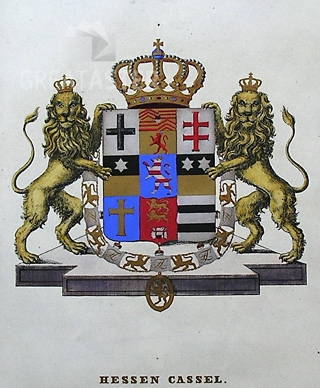
Kurfürstentum Hessen
The Electorate of Hesse was a state raised in 1803 by Napoleon from the Landgraviate of Hesse-Kassel. When the Holy Roman Empire was abolished in 1806, the Prince-elector chose to remain an Elector, even without an Empire. In 1807, with the Treaties of Tilsit the area was annexed to the Kingdom of Westphalia. The Congress of Vienna recovered it in 1814 with the previous title. It survived until 1866 as electorate inside the German Confederation, consisting of several detached masses of territory, to the north of Frankfurt. It contained a superficial area of 3699 square miles, and its population in 1864 was 745,063.
History of the Elecorate of Hesse-Kassel
The reign of the Landgrave William IX, was an important epoch in the history of Kassel. Ascending the throne in 1785, he took part in the War of the First Coalition against French First Republic a few years later, but in 1795 Peace of Basel was arranged. For the loss in 1801 of his possessions on the left bank of the Rhine he was in 1803 compensated with some former French territory round Mainz, and at the same time was raised to the dignity of Prince-elector (Kurfürst) William I.
In 1806 William I made a treaty of neutrality with Napoleon Bonaparte, but after the Battle of Jena-Auerstedt the latter, suspecting William’s designs, occupied his country, and expelled him. Hesse-Kassel was then incorporsted to the Kingdom of Westphalia ruled by Jérôme Bonaparte; but after the Battle of Leipzig in 1813 the French were driven out and on 21 November the Elector returned in triumph to his capital Kassel. A treaty concluded by him with the Coalition (2 December) stipulated that he was to receive back all his former territories, or their equivalent, and at the same time to restore the ancient constitution of his country. This treaty, so far as the territories were concerned, was carried out by the Great Powers at the Congress of Vienna. They refused, however, the Elector’s request to be recognized as “King of the Chatti” (Konig der Katten), a request which was again rejected at the Congress of Aix-la-Chapelle (1818). He therefore retained the now meaningless title of prince-elector, with the predicate of “royal highness”.
William I had marked his restoration by abolishing with a stroke of the pen all the reforms introduced under the French regime, repudiating the Westphalian debt and declaring null and void the sale of the crown domains. Everything was set back to its condition on 1 November 1806; even the officials had to descend to their former rank, and the army to revert to the old uniforms and powdered pigtails. The Estates (Parliament), indeed, were summoned in March 1815, but the attempt to devise a constitution broke down; their appeal to the Federal Assembly Bundesversammlung at Frankfurt to call the Elector to order in the matter of the debt and the domains came to nothing owing to the intervention of Klemens von Metternich; and in May 1816 they were dissolved, never to meet again.
William I died on 27 February 1821, and was succeeded by his son, William II. Under him the constitutional crisis in Kassel came to a head. He was arbitrary and avaricious like his father, and moreover shocked public sentiment by his treatment of his wife, a popular Prussian princess, and his relations with his mistress, one Emilie Ortlöpp, created countess of Reichenbach, whom he loaded with wealth. The July Revolution in Paris gave the signal for disturbances; William II was forced to summon the Estates; and on 6 January 1831 a constitution on the ordinary Liberal basis was signed. The elector now retired to Hanau, appointed his son Frederick William regent, and took no further part in public affairs.
Frederick William, without his father’s coarseness, had a full share of his arbitrary and avaricious temper. Constitutional restrictions were intolerable to him; and the consequent friction with the Diet (lower house) was aggravated when, in 1832, Hans Hassenpflug was placed at the head of the administration. The whole efforts of William II and his minister were directed to nullifying the constitutional control vested in the Diet; and the Opposition was fought by manipulating the elections, packing the judicial bench, and a vexatious and petty persecution of political “suspects”, and this policy continued after the retirement of Hassenpflug in 1837.
The situation that resulted issued in the revolutionary year 1848 in a general manifestation of public discontent; and Frederick William, who had become Elector on his father’s death (20 November 1847), was forced to dismiss his reactionary ministry and to agree to a comprehensive programme of democratic reform. This, however, was but short lived. After the breakdown of the Frankfort National Parliament, Frederick William joined the Prussian Northern Union, and deputies from Hesse-Kassel were sent to the Erfurt Parliament. But as Austria recovered strength, the Elector’s policy changed. On 23 February 1850 Hassenpflug was again placed at the head of the administration and threw himself with renewed zeal into the struggle against the constitution and into opposition to the Kingdom of Prussia. On 2 September the Diet was dissolved; the taxes were continued by electoral ordinance; and the country was placed under martial law. It was at once clear, however, that the Elector could not depend on his officers or troops, who remained faithful to their oath to the constitution. Hassenpflug persuaded the Elector to leave Kassel secretly with him, and on 15 October appealed for aid to the reconstituted federal diet, which willingly passed a decree of “intervention”. On the first of November an Austrian and Bavarian force marched into the electorate.
This was a direct challenge to Prussia, which under conventions with the elector had the right to the use of the military roads through Hesse that were her sole means of communication with her Rhine provinces. War seemed imminent; Prussian troops also entered the country, and shots were actually exchanged between the outposts. But Prussia was in no condition to take up the challenge; and the diplomatic contest that followed issued in the Austrian triumph at Olmütz (1851). Hesse was surrendered to the federal diet; the taxes were collected by the federal forces, and all officials who refused to recognize the new order were dismissed.
In March 1852 the federal diet abolished the constitution of 1831, together with the reforms of 1848, and in April issued a new provisional constitution. The new diet had, under this, very narrow powers; and the elector was free to carry out his policy of amassing money, forbidding the construction of railways and factories, and imposing strict orthodoxy on churches and schools. In 1855, however, Hassenpflug who had returned with the Elector was dismissed; and five years later, after a period of growing agitation, a new constitution was granted with the consent of the federal diet (30 May 1860). The new chambers, however, demanded the constitution of 1831; and, after several dissolutions which always resulted in the return of the same members, the federal diet decided to restore the constitution of 1831 (14 May 1862). This had been due to a threat of Prussian occupation; and it needed another such threat to persuade the Elector to reassemble the chambers, which he had dismissed at the first sign of opposition; and he revenged himself by refusing to transact any public business.
In 1866 the end came. The elector, Frederick William, full of grievances against Prussia, threw in his lot with Austria; the electorate was at once overrun with Prussian troops; Kassel was occupied (20 June); and the Elector was taken as a prisoner to Stettin. By the Peace of Prague Hesse-Kassel was annexed to Prussia. The elector Frederick William (d. 1875) had been, by the terms of the treaty of cession, guaranteed the entailed property of his house. This was, however, sequestered in 1868 owing to his intrigues against Prussia; part of the income was paid, however, to the eldest agnate, the landgrave Frederick (d. 1884), and part, together with certain castles and palaces, was assigned to the cadet lines of Philippsthal and Philippsthal-Barchfeld. Along with the annexed Duchy of Nassau and Free City of Frankfurt, Hesse-Kassel became part of the new Province of Hesse-Nassau of the Kingdom of Prussia.
In 1918, Hesse-Nassau became part of the Free State of Prussia until 1944. From 1944-45 as part of Nazi Germany, it was divided into the Prussian provinces of Kurhessen and Nassau. From 1945-46, it was renamed Greater Hesse (German: Großhessen) and was part of the US occupation zone in Germany. From 1946 onwards, it was reorganised into the State of Hesse, a federal state of West Germany. In 1918, Prince Frederick Charles of Hesse, younger brother of the head of the house and a brother-in-law of Emperor William II, was elected by the pro-German Finnish government to be King of Finland, but he never reigned. In 1968, the head of the House of Hesse-Kassel became the head of the entire House of Hesse due to the extinction of the House of Hesse-Darmstadt.
History of the House of Hesse
The House of Hesse is a European royal dynasty from the region of Hesse, originally and still formally the House of Brabant, The origins of the House of Hesse begin with the marriage of Sophie of Thuringia, daughter of Louis IV, Landgrave of Thuringia and Elizabeth of Hungary with Henry II, Duke of Brabant from the House of Reginar. Sophie was the heiress of Hesse which she passed on to her son, Henry upon her retention of the territory following her partial victory in the War of the Thuringian Succession in which she was one of the belligerents.
Originally the western part of the Landgraviate of Thuringia, in the mid 13th century it was inherited by the younger son of Henry II, Duke of Brabant, and became a distinct political entity. From the late 16th century it was generally divided into several branches, the most important of which were those of Hesse-Kassel (or Hesse-Cassel) and Hesse-Darmstadt. In the early 19th century the Landgrave of Hesse-Kassel was elevated to Elector of Hesse (1803), while the Landgrave of Hesse-Darmstadt became the Grand Duke of Hesse (1806), later Grand Duke of Hesse and by Rhine. Electoral Hesse (Hesse-Kassel) was annexed by Prussia in 1866, while Grand Ducal Hesse (Hesse-Darmstadt) as lasted until the end of the German monarchies in 1918. Moritz, Landgrave of Hesse is the current (2012) head of the house.
The Branches of the House of Hesse
Philip I, Landgrave of Hesse, died in 1567. Hesse was divided between his four sons, four new lines which arose: Hesse-Darmstadt, Hesse-Kassel, Hesse-Marburg and Hesse-Rheinfels. The line of Hesse-Darmstadt was also part of the morganatic line of the Battenberg family when Prince Alexander of Hesse and by Rhine married to Countess Julia Hauke. The Battenbergs who later settled in England changed that name to Mountbatten after World War I.
- House of Brabant
- Hesse (1264-1567)
- Hesse-Darmstadt (1567-1918), became Grand Duchy of Hesse in 1806
- Hesse-Butzbach (1609-1642)
- Hesse-Braubach (1609-1651)
- Hesse-Homburg (1622-1866)
- Hesse-Itter (1661-1676)
- Battenberg (1858, morganatic line. Mountbatten since 1917)
- Hesse-Kassel (1567-1866), became Electorate of Hesse in 1803
- Hesse-Rotenburg (1627-1834)
- Hesse-Wanfried (1627-1755)
- Hesse-Rheinfels (1627-1754)
- Hesse-Philippsthal (1685-1866)
- Hesse-Philippsthal-Barchfeld (1721-1866)
- Hesse-Marburg (1567, divided in 1604 between Hesse-Darmstadt and Hesse-Kassel)
- Hesse-Rheinfels (1567, divided in 1583 between Hesse-Darmstadt, Hesse-Kassel and Hesse-Marburg)
- Hesse-Darmstadt (1567-1918), became Grand Duchy of Hesse in 1806
- Hesse (1264-1567)
Hesse-Kassel and its junior lines were annexed by Prussia in 1866; Hesse-Darmstadt became the People’s State of Hesse when the monarchy was abolished in 1918. Hesse-Philippsthal died out in the male line in 1925; Hesse-Darmstadt in 1968. Descendants of Hesse-Kassel and Hesse-Philippsthal-Barchfeld are alive to this day.
The List of the Princes and Electors of Hesse-Kassel
Hesse-Kassel, 1567-1803
| Image | Name | Start term | End term | Note |
|---|---|---|---|---|
| William IV Wilhelm IV |
31 March 1567 | 25 August 1592 | eldest son of Philip the Magnanimous. Called “the Wise.” | |
| Maurice Moritz |
25 August 1592 | 17 March 1627 | ||
| William V Wilhelm V |
17 March 1627 | 21 September 1637 | ||
| William VI Wilhelm VI |
21 September 1637 | 16 July 1663 | ||
| William VII Wilhelm VII |
16 July 1663 | 21 November 1670 | ||
| Charles Karl |
21 November 1670 | 23 March 1730 | ||
| Frederick I Friedrich I |
23 March 1730 | 25 March 1751 | also King of Sweden from 1720. Hesse-Kassel under the regency of his brother, William, later Landgrave William VIII. | |
| William VIII Wilhelm VIII |
25 March 1751 | 1 February 1760 | brother of Frederick I; already regent from 1730 | |
| Frederick II Friedrich II |
1 February 1760 | 31 October 1785 | ||
| William IX Wilhelm IX |
31 October 1785 | 15 May 1803 | created Prince-elector of Hesse as His Royal and Serene Highness William I in 1803. |
Electors of Hesse (-Kassel), 1803-1866
| Image | Name | Start term | End term | Note |
|---|---|---|---|---|
| William I Wilhelm I |
15 May 1803 | 28 August 1807 | previously Landgrave of Hesse-Kassel as William IX; deposed | |
| to the Kingdom of Westphalia, 1807-1813 | ||||
| William I Wilhelm I |
30 October 1813 | 27 February 1821 | restored | |
| William II Wilhelm II |
27 February 1821 | 20 November 1847 | His son Frederick William acted as regent from 30 September 1831 | |
| Frederick William Friedrich Wilhelm |
20 November 1847 | 20 September 1866 | regent for his father from 30 September 1831. The electorate was annexed by Prussia in 1866 | |
Hesse-Kassel since 1866
- Frederick William I, the former Elector, 1866-1875
- Landgrave Frederick William II of Hesse-Kassel, 1875-1884, son of Prince William of Hesse-Kassel.
- Landgrave Frederick William III of Hesse, 1884-1888
- Landgrave Alexander Frederick, 1888-1925 (abdicated, d. 1945)
- Landgrave Frederick Charles, 1925-1940, elected King of Finland with the name Fredrik Kaarle I in 1918 but renounced the throne the same year
- Landgrave Philip, 1940-1980
- Moritz, Landgrave of Hesse (born 1926), 1980-present
The Family Titles and Styles
The present members of this line of the family bear the title Prince Princess of Hesse, together with the formal appellation of His or Her Highness, except the head and his heir hold the formal appellation of Royal Highness.
The Genealogy of the Princely House
FRIEDRICH II, Landgrave of Hesse-Kassel on the death of his father 1 Feb 1760 (Kassel 14 Aug 1720-Schloß Weissenstein 31 Oct 1785); m.1st Kassel 28 Jun 1740 Mary Pss of Great Britain, Ireland and Hannover (Leicester House 22 Feb 1723-Hanau 14 Jan 1772); m.2d Berlin 10 Jan 1773 Philippine Margravine of Brandenburg-Schwedt (Schwedt 10 Oct 1745-Berlin 1 May 1800)
- 1a) Wilhelm (Kassel 25 Dec 1741-Kassel 1 Jul 1742)
- 2a) Wilhelm IX, Landgrave of Hesse-Kassel, Elector WILHELM I of Hesse 1803 (Kassel 3 Jun 1743-Kassel 27 Feb 1821); m. Copenhagen 1 Sep 1764 Pss Caroline of Denmark (Copenhagen 10 Jul 1747-Kassel 14 Jan 1820)
- 1b) Marie Friederike (Hanau 14 Sep 1768-Hanau 17 Apr 1839); m. Kassel 29 Nov 1794 (div 1817) Alexis Pr von Anhalt-Bernburg (Ballenstedt 12 Jun 1767-Ballenstedt 24 Mar 1834)
- 2b) Karoline Amalie (Hanau 11 Jul 1771-Gotha 22 Feb 1848); m. Kassel 24 Apr 1802 Duke August of Saxe-Gotha (Gotha 23 Nov 1772-Gotha 27 May 1822)
- 3b) Friedrich (Hanau 8 Aug 1772-Hanau 20 Jul 1784)
- 4b) WILHELM II, Elector of Hesse (Hanau 28 Jul 1777-Frankfurt 20 Nov 1847); m.1st Berlin 13 Feb 1797 Auguste Pss of Prussia (Potsdam 1 May 1780-Kassel 19 Feb 1841); m.2d (morganatically) Schloß Bisenz, Moravia 8 Jul 1841 Emilie Ortlöpp, cr 1821 “Gfn von Reichenbach-Lessonitz” (Berlin 13 May 1791-Frankfurt 12 Feb 1843); there were 8 children born of this marriage before the marriage itself occurred, and they were apparently subsequently legitimated; these children of the second marriage bore the title Graf/Gräfin von Reichenbach-Lessonitz; m.3d (morganatically) Wilhelmsbad 28 Aug 1843 Caroline Frn von Berlepsch, cr Frfrau von Bergen 1844 and Gfn von Bergen 1846 (Hersfeld 9 Jan 1820-Knauthayn 21 Feb 1877)
- 1c) Wilhelm Friedrich Karl Ludwig (Hanau 9 Apr 1798-Hanau 25 Oct 1802)
- 2c) Karoline Friederike Wilhelmine (Philippsruhe 29 Jul 1799-Kassel 28 Nov 1854)
- 3c) Luise Friederike (Hanau 3 Apr 1801-Philippsruhe 28 Sep 1803)
- 4c) FRIEDRICH WILHELM, Elector of Hesse (Philippsruhe 20 Aug 1802-Prague 6 Jun 1875); m.(morganatically) Rellingshausen 26 Jun 1831 Gertrud Falkenstein, cr Gfn von Schaumburg 1831 and Pss von Hanau und zu Horowitz (Serene Highness) 1862 (Bonn 18 May 1803-Prague 9 Jul 1882); their issue bore the titles Prince[ss] von Hanau u.zu Horowitz, Graf/Gräfin von Schaumburg; the head of this line was Fst von Hanau, but the eldest son, Friedrich Wilhelm, and his issue were bypassed until all other sons and their issue male had died
- 1d) Pss Auguste Marie Gertrud (Niederdorfelden 21 Sep 1829-Halle an der Saale 18 Sep 1887); m. Wilhelmshohe 17 Jul 1849 Ferdinand Maximilian III Fst zu Isenburg-Büdingen in Wächtersbach (Wächtersbach 24 Oct 1824-Wächtersbach 5 Jun 1903)
- 2d) Pss Alexandrine Friederike Wilhelmine (Fulda 22 Dec 1830-Lindau 20 Dec 1871); m. Kassel 12 Jun 1851 Felix Pr zu Hohenlohe-Oehringen (Oehringen 1 Mar 1818-Asnières 8 Sep 1900)
- 3d) Pr Friedrich Wilhelm von Hanau (Schloß Wilhelmshöhe 18 Nov 1832-Horowitz 14 May 1889); m.1st London 23 Sep 1856 (div) Auguste Birnbaum (Kassel 9 Nov 1837-Cannstatt 29 Jun 1862); m.2d Vienna 8 Apr 1875 Ludowika Gloede (Hamburg 6 May 1840-Munich 20 Apr 1912)
- 1e) Pr Friedrich August (Wiesbaden 14 Apr 1864-Brünn 26 Apr 1940); m.1st Vienna 6 Jul 1899 (div 1922) Hildegard Gfn Almásy de Zsadány et Török-Szent-Miklós (Zsadány, Hungary 10 Mar 1879-Augsburg 1 Feb 1933); m.2d Munich 12 Dec 1932 Christine-Ernestine Detzer (Munich 29 Jan 1894-Munich 10 Jan 1978)
- 1f) Friedrich Wilhelm Tassilo Ludwig Hubertus Heinrich, succeeded Fst Heinrich (d.1917) as 5th Fst von Hanau (Söcking bei Starnberg 27 Dec 1900-Munich 12 Oct 1971); m. Babenhausen 1 Aug 1921 Maria Theresia Gfn Fugger von Babenhausen (Vienna 1 Mar 1899-Starnberg 28 Jun 1994)
- 1g) Friedrich Wilhelm Karl Heinrich Fst von Hanau (Vienna 27 Apr 1923-Starnberg 16 Feb 1998); m. Friedberg bei Volders, Tyrol 15 Jun 1948 Maria Antonia Gfn Strachwitz von Gross-Zauche und Camminetz (Baden bei Wien 3 Sep 1922-Percha 17 Nov 2005)
- 1h) Pss Franziska Elisabeth Maria Antonia (b. Munich 27 Oct 1954); m.1st Söcking bei Starnberg 5 Oct 1974 (div 1986) Rupert Gf Strachwitz von Gross-Zauche und Camminetz (b. Luzern 30 Apr 1947); m.2d London 14 Mar 1988 (div 1996) John Scarisbrick (b. Rome 3 Nov 1948)
- 2h) Friedrich Wilhelm Philipp Georg Heinrich Jakob Fst von Hanau (b. Munich 26 Jun 1959); m. Aufkirchen 30 May 1987 Julia Schelkopf (b. Munich 15 Sep 1962)
- 1i) Pr Tassilo Hubertus Heinrich Antonius (b. Starnberg 8 Nov 1987)
- 2i) Pss Philippa Maria Theresia (b. Starnberg 15 Jan 1989)
- 3i) Pr Thaddäus Carl Heinrich (b. Starnberg 16 Jun 1995)
- 2g) Pr Friedrich Wilhelm Ferdinand Leopold Tassilo (Vienna 7 May 1924-Vienna 11 May 1997); m. Vienna 17 Dec 1949 Marie Alice Frn von Loudon (Bistritz am Hostein, Moravia 7 Jul 1919-Vienna 20 May 1985)
- 1h) Pss Friederike Wilhelmine Elisabeth Viktoria Maria (b. Vienna 23 Dec 1953); m. Vienna 16 May 1981 Manfred Leo Ritter Mautner von Markhof (b. Vienna 2 Sep 1952)
- 2h) Pr Friedrich Wilhelm Heinrich Antonius (b. Vienna 28 Feb 1956); m. Las Vegas, NV 8 Aug 1980 (div 1988) Bianca Kyd von Rebenburg (b. Graz 24 Mar 1953)
- 1i) Pss Marie Sophie Bianca Johanna Theresa Marie Alice (b. Marbella, Spain 19 Jun 1981)
- 3g) Pss Eleonore Marie Elisabeth Hildegarde (Horowitz 16 May 1925-Hamburg 13 Apr 1997); m.1st Hinterhör 15 Jan 1946 (div 1954) Bela Spanyi (Klagenfurt 23 Feb 1921-Hinterstoder, Austria 14 Feb 1997); m.2d Munich 26 May 1959 (div 1976) Herbert Joost (Hamburg 30 Apr 1908-Hamburg 16 Nov 2001)
- 4g) Pr Friedrich Wilhelm (b. Horowitz 3 Dec 1927); m. San Antonio, Texas 5 Jun 1954 Maria von Kossaczky (b. Budapest 9 Dec 1924)
- 1h) Pr Friedrich Wilhelm Heinrich Christoph (b. San Antonio 5 Jun 1956); m. Riverside 13 Jun 1987 Candace McDonnell (b. Zürich 26 Oct 1954)
- 1i) Pss Victoria Marie Therese (b. New York 1 May 1990)
- 2i) Pr Friedrich Wilhelm Maximilian Kenneth (b. New York 3 Jul 1993)
- 2f) Pr Tassilo Karl Friedrich Wilhelm Antonius Hubertus (Söcking 21 Dec 1901-k.in air crash at Klecany, nr Prague 16 May 1932)
- 3f) Pss Hildegard Marie Ludovika Mathilde Anna (Söcking bei Starnberg 12 Mar 1903-Munich 12 Apr 1990); m.1st Salzburg 10 Jan 1922 (div 1928) Karl Max Gf von Sandizell (Sandizell 4 Oct 1895-Sandizell 21 May 1962); m.2d Munich 22 Jun 1928 (div 1941) Wulf-Diether Gf zu Castell-Rüdenhausen (Berlin 20 Nov 1905-Munich 1 Jul 1980)
- 4f) Pss Emmerentiana Philippine Ernestine Anna Marie (Munich 22 Apr 1913-Tutzing 8 Sep 1986); m. Horowitz 5 Oct 1933 LudwigGf von Montgelas (Munich 15 Dec 1907-Mühldorf 12 Nov 1982)
- 2e) Pr Ludwig Cäcilius Felix (Hamburg 19 May 1872-Munich 8 Jan 1940)
- 4d) Moritz Philipp Heinrich Fst von Hanau (Schloß Wilhelmshöhe 4 May 1834-Horowitz 30 Mar 1889); m. Freiburg 15 Apr 1875 Anne von Lossberg (Kassel 14 Aug 1829-Horowitz 27 Oct 1876)
- 5d) Wilhelm 2nd Fst von Hanau (Kassel 19 Dec 1836-Horowitz 3 Jun 1902); m.1st Frankfurt 30 Jan 1866 (div 1868) Pss Elisabeth zuSchaumburg-Lippe (Bückeburg 5 Mar 1841-Wiesbaden 30 Nov 1926); m.2d Doberitz 12 May 1890 Elisabeth Gfn zur Lippe-Weissenfeld (Dresden 1 Jul 1868-Schweinfurt 24 Oct 1952)
- 6d) Pss Marie Auguste von Hanau, cr Pss von Ardeck 28 Jul 1876 (Wilhelmshöhe 22 Aug 1839-Bonn 26 Mar 1917); m. Kassel 27 Dec 1857 (div 1872) Pr Wilhelm Hesse-Philippsthal-Barchfeld (Burgsteinfurt 3 Oct 1831-Rotenburg 17 Jan 1890)
- 7d) Karl 3rd Fst von Hanau (Kassel 29 Nov 1840-Kassel 27 Jan 1905); m. Hannover 11 Nov 1882 Hermine Gfn Grote (Hannover 8 Oct 1859-Münchhagen 31 Mar 1939)
- 8d) Friedrich Wilhelm Heinrich Ludwig 4th Fst von Hanau (Kassel 8 Dec 1842-Prague 15 Jul 1917); m. Prague 5 Jun 1917 Martha Riegel (Bischofsburg, East Prussia 26 Oct 1876-Prague 10 Mar 1943)
- 9d) Pr Friedrich Wilhelm Philipp (Kassel 29 Dec 1844-Oberurf 28 Aug 1914); m. Vienna 29 Mar 1875 Albertine Hubatschek-Stauber (Semlin 7 Dec 1840-Gratsch nr Meran 11 Apr 1912); their children were “Grafen von Schaumburg”
- 1e) Philipp Gf von Schaumburg (Purkersdorf 17 Apr 1868-Berlin 19 Sep 1890)
- 2e) Friedrich Wilhelm August Gf von Schaumburg (Eaux Vives, nr Geneva 18 Dec 1875-Leipzig 26 Dec 1898)
- 3e) Karl August Friedrich Felix Gf von Schaumburg (Oberurf 10 Aug 1878-Lehrbach 2 Dec 1905); m. Oberurf 28 Sep 1901 Anna von Trott zu Solz (Diez 27 Dec 1870-Zimmersrode 15 Oct 1942)
- 1f) Albertine Gfn von Schaumburg (Lehrbach 23 Aug 1902-Höchst-am-Main 29 Aug 1935); m. Oberurf 16 Sep 1922 Edwin Gf von Rothkirch und Trach (Militsch 1 Nov 1888-Rettershof 29 Jul 1980)
- 2f) Marie Luise Gfn von Schaumburg (Lehrbach 17 Dec 1903-30 Jun 1975); m. Oberurff 2 Jun 1927 Hans Treusch Frhr von Buttlar-Brandenfels (Berlin 5 May 1885-Oberurff 29 Jul 1946); note: I received this information from a correspondent: “I have recently visited the village Oberurff (with double f !) in Northern Hesse and took the chance also to visit the graveyard…. I did find one grave in the field of the Counts of Schaumburg were obviously the following person was buried: Marie Luise Gfn von Schaumburg (b. Lehrbach 17 Dec 1903). The gravestone gave as the date of her death the following information: 30th June 1975. Her husbands date of death was given as 29th July 1946 (and not the 27th as noted on your file).”
- 5c) Marie Friederike Wilhelmine Christine (Kassel 6 Sep 1804-Meiningen 1 Jan 1888); m. Kassel 23 Mar 1825 Duke Bernhard II of Saxe-Meiningen (Meiningen 17 Dec 1800-Meiningen 3 Dec 1882)
- 6c) Friedrich Wilhelm Ferdinand (Berlin 9 Oct 1806-Berlin 21 Nov 1806)
- 7c) Luise Wilhelmine Emilie Gfn von Reichenbach-Lessonitz (Berlin 26 Feb 1813-Baden-Baden 3 Oct 1883); m. Baden-Baden 15 May 1845 Karl Gf von Bose (7 Nov 1814-Baden-Baden 25 Dec 1887)
- 8c) Julius Wilhelm Albrecht Gf von Reichenbach-Lessonitz (Kassel 4 Oct 1815-Kassel 15 Jan 1822)
- 9c) Amalie Wilhelmine Emilie Gfn von Reichenbach-Lessonitz (Kassel 21 Dec 1816-Dresden 28 Dec 1858); m.1st Dresden 3 Oct 1836 (div) Wilhelm Gf von Luckner (29 Jan 1805-19 Feb 1865); m.2d Dresden 7 Apr 1840 Karl Frhr von Watzdorf (Dresden 9 Mar 1807-Dresden 5 Dec 1846); m.3d 21 Dec 1847 her 1st husband
- 10c) Gustav Karl Gf von Reichenbach-Lessonitz (Kassel 24 Aug 1818-Prague 26 Sep 1861); m. Prague 20 Dec 1861 Clementine Richter (Prague 28 Aug 1840-Bad Ischl 13 Jul 1908)
- 11c) Emilie Gfn von Reichenbach-Lessonitz (Kassel 8 Jun 1820-Budapest 30 Jan 1891); m.10 Mar 1839 Felix Gf Zichy-Ferraris (20 Nov 1810-8 Sep 1885)
- 12c) Friederike Gfn von Reichenbach-Lessonitz (Kassel 16 Dec 1821-Weilburg 23 Feb 1898); m.3 Nov 1841 Wilhelm Frhr von Dungern (Weilburg 20 Jun 1809-Wildbad 3 Jul 1874)
- 13c) Wilhelm Gf von Reichenbach-Lessonitz (Kassel 29 Jun 1824-Neufchâtel, Switzerland 19 Jan 1866); m. Karlsruhe 19 Mar 1857 Helene Amelie Frn Goeler von Ravensburg (Karlsruhe 27 Apr 1838-Frankfurt 14 Mar 1912)
- 1d) Pauline Victoria Caroline Wilhelmine Emilie Gfn von Reichenbach-Lessonitz (Frankfurt 6 May 1858-Langenzell 21 Oct 1927); m. Frankfurt 9 Feb 1880 Alfred Fst zu Löwenstein-Wertheim-Freudenberg (Siebleben 19 Oct 1855-Langenzell 20 Apr 1925)
- 2d) Karoline Amalie Gfn von Reichenbach-Lessonitz (Frankfurt 23 May 1860-Stuttgart 28 Apr 1874)
- 14c) Helene Gfn von Reichenbach-Lessonitz (Wilhelmshöhe 8 Aug 1825-Munich 14 Mar 1898); m. Dresden Jan 1843 Oswald Frhr von Fabrice (Bonn 8 Jan 1820-Munich 3 Jun 1898)
- 3a) Karl (Kassel 19 Dec 1744-Luisenlund 17 Aug 1836); m. Copenhagen 30 Aug 1766 Pss Lovisa of Denmark (Christiansborg 30 Jan 1750-Gottorp 12 Jan 1831)
- 1b) Marie Sophie Friederike (Hanau 28 Oct 1767-Copenhagen 21 Mar 1852); m. Gottorp 31 Jul 1790 King Frederik VI of Denmark (Copenhagen 28 Jan 1768-Copenhagen 3 Dec 1839)
- 2b) Wilhelm (Hanau 26 Jan 1769-Hanau 14 Jul 1772)
- 3b) Friedrich (Gottorp 24 May 1771-Panker 24 Feb 1845); m.in Norway 21 May 1813 Klara von Brockdorff (Rohlstorff 16 Jan 1778-Rendsborg 24 Aug 1836)
- 4b) Juliane Luise Amalie (Copenhagen 19 Jan 1773-Itzehoe 11 Mar 1860)
- 5b) Christian (Gottorp 14 Aug 1776-Odense 14 Nov 1814)
- 6b) Luise Caroline (Gottorp 28 Sep 1789-Ballenstedt 13 Mar 1867); m. Gottorp 28 Jan 1810 Duke Wilhelm of Schleswig-Holstein-Glücksburg (Lindenau, nr Königsberg 4 Jan 1785-Gottorp 27 Feb 1831)
- 4a) Friedrich (Kassel 11 Sep 1747-Frankfurt 20 May 1837); m. Biebrich 2 Dec 1786 Pss Karoline of Nassau-Usingen (Biebrich 4 Apr 1762-Schloß Rumpenheim 17 Aug 1823)
- 1b) Wilhelm (Biebrich 24 Dec 1787-Copenhagen 5 Sep 1867); m. Copenhagen 10 Nov 1810 Charlotte Pss of Denmark (Copenhagen 30 Oct 1789-Copenhagen 28 Mar 1864)
- 1c) Karoline Friederike Marie Wilhelmine (Copenhagen 15 Aug 1811-Copenhagen 10 May 1829)
- 2c) Marie Luise Charlotte (Copenhagen 9 May 1814-Schloß Hohenberg 28 Jul 1895); m. Schloß Rumpenheim 11 Sep 1832 Friedrich Pr of Anhalt-Dessau (Dessau 23 Sep 1799-Dessau 4 Dec 1864)
- 3c) Luise Wilhelmine Friederike Caroline Auguste Julie (Kassel 7 Sep 1817-Bernstorff 29 Sep 1898); m. Amalienborg 26 May 1842 King Christian IX of Denmark (Gottorp 8 Apr 1818-Amalienborg 29 Jan 1906)
- 4c) FRIEDRICH Wilhelm Georg Adolf, Landgrave of Hesse (Kassel 26 Nov 1820-Frankfurt 14 Oct 1884); m.1st St. Petersburg 28 Jan 1844 Alexandra Grand Dss of Russia (St. Petersburg 24 Jun 1825-Tsarskoie Selo 10 Aug 1844); m.2d Charlottenburg 16 May 1853 Anne Pss of Prussia (Berlin 17 May 1836-Frankfurt 12 Jun 1918)
- 1d) Wilhelm (b.and d. Tsarskoie Selo 10 Aug 1844)
- 2d) FRIEDRICH WILHELM Nikolaus Karl (Copenhagen 15 Oct 1854-d.at sea en route from Batavia to Singapore 14 Oct 1888)
- 3d) Elisabeth Alexandra Maria Charlotte Luise (Copenhagen 13 Jun 1861-Dessau 1 Jan 1955); m. Philippsruhe 26 May 1884 Pr Leopold of Anhalt-Dessau (Dessau 18 Jul 1855-Cannes 2 Feb 1886)
- 4d) ALEXANDER FRIEDRICH Wilhelm Albrecht Georg; he renounced his rights as head of the Electoral House of Hesse 15 Mar 1925 (Copenhagen 25 Jan 1863-Fronhausen an der Lahn 26 Mar 1945); m. Frankfurt 25 Mar 1925 Gisela Frn Stockhorner von Starein (Mannheim 17 Jan 1884-Freiburg im Breisgau 22 Jun 1965)
- 5d) FRIEDRICH KARL Ludwig Konstantin, Landgrave of Hesse, head of the Electoral House of Hesse from 15 Mar 1925 (Schloß Panker, Holstein 1 May 1868-Kassel 28 May 1940); m. Berlin 25 Jan 1893 Margarethe Pss of Prussia (Neues Palais, nr Potsdam 22 Apr 1872-Schönberg bei Kronberg, Taunus 22 Jan 1954)
- 1e) Friedrich Wilhelm Sigismund Viktor (Frankfurt 23 Nov 1893-k.a. Kara Orman, Romania 12/13 Sep 1916)
- 2e) Maximilian Friedrich Wilhelm Georg Eduard (Schloß Rumpenheim 20 Oct 1894-k.a. St. Jean-Chapelle 13 Oct 1914)
- 3e) PHILIPP, Landgrave of Hesse, became head of all the House of Hesse 30 May 1968 (Schloß Rumpenheim 6 Nov 1896-Rome 25 Oct 1980); m. Racconigi 23 Sep 1925 Mafalda Pss of Savoy (Rome 19 Nov 1902-d.in Buchenwald concentration camp 28 Aug 1944)
- 1f) MORITZ Friedrich Karl Emmanuel Humbert, Landgrave of Hesse, b. Racconigi 6 Aug 1926; m. Kronberg (civ) 1 Jun 1964 (rel) 3 Jun 1964 (div 1974) Tatiana Pss zu Sayn-Wittgenstein-Berleburg (b. Gießen 31 Jul 1940)
- 1g) Mafalda Margarethe, b. Kiel 6 Jul 1965; m.1st Kronberg 6 Jul 1989 (div 1991) Enrico dei Conti Marone Cinzano (b. Turin 5 Apr 1963); m.2d Lütjenburg 19 Dec 1991 (div 1999) Carlo Galdo (b. Naples 26 Mar 1954); m.3d Rome 14 Jul 2000 (rel) Palazzo Grotta Pallotta 28 Sep 2000 Ferdinando dei Conti Brachetti-Peretti (b. Rome 13 Jan 1960)
- 2g) Heinrich Donatus Philipp Umberto, Hereditary Pr of Hesse, b. Kiel 17 Oct 1966; m. Wiesbaden 25 Apr 2003 (rel) Kronberg 17 May 2003 Floria-Franziska Gfn von Faber-Castell (b. Düsseldorf 14 Oct 1974)
- 1h) Paulina Elisabeth Adelheid Tatiana Suzanne, b. Frankfurt 26 Mar 2007
- 2h) Moritz Ludwig Georg Wolf, b. Frankfurt 26 Mar 2007
- 3g) Elena Elisabeth Madeleine, b. Kiel 8 Nov 1967
- 4g) Philipp Robin, b. Kiel 17 Sep 1970; m. Hamburg 5 May 2006 (rel) Panker 10 Jun 2006 Laetitia Bechtolf (b. Wedel 5 May 1978)
- 1h) Elena Margherita Lotti Christiane Elizabeth, b. Hamburg 5 Dec 2006
- 2h) Tito Friedrich Hans Andreas Alnwick (b. Hamburg 24 Aug 2008)
- 2f) Heinrich Wilhelm Konstantin Victor Franz (Rome 30 Oct 1927-Langen, Hessen 18 Nov 1999)
- 3f) Otto Adolf (Rome 3 Jun 1937-Hannover 3 Jan 1998); m.1st (morganatically) (civ) Munich 5 Apr 1965 (rel) Trostberg, Upper Bavaria 6 Apr 1965 (div 1969) Angela von Doering (Goslar 12 Aug 1940-Hannover 11 Apr 1991); m.2d (morganatically) Latrup-Matrum 28 Dec 1988 (div 1994) Elisabeth Bönker (b. Rumburg, Czechoslovakia 31 Jan 1944)
- 4f) Elisabeth Margarethe Elena Johanna Maria Jolanda Polyxene, b. Rome 8 Oct 1940; m. Frankfurt (civ) 26 Feb 1962 (rel) 28 Feb 1962 Friedrich Carl Gf von Oppersdorff (Oberglogau 30 Jan 1925-Gravenbruch 11 Jan 1985)
- 4e) Wolfgang Moritz (Schloß Rumpenheim 6 Nov 1896-Kronberg, Taunus 12 Jul 1989); m.1st Salem 17 Sep 1924 Marie Alexandra Pss of Baden (Salem 1 Aug 1902-k.in air raid at Frankfurt 29 Jan 1944); m.2d Frankfurt 7 Sep 1948 Ottilie Moeller (Frankfurt 24 Jun 1903-Kronberg 4 Nov 1991)
- 5e) Richard Wilhelm Leopold (Frankfurt 14 May 1901-Frankfurt 11 Feb 1969)
- 6e) Christoph Ernst August (Frankfurt 14 May 1901-k.a.in the Apennines 7 Oct 1943); m. Kronberg 15 Dec 1930 Sophie Pss of Greece and Denmark (Corfu 26 Jun 1914-Neuhaus bei Schliersee 24 Nov 2001)
- 1f) Christina Margarethe (Kronberg 10 Jan 1933-Gersau 21 Nov 2011); m.1st Kronberg 2 Aug 1956 (div 1962) Andreas Pr of Yugoslavia (Veldes, Krain 28 Jun 1929-Irvine, California 7 May 1990); m.2d London 3 Dec 1962 (div 1986) Robert van Eyck (The Hague 3 May 1916-Ashford 19 Dec 1991)
- 2f) Dorothea Charlotte Karin, b. Schloß Panker 24 Jul 1934; m.(civ) Schliersee, Upper Bavaria 31 Mar 1959 (rel) Munich 1 Apr 1959 Friedrich Pr zu Windisch-Grätz (Heiligenberg, Baden 7 Jul 1917-Gersau 29 May 2002)
- 3f) Karl Adolf Andreas, b. Berlin 26 Mar 1937; m. The Hague (civ) 26 Mar 1966 (rel) 18 Apr 1966 Yvonne Gfn Szapáry von Muraszombath, Széchysziget u. Szapár (b. Budapest 4 Apr 1944)
- 1g) Christoph, b. Munich 18 Jun 1969
- 2g) Irina Verena, b. Munich 1 Apr 1971; m.(civ) Berlin 30 Apr 1999 (rel) Heusenstamm 29 May 1999 Alexander Gf von Schönburg-Glauchau (b. Mogadishu, Somalia 15 Aug 1969)
- 4f) Rainer Christoph Friedrich, b. Kronberg 18 Nov 1939
- 5f) Clarissa Alice, b. Kronberg 6 Feb 1944; m. Paris 20 Jul 1971 (div 1976) Claude Jean Derrien (b. Boulogne-sur-Seine 12 Mar 1948)
- 6d) Marie Polyxene Olga Viktoria Dagmar Anna (Schloß Panker 29 Apr 1872-Kiel 16 Aug 1882)
- 7d) Sibylle Margaretha Christa Thyra Hedwig Catharina (Schloß Panker 3 Jun 1877-Wiesbaden 11 Feb 1953); m. Frankfurt 3 Sep 1898 (div 1923) Friedrich Frhr von Vincke (Zeesen 24 Jul 1867-Wiesbaden 31 Dec 1925)
- 5c) Auguste Sophie Friederike Marie Caroline Julie (Copenhagen 30 Oct 1823-Copenhagen 17 Jul 1889); m. Schloß Panker 28 May 1854 Baron Karl Friedrich von Blixen-Fineke (Dallund 15 Aug 1822-Baden-Baden 6 Jan 1873)
- 6c) Sophie (Copenhagen 18 Jan 1827-Copenhagen 20 Dec 1827)
- 2b) Karl Friedrich (Maastricht 8 Mar 1789-Schloß Rumpenheim 10 Sep 1802)
- 3b) Friedrich Wilhelm (Maastricht 24 Apr 1790-Schloß Rumpenheim 25 Oct 1876)
- 4b) Ludwig Karl (Biebrich 12 Nov 1791-Schloß Rumpenheim 12 May 1800)
- 5b) Georg Karl (Maastricht 14 Jan 1793-Frankfurt 4 Mar 1881)
- 6b) Luise Caroline Marie Friederike (Maastricht 9 Apr 1794-Frankfurt 16 Mar 1881); m. Gotha 4 Apr 1833 Georg Frhr von der Decken (23 Nov 1787-Schloß Rumpenheim 20 Aug 1859)
- 7b) Marie Wilhelmine Friederike (Hanau 21 Jan 1796-Neustrelitz 30 Dec 1880); m. Kassel 12 Aug 1817 Georg, Grand Duke of Mecklenburg-Strelitz (Hannover 12 Aug 1779-Schweizerhaus, nr Neustrelitz 6 Sep 1860)
- 8b) Augusta Wilhelmine Luise (Schloß Rumpenheim 25 Jul 1797-St. James’ Palace 6 Apr 1889); m. Kassel 7 May 1818 and at the Queen’s House, St. James’s, 1 Jun 1818 Adolphus Pr of Great Britain, Ireland and Hannover, Duke of Cambridge (Buckingham House 24 Feb 1774-Cambridge House 8 Jul 1850)
- Landgraviate of Hesse-Kassel