
Formerly Sovereign House
Duchy of Courland and Semigallia – House of Biron
Duchy of Courland and Semigallia – House of Biron
- Jurisdiction
- Courland and Semigallia
- Dynasty
- House of Biron
- Entry type
- House
- Editorial status
- Reviewed - Verified

Herzogtum Kurland und Semgallen
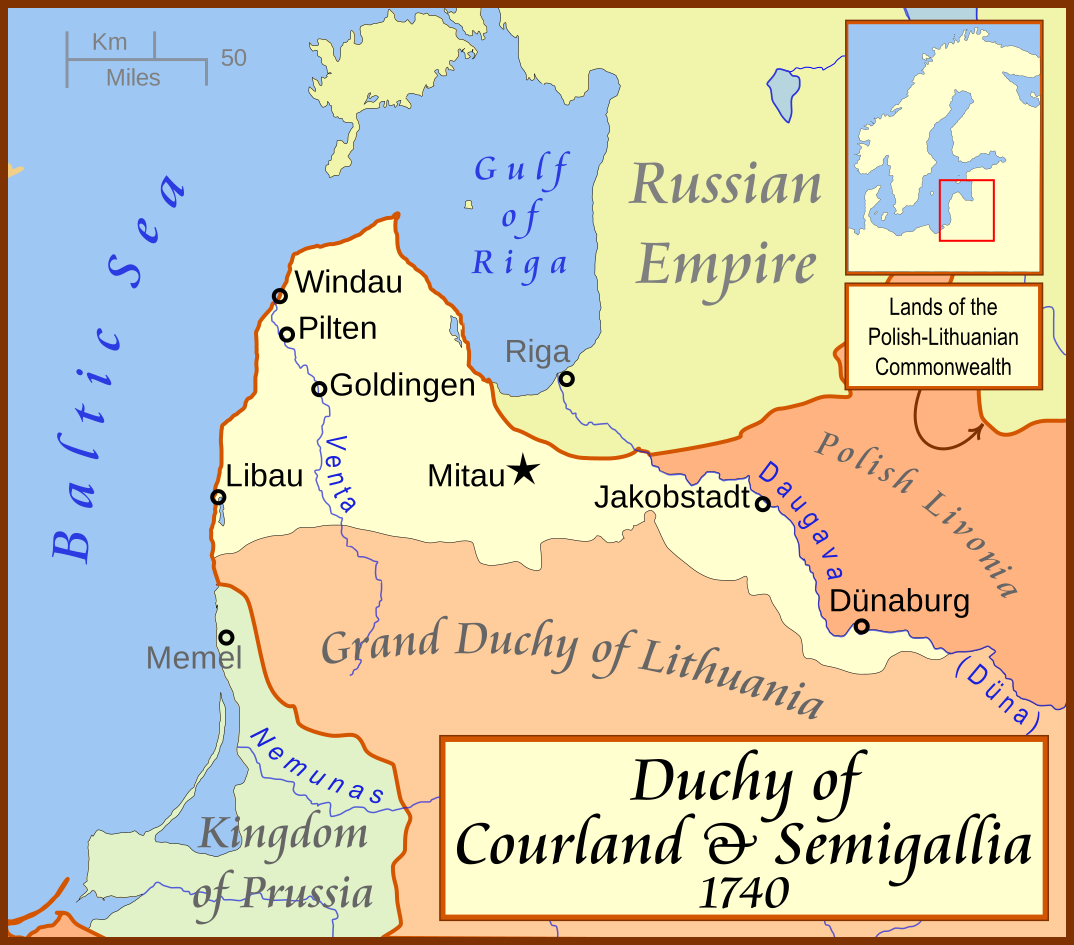
The Duchy of Courland and Semigallia (Latin: Ducatus Curlandiæ et Semigalliæ, Polish: Księstwo Kurlandii i Semigalii, German: Herzogtum Kurland und Semgallen, Latvian: Kurzemes un Zemgales hercogiste) is the name of a duchy in the Baltic region that existed from 1562 to 1569 as a vassal state of the Grand Duchy of Lithuania and from 1569 to 1726 the Polish-Lithuanian Commonwealth, incorporated into Polish-Lithuanian Commonwealth by Sejm in 1726, but on March 28, 1795, it was annexed by the Russian Empire in the third Partition of Poland. The name was also given to a short-lived wartime state existing from March 8 to September 22, 1918. Plans for it to become part of the United Baltic Duchy, subject to the German Empire, were thwarted by Germany’s surrender of the Baltic region at the end of the First World War. The area became a part of Latvia at the end of World War I
History of Courland
In 1562, during the Livonian Wars, the Livonian Confederation was dismembered and the Livonian Brothers of the Sword, an order of German knights, was disbanded. On the basis of the Vilnius Pact, the southern part of Estonia and the northern part of Latvia were ceded to the Grand Duchy of Lithuania and formed into the Ducatus Ultradunensis (Pārdaugavas hercogiste). The part of Latvia between the west bank of the Daugava River and the Baltic Sea became the Duchy of Courland and Semigallia, nominally a vassal state of the King of Poland.
Gotthard Kettler, the last Master of the Order of Livonia, became the first duke of Courland. Other members of the Order became the Courland nobility, with the fiefdoms they had hitherto held becoming their estates. In all, Kettler received nearly one-third of the land in the new duchy. Mitau (Jelgava) was designated as the new capital and a Diet was to meet there twice a year.
Several parts of the Courland area did not belong to the Duchy. The Order of Livonia had already loaned the Grobiņa district (on the coast of Baltic Sea) to the Duke of Prussia. Another district, the Bishopric of Piltene, also called the “Bishopric of Courland” (on the Venta River in western Courland), belonged to Magnus, son of the king of Denmark. He promised to transfer it to the Duchy of Courland after his death, but this plan failed and only later did Wilhelm Kettler regain this district.
Like the other members of the Order, Kettler was German and set about establishing the Duchy along the lines of similar German states. In 1570, he issued the Privilegnum Gotthardinum, which allowed the landholders to enserf the native peasantry on their lands.
When Gotthard Kettler died in 1587, his sons, Friedrich and Wilhelm, became the dukes of Courland. They divided the Duchy into two parts in 1596. Friedrich controlled the eastern part, Semigalia (Zemgale), with his residence in Jelgava (Mitau). Wilhelm owned the western part, Courland (Kurzeme), with his residence in Kuldīga (Goldingen). Wilhelm regained the Grobiņa district when he married the daughter of the Duke of Prussia. He also paid out and regained control over the Piltene district, but eventually it fell to the Polish-Lithuanian Commonwealth. Here he developed metalworking, shipyards, and the new ships delivered the goods of Courland to other countries.
However, relations between the duke and the landowners were quite hostile. In addition, the Commonwealth, the overlord of the Duchy of Courland, supported the landowners. Wilhelm expressed his disappointment with the landowners, but this ended with his removal from the duke’s seat in 1616. Finally, Wilhelm left Courland and spent the rest of his life abroad. Thus, Friedrich became the only duke of Courland after 1616.
From 1600 to 1629, the Polish-Lithuanian Commonwealth and Sweden conducted a war with its main battlefields around Riga. As the result, Sweden gained control of central and northern Latvia, which became Swedish Livonia. The Commonwealth retained the eastern part of the Duchy of Livonia, thereafter called Inflanty Voivodeship in Polish. Courland was also involved in this war, but did not suffer severe damage.
Under the next duke, Jacob Kettler, the Duchy reached the peak of its prosperity. During his travels in Western Europe, Jacob became the eager proponent of mercantilist ideas. Metalworking and ship building became much more developed, and powder mills began producing gunpowder. Trading relations developed not only with nearby countries, but also with Britain, France, the Netherlands and Portugal. Jacob established the merchant fleet of the Duchy of Courland, with its main harbours in Ventspils and Libau.
Colonization
In 1651 the Duchy established its first colony in Africa, St. Andrews Island at the Gambia River and founded Jacob Fort there. The main export goods included ivory, gold, furs and spices. Soon afterwards, in 1652, Courlanders established another colony, in Tobago in the West Indies. There the main export goods included sugar, tobacco, coffee and spices.
However, during this time, the Duchy of Courland remained an object of interest for both Sweden and the Polish-Lithuanian Commonwealth. In 1655 the Swedish army entered the territory of the Duchy and the Swedish-Polish war (1655-60) had begun. The Swedish army captured Duke Jacob (1658-60). During this period, the Dutch took over both of Courland’s colonies, and the merchant fleet and factories suffered destruction. This war ended with the peace Treaty of Oliwa (1660). Courland regained Tobago on the basis of the treaty and held it until 1689. Duke Jacob set about restoring the fleet and factories, but the Duchy of Courland never again reached its pre-war level of prosperity.
Duchy of Courland in the 18th Century
When Jacob died in 1682, his son, Friedrich Casimir, became the next duke. During his reign production continued to decrease. The duke himself was more interested in glamorous celebrations, and spent more money than he had. This resulted in his having to sell Tobago to the British. He died in 1698. During this period, the Commonwealth increased its influence in the political and economic life of the Duchy. Additionally, Russia showed an interest in this area.
The next Duke, Friedrich Wilhelm Kettler, was only six years old when he succeeded in 1698, and he was under the regency of his uncle Ferdinand – a Polish general. During this time the Great Northern War (1700-21) began between Sweden and Russia with its allies – the Commonwealth, Saxony and Denmark. As a result of the war, Russia took control of the central part of Latvia starting in 1710. In Courland, Russia also had such a strong influence that its ambassador, Peter Bestuzhev, became the most powerful man in the duchy. The Tsar of Russia, Peter the Great, received a promise from Friedrich Wilhelm that he would marry one of the daughters of the tsar’s brother. By having this promise, Peter the Great wished to increase the influence of Russia in Courland. So, in 1710, Friedrich Wilhelm married Anna Ivanovna (later Empress of Russia), but on his way back from St Petersburg, he took ill and died. Anne ruled as duchess of Courland from 1711 to 1730.
After the death of Friedrich Wilhelm, the next candidate for the seat of duke was Ferdinand Kettler, but his residence was in Danzig. Because the law required the duke to reside within the Duchy, the Diet did not recognize him. Because Ferdinand was the last representative of Kettler’s family, a remarkable number of candidates tried to gain the seat of duke during this period. One favorite was Maurice de Saxe, natural son of Frederick Augustus I the Strong, king of Poland. He was elected duke in 1726, but only managed to maintain himself by force of arms till the next year. Russia disliked him and sent an army to western Courland to destroy Maurice’s base. As the result Maurice had to leave Courland and Russia increased its influence. Russian influence increased further when Frederick August II, the Elector of Saxony, in his successful bid to succeed his father on the Polish throne in the 1730s, agreed to grant Anna of Russia her choice of successor to the Courland duchy in exchange for Russian support in the War of the Polish Succession. (Because of the duchy’s position as a Polish vassal and Ferdinand Kettler’s lack of issue, the duchy would otherwise formally have devolved onto the Polish throne.) Anna appointed Ernst Johann von Biron duke of Courland in 1737.
Von Biron received remarkable financial support from Russia and invested it in construction – for example, the castle of Schloss Ruhenthal projected by the distinguished Italian architect Bartolomeo Rastrelli. Anna Ivanovna died in 1740, resulting in von Biron’s exile to Siberia the following year. From there, through the Council of the Duke, he continued to control the Duchy, having accept from the king of Poland. However, the landowners of Courland disliked that and even refused to follow the regulations of the Council of the Duke. Louis Ernest of Brunswick-Lüneburg was selected as Ernst Johann von Biron’s successor on 27 June 1741 with the support of his cousin Maria Theresa of Austria, but whilst in St Petersburg to get this title ratified, Elizabeth of Russia carried out a coup on 6 December 1741 and he lost the title.
King August III of Poland gave up against the landowners of Courland and declared his son, Carl Christian Joseph of Saxony, the next Duke. Thus, the Duchy of Courland had two dukes simultaneously thereafter. The situation became extremely tense – one part of the landowners acceptedErnst Johann von Biron, the other, Carl of Saxony. The Empress Catherine II of Russia (reigned 1762-96) solved this situation by recalling Ernst von Biron from exile in 1763. By doing this, she avoided the possible increase of influence of the Commonwealth in Courland. However, political fighting had exhausted Ernst Biron, and he turned the seat of duke over to his son, Peter von Biron, in 1769. But political tumult continued in Courland. Some landowners supported the Commonwealth, some Russia. Ultimately, Russia determined the further fate of Courland when with its allies it began the third division of Poland (1795). Given a “nice recommendation” by Russia, Duke Peter von Biron gave up his rights to Russia in 1795. With the signing of the final document on March 28, 1795, the Duchy of Courland was included to Russian state and title of Duke of Courland was added to the title of Russian emperors.
Dukes of Courland
- Gotthard Kettler, 1561-87
- Friedrich (1587-1642) and Wilhelm Kettler (1587-1616)
- Jacob Kettler, 1642-82
- Friedrich Casimir Kettler, 1682-98
- Friedrich Wilhelm Kettler, 1698-1711
- Ferdinand Kettler, 1711-37
- Ernst Johann Biron, 1737-40
- Louis Ernest of Brunswick-Lüneburg, 27 June-6 December 1741
- Council of the Duke, 1740-58
- Carl of Saxony, 1758-63
- Ernst Johann Biron, 1763-69
- Peter von Biron, 1769-95
- Emperor of Russia, 1795-1917
The Family Titles and Styles
The members of this family bear the title Prince or Princess Biron von Curland or Kurland, together with the fomal appellation of His or Her Serene Highness.
The Genealogy of the Royal House
ERNST JOHANN von Biron, cr Reichsgraf 1733, became Duke of Kurland (Courland) and Semgallen 1737, Regent and Prime Minister of Russia 1740 (Kalnzeem 23 Nov 1690-Mitau 29 Dec 1772); m. Mitau 25 Feb 1723 Benigna Gottlieb von Trotha gt Treyden (15 Oct 1703-Mitau 5 Nov 1782)
- 1a) PETER, Duke von Kurland 1772-95, Duke von Sagan 1786 (Mitau 15 Feb 1724-Schloß Gellenau 13 Jan 1800); m.1st Arolsen 15 Oct 1765 (div 1772) Karoline Pss zu Waldeck u. Pyrmont (Arolsen 14 Aug 1748-Lausanne 18 Aug 1782) NOTE: sic, per Europäische Stammtafeln, Band I.3 (2000); this marriage is not mentioned in the l’Allemagne Dynastique article on Waldeck; m.2d 6 Mar 1774 (div 1778) Pss Eudoxia Yusupova (16 May 1743-St. Petersburg 19 Jul 1780); m.3d Mitau 6 Nov 1779 Dorothea Gfn von Medem (Mesothen, Courland 3 Feb 1761-Löbichau 20 Aug 1821)
- 1b) Katharina Friederike Wilhelmine, Dss von Sagan (Mitau 8 Feb 1781-Vienna 29 Nov 1839); m.1st Sagan 23 Jun 1800 (div 1805) Jules, Pr de Rohan-Guéméné (d.13 Jan 1836); m.2d Dresden 5 May 1805 (div 1806) Pr Vassili Trubetzkoi (d.1841); m.3d Löbichau 8 Oct 1818 Carl Rudolf Gf von der Schulenburg (d. Schloß Sagan 4 Oct 1856)
- 2b) Marie Luise Pauline (Mitau 19 Feb 1782-Vienna 8 Jan 1845); m. Prague 26 Feb 1800 Friedrich Fst von Hohenzollern-Hechingen (Namur 22 Jul 1776-Schloß Lindich 13 Sep 1838)
- 3b) Johanna Catharine (Mitau 24 Jun 1783-Löbichau 11 Apr 1876); m. Dresden 18 Mar 1801 (div 1806) Francesco Pignatelli Duca di Acerenza (d.1840)
- 4b) Peter (Würzau, Courland 26 Jan 1787-Würzau 25 Mar 1790)
- 5b) Johanna Dorothea, Dss von Sagan (Berlin 21 Aug 1793-Sagan 19 Sep 1862); m. Aschaffenburg 24 Apr 1809 Edmund de Talleyrand-Périgord, Duc de Dino, Duc de Talleyrand (d. Florence 14 May 1872)
- 2a) Hedwig Elisabeth (Mitau 4 Jul 1727-Dorpat 31 Mar 1793); m.25 Nov 1759 Baron Aleksander Tscherkassov (d. Smolensk 1788)
- 3a) Carl Ernst, cr Prinz Biron von Curland (11 Oct 1728-Königsberg 16 Oct 1801); m. Dubno 18 Feb 1778 Apollonia Lodzia-Poninska (Vresno 4 Feb 1760-St. Petersburg 24 Jul 1800)
- 1b) Benigna (30 Dec 1778-13 Aug 1779)
- 2b) Gustav Kalixt (29 Jan 1780-Bad Ems 20 Jun 1821); m.8 Sep 1806 Franziska Gfn von Maltzahn (Dt.-Lissa 23 Sep 1790-Dyherrnfurth 25 Mar 1849)
- 1c) Louise (30 May 1808-Braunschweig 14 Aug 1845); m. Dyherrnfurth 30 May 1829 Alfred Gf von Hohenthal (d. Döbernitz 16 Nov 1860)
- 2c) Laura Franziska Johanna Antonia (15 Aug 1810-31 Jul 1811)
- 3c) Carl (13 Dec 1811-Breslau 21 Mar 1848); m. Oberkassel 26 Feb 1833 Agnes Gfn zur Lippe-Biesterfeld (Köln 30 Apr 1810-Breslau 21 Apr 1884)
- 4c) Antoinette (17 Jan 1813-6 Jan 1882); m.29 Oct 1834 Lasar Jakimovic Frhr von Lasarev (d.26 Oct 1871)
- 5c) Franziska (Fanny) (Breslau 1 Apr 1815-Berlin 25 Dec 1888); m.25 Jun 1850 Hermann von Boyen (d. Jena 18 Feb 1886)
- 6c) Calixt (Schleise bei Wartenberg 3 Jan 1817-Wartenberg 8 Mar 1882); m. Oscheikino 6 Aug 1845 Pss Jelena Mestscherskaja (St. Petersburg 14 Jan 1820-Wartenberg 7 Oct 1905)
- 1d) Gustav Peter Johannes (Dresden 17 Oct 1859-Wartenberg 8 Jan 1941); m.1st Triefenstein 20 Jun 1885 Adele zu Pss Löwenstein-Wertheim-Freudenberg (Kreuzwertheim 24 Mar 1866- Groß-Wartenberg 15 Oct 1890); m.2d Paris 29 Jul 1902 Françoise Levisse de Montigny de Jaucourt (Paris 23 Dec 1874-Munich 6 Jul 1957)
- 1e) Karl Peter François Andreas Alexander (Wartenberg 15 Jun 1907-Munich 28 Feb 1982); m. Potsdam (civ) 15 Aug 1938 (rel) 16 Aug 1938 Herzeleide Pss of Prussia (Bristow 25 Dec 1918-Munich 22 Mar 1989)
- 1f) Viktoria Benigna Ina-Marie Cecilie Friederike-Luise Helene (b. Schloß Wartenberg 2 Jul 1939); m. Munich (civ) 3 May 1968 (rel) 6 May 1968 (div 1993) Johann Frhr von Twickel (b. Berlin 25 Jul 1940)
- 2f) Ernst-Johann Karl Oskar Eitel-Friedrich Peter Burchard (b. Berlin 6 Aug 1940); m. Munich (civ) 14 Aug 1967 (rel) 15 Aug 1967 Elisabeth Gfn zu Ysenburg- Philippseich (b. Rome 9 Dec 1941)
- 3f) Michael Karl August Wilhelm (b. Groß Wartenberg 20 Jan 1944); m. Munich (civ) 1 Jul 1969 (rel) 2 Jul 1969 Kristin von Oertzen (b. Liessow 6 Nov 1944)
- 1g) Veronika (b. Munich 23 Jan 1970); m.7 Oct 2006 Christoph Carl
- 2g) Alexander (b. Munich 18 Sep 1972); m. Bernried 16 Aug 2003 (rel) 4 Oct 2003 Michaela Gfn Strachwitz v. Groß-Zauche u. Camminetz (b. Starnberg 19 Mar 1979)
- 3g) Stephanie (b. Munich 24 Sep 1975); m.13 Sep 2008 Georg Güber
- 2e) Helene Elisabeth Martha Wilhelmine Friederike (Wartenberg 2 Dec 1908-Paris 14 May 1950); m. New York 7 Mar 1950 Stephan Fournel de Beauvoir du Rouvre (Alleyras 16 Mar 1918-St. Etienne/Loire 14 Jan 1995)
- 3e) Friedrich-Franz Christian Wolf Calixt (Wartenberg 18 Apr 1910-Bonn-Bad Godesberg 15 Apr 1997); m. Puschine (civ) 19 Jul 1933 (rel) 20 Jul 1933 Maria-Irmgard Gfn von Ballestrem (Breslau 28 Feb 1908-Bad Godesberg 5 Aug 1993)
- 1f) Franz Calixt Gustav Friedrich Erdmann (b. Ober-Langendorf 5 Jul 1934); m.(civ) Dabringhausen 18 Apr 1963 (rel) Bonn 20 Jul 1963 Gustava Bss von Brockdorff (b. Warsaw 31 Mar 1939)
- 1g) Isabella (Bonn 24 May 1965-Bonn 26 May 1965)
- 2g) Marcus Friedrich-Gustav Nikolaus Ernst-Johann (b. Bonn 29 Nov 1967)
- 3g) Johannes (Bonn 9 Oct 1968-Bonn 14 Oct 1968)
- 4g) Calixta Johanna Margarethe Viktoria Sophie Elisabeth (b. Bad Neuenahr-Ahrweiler 31 Jan 1975); m. Weimar 27 May 2006 Christian Georg Fuchs
- 2f) Dorothea Franziska Maria-Klara Auguste Irmgard Anna (b. Ober-Langendorf 27 Jul 1935); m. Dabringhausen (civ) 4 Apr 1961 (rel) 16 May 1961 Karl Michael Frhr von Aretin (b. Vagen 23 May 1924)
- 3f) Friedrich-Carl Johannes Detlev Franz (b. Ober-Langendorf 9 Mar 1938); m. Munich (civ) 9 May 1969 (rel) 18 Jul 1969 Ingrid Farnsteiner (b. Köln 10 Jan 1938)
- 1g) Annina Franziska Beatrix (b. Munich 6 Sep 1974); m. St. Joseph, Barbados 29 Dec 2000 Christian Thierfelder (b. Tegernsee 8 Jun 1961)
- 4f) Irmgard Gustava Sophie Helene Christiane Herzeleide Maria Anna (b. Breslau 18 Nov 1939); m. Munich 10 Sep 1977 Erich Reinhold Baumann (b. Munich 9 Nov 1944)
- 5f) Gustav Johannes Thassilo Silvius Leopold (b. Ober-Langendorf 29 Jan 1941); m.(civ) Feldafing 29 Aug 1968 (rel) Andechs 31 Aug 1968 Adelheid Greite (b. Berlin 14 Mar 1943)
- 1g) Alexandra (b. Munich 26 May 1970)
- 2g) Franziska (b. Munich 8 Jan 1975)
- 6f) Benedicta Natalie Johanna (b. Meschede 26 Dec 1946); m. Dabringhausen (civ) 4 Jun 1973 (rel) 14 Jul 1973 (div 1983) Rudolf Konrad Gf von Montgelas Frhr von der Heydte (b. Egglkofen 10 Nov 1939)
- 4e) Ludwig Gustav (Wartenberg 11 Mar 1912-k.a.11 Apr 1941)
- 7c) Peter (12 Apr 1818-29 Apr 1852)
- 3b) Peter Alexis (21 Feb 1781-20 Apr 1809)
- 4b) Karoline (b.26 Jul 1782, d.young)
- 5b) Adolf (1 Dec 1783-1789)
- 6b) Constance (14 Mar 1787-1793)
- 7b) Luise (25 Jul 1791-8 Mar 1853); m.23 Apr 1816 Joseph Gf Wielohursky (d.28 Aug 1826)
- 8b) Catharina (15 Sep 1792-31 Jan 1813); m.1812 Joseph Gf Wielohursky (d.28 Apr 1826)