Formerly Sovereign House

Kingdom of Iraq – House of Al-Hashimi

Kingdom of Iraq – House of Al-Hashimi

Jurisdiction
Iraq
Dynasty
House of Al-Hashimi
Entry type
House
Editorial status
Reviewed - Verified
Coat of arms of Kingdom of Iraq (1921–1958).png
Source: Wikimedia Commons

Al-Mamlakah Al-‘Irāqiyyah

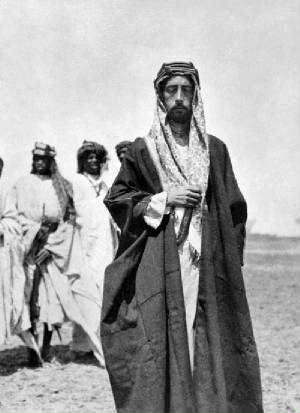
The Kingdom of Iraq (Arabic: المملكة العراقية‎ Al-Mamlakah Al-‘Irāqiyyah) was the first modern state in Iraq, which began in August 1921 with the coronation of Faisal bin al-Hussein bin Ali al-Hashemi as King Faisal I. Although a League of Nations mandate was awarded to Britain in 1920, the 1920 Iraqi revolt resulted in the mandate plan being dropped and a semi-independent kingdom being created under the Hashemite allies of Britain. The kingdom was granted full independence in 1932 following the Anglo-Iraqi Treaty (1930). The kingdom ended in 1958 when King Faisal II together with the Crown Prince were murdered and the monarchy was over thrown in a coup led by Abd al-Karim Qasim.
king-of-iraq.jpg

The House of Hashemite

Hashemite is the Latinate version of the Arabic: هاشمي‎, transliteration: Hāšimī, and traditionally refers to those belonging to the Banu Hashim, or “clan of Hashim”, a clan within the larger Quraish tribe. It also refers to an Arab dynasty whose original strength stemmed from the network of tribal alliances and blood loyalties in the Hejaz region of Saudi Arabia, along the Red Sea.

The Hashemites trace their ancestry from Hashim ibn Abd al-Manaf (died c. 510 AD), the great-grandfather of the Islamic prophet Muhammad, although the definition today mainly refers to the descendants of the prophet’s daughter, Fatimah. The early history of the Hashemites saw them in a continuous struggle against the Umayyads for control over who would be the caliph or successor to Muhammad. The Umayyads were of the same tribe as the Hashemites, but a different clan. After the overthrow of the Umayyads, the Abbasids would present themselves as representatives of the Hashemites, as they claimed descent from Abbas ibn Abd al-Muttalib, an uncle of Muhammad. Muhammad’s father had died before he was born, and his mother died while he was a child, so Muhammad was raised by his uncle Abu Talib, chief of the Hashemites.

From the 10th century onwards, the Sharif (religious leader) of Mecca and its Emir was by traditional agreement a Hashemite. Before World War I, Hussein bin Ali of the Hashemite Dhawu-‘Awn clan ruled the Hejaz on behalf of the Ottoman sultan. For some time it had been the practice of the Sublime Porte to appoint the Emir of Mecca from among a select group of candidates. In 1908, Hussein bin Ali was appointed Emir of Mecca. He found himself increasingly at odds with the Young Turks in control at Istanbul, while he strove to secure his family’s position as hereditary Emirs
king-faisal-I-of-iraq-group-picture.jpg

During and after World War I

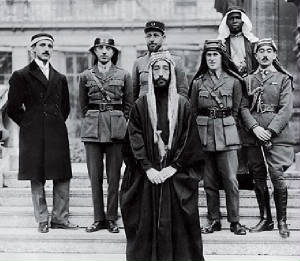
Sharif Hussein bin Ali rebelled against the rule of the Ottomans during the Arab Revolt of 1916. Between 1917 and 1924, after the collapse of Ottoman power, Hussein bin Ali ruled an independent Hejaz, of which he proclaimed himself king, with the tacit support of the British Foreign Office. His supporters are sometimes referred to as “Sharifians” or the “Sharifian party”. His chief rival in the Arabian peninsula was the king of the highlanders on the highland of Najd named Ibn Saud, who annexed the Hejaz in 1925 and set his own son, Faysal bin Abdelaziz Al Saud, as governor, the region was later incorporated into Saudi Arabia.

Hussein bin Ali had five sons:

  • Ali, who briefly succeeded to the throne of Hejaz before its loss to the Saud family.
  • Abdullah, later became the king of Transjordan, and whose descendants rule the kingdom, that has been known ever since as the Hashemite Kingdom of Jordan.
  • Faisal, was briefly proclaimed King of Syria, and ended up becoming King of Iraq.
  • Prince Zeid, who moved to Jordan when his brother’s grandson, King Faisal II of Iraq, was overthrown and murdered in a coup in 1958.
  • Hassan, died at a young age.
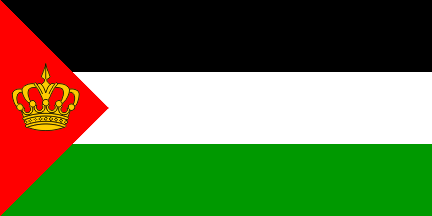
royal-flag-of-iraq.gif

Royal Standard of the Kingdom of Iraq

Iraq’s first flag was inspired by the flag of the Kingdom of Hejaz, and was in use at the time of independence in 1932. The flag was actually used before independence, from 1924 to 1959.
faisalofiraq.jpg

Hashemite Kingdom of Iraq – 1921-1958

Name Lifespan Reign – start Reign – end Family King
Faisal I

  • Arabic: فيصل بن حسين بن علي الهاشمي ‎
20 May 1883 – 8 September 1933 23 August 1921 8 September 1933 Hashemite
King Faisal I
Ghazi

  • Arabic: غازي ابن فيصل‎
21 March 1912 – 4 April 1939 8 September 1933 4 April 1939 Hashemite
Faisal II

  • Arabic: الملك فيصل الثاني‎
2 May 1935 – 14 July 1958 4 April 1939 14 July 1958 Hashemite

The 14th July Revolution in Iraq

In the summer of 1958, King Hussein of Jordan asked for Iraqi military assistance during the escalating Lebanon crisis. Units of the Iraqi Army under the command of Abd al-Karim Qasim, en route to Jordan, chose to march on Baghdad instead, where they mounted a coup d’état on 14 July 1958. During the 14 July Revolution, Faisal II ordered the royal guard to offer no resistance, and Faisal himself surrendered to the insurgents. Around 8 am, Captain Abdul Sattar Sabaa Al-Ibousi, leading the revolutionary assault group at the palace, ordered the King, Crown Prince ‘Abd al-Ilah‎, Princess Hiyam (‘Abd al-Ilah‎’s wife), Princess Nafeesa (‘Abd al-Ilah‎’s mother), Princess Abadiya (Faisal’s aunt) and several servants to gather in the palace courtyard. Here, they were told to turn towards the wall, where all were immediately machine-gunned by their captors. Faisal, who had not died during the initial fusillade, was transported to a hospital, but died en-route. Princess Hiyam survived her injuries, caused during the massacre, and was able to escape the country.
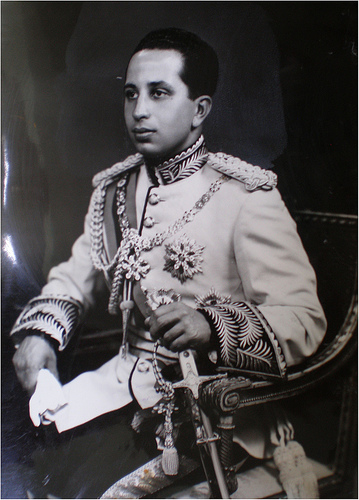
kingfaisalofiraq.jpg

Nuri as-Said, Faisal’s Prime Minister, was killed by Qassim’s supporters the following day. The monarchy was formally abolished, and control over the country passed to a tripartite “Sovereignty Council,” composed of representatives of Iraq’s three major ethnic groups. A lengthy period of political instability ensued, culminating in the ultimate triumph in 1963 of the Ba’ath Party, which in turn led to the eventual coming to power of Saddam Hussein.
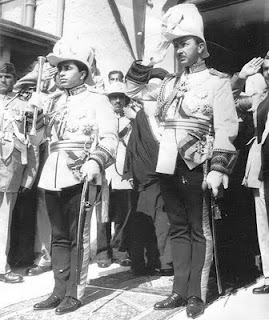
kingofiraqandthekingofjordan.jpg

The Royal Family Titles and Styles

Sovereign of Iraq: has the Title of King of Iraq, with the formal appellation of His Majesty, wife of the Sovereign: has the Title of Queen of Iraq, with the formal appellation of Her Majesty, Heir Apparent: has the Title of Crown Prince, with the formal appellation of His Royal Highness, sons of the Sovereign: have the Title of Amir – Prince, with the formal appellation of His Royal Highness, daughters of the Sovereign: have the Title of Amira – Princess, with the formal appelltion of Her Royal Highness, whereas other members of the Royal Family of Iraq: have the Titles of Amir – Prince or Amira – Princess with the formal appellation of His or Her Highness, wives of Amirs, and the widows until they remarry: are able to use the title of Amira – Princess together with the formal appellation borne by husbands.
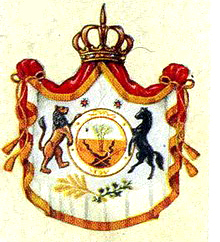
Kingdom-of-Iraq.jpg

The Genealogy of The Royal House of Iraq
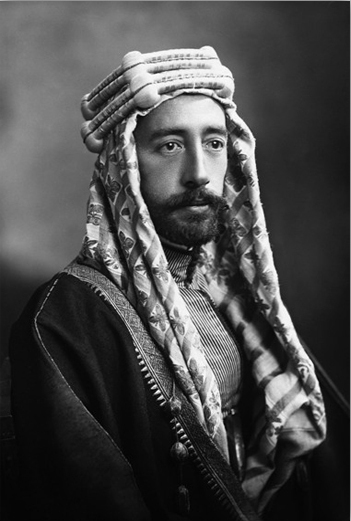
king-faisal-I-of-iraq.jpg

King of Iraq: 1921 – 1933

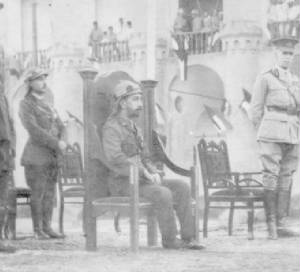
HM Faisal I bin Hussein bin Ali al-Hashemi, (Arabic: فيصل بن حسين بن علي الهاشمي‎ Fayṣal ibn Ḥusayn; 20 May 1885 – 8 September 1933) was for a short time King of the Arab Kingdom of Syria or Greater Syria in 1920, and was King of the Kingdom of Iraq (today Iraq) from 23 August 1921 to 1933. He was a member of the Hashemite dynasty. Faisal encouraged overcoming cleavage between Sunni and Shiite to foster common loyalty and promote pan-Arabism in the goal of creating an Arab state that would include Iraq, Syria and the rest of the Fertile Crescent. While in power, Faisal tried to diversify his administration by including different ethnic and religious groups in offices. He faced great challenges in achieving this because the region was under European, specifically French and British, control and other Arab leaders of the time were hostile to his ideas as they pursued their own political aspirations for power. In addition, Faisal’s attempt at pan-Arab nationalism inevitably isolated certain religious groups.
Coronation_of_Prince_Faisal_as_King_of_Iraq_1921.jpg

Faisal was born in Ta’if (in present-day Saudi Arabia) in 1883, the third son of Hussein bin Ali, Sharif of Mecca, the Grand Sharif of Mecca. He grew up in Constantinople and learned about leadership from his father. In 1913, he was elected as representative for the city of Jeddah for the Ottoman parliament. In 1916, on a mission to Istanbul, he visited Damascus twice. On one of these visits he received the Damascus Protocol, joined with the Al-Fatat group of Arab nationalists, and his father became king of Hejaz.

Faisal was married to Hazima bint Nasser and had one son and three daughters:

  • Princess Azza bint Faisal
  • Princess Rajiha bint Faisal
  • Princess Raifia bint Faisal
  • Ghazi, King of Iraq born 1912 died 4 April 1939, married Princess Aliya bint Ali daughter of HM King Ali of Hejaz.
king-ghazi-of-iraq.jpg

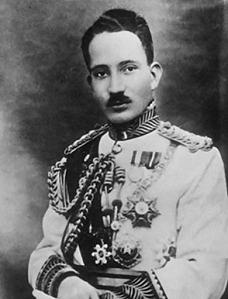
King of Iraq: 1933 – 1939

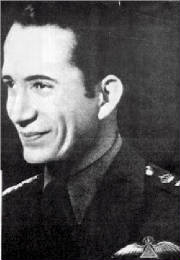
HM King Ghazi I (Arabic: غازي ابن فيصل‎ Ġāzī bin Fayṣal) (March 21, 1912 – April 4, 1939) was the King of the Hashemite Kingdom of Iraq from 1933 to 1939 having been briefly Crown Prince of the Kingdom of Syria in 1920. He was born in Mecca (in present-day Saudi Arabia), the only son of Faisal I, the first King of Iraq.
ghazi-I-of-iraq.jpg

On 8 September 1933, King Faisal I died, and Ghazi was crowned as King Ghazi I. On the same day, Ghazi was appointed Admiral of the Fleet in the Royal Iraqi Navy, Field Marshal of the Royal Iraq Army, and Marshal of the Royal Iraqi Air Force. A staunch pan-Arab nationalist, opposed to British interests in his country, Ghazi’s reign was characterized by tensions between civilians and the army, which sought control of the government. He supported General Bakr Sidqi in his coup, which replaced the civilian government with a military one. This was the first coup d’état to take place in the Arab world. He was rumored to harbor sympathies for Nazi Germany and also put forth a claim for Kuwait to be annexed to Iraq. For this purpose he had his own radio station in al-Zuhoor royal palace in which he promoted that claim and other radical views. Ghazi died in 1939 in a mysterious accident involving a sports car he was driving. Some believe he was killed on the orders of Nuri as-Said. Faisal, Ghazi’s only son, succeeded him as King Faisal II. Because Faisal was under age, Prince Abdul Ilah served as Regent until 1953.
queen-of-iraq.jpg

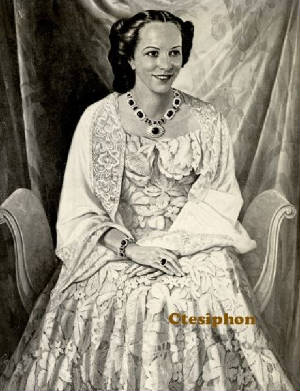
On January 25, 1934 Ghazi married Princess Aliya bint Ali daughter of King Ali of Hejaz in Baghdad Iraq. They had only one son:

  • Faisal II, King of Iraq – born May 2, 1935 died July 14, 1958
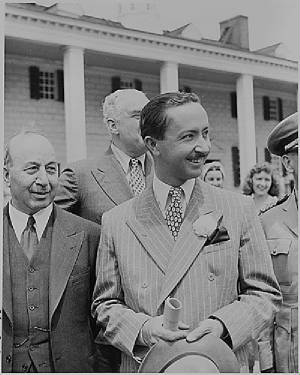
Prince_Abdul_Ilah_of_Iraq_at_Mount_Vernon.jpg

King of Iraq: 1939 – 1958

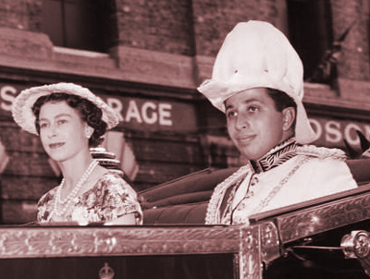
HM Faisal II (Arabic: الملك فيصل الثاني Al-Malik Fayṣal Ath-thānī) (May 2, 1935 – July 14, 1958) was the last King of Iraq. He reigned from 4 April 1939 until July 1958, when he was killed during the “14 July Revolution” together with several members of his family. Faisal’s regicide marked the end of the thirty-seven year old Hashemite monarchy in Iraq, which became a republic.
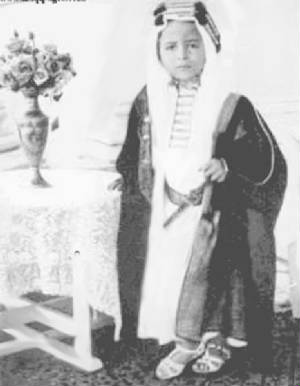
young-Faisal-II-of-iraq.jpg

Faisal was the only son of Iraq’s second king, Ghazi, and his wife Queen Aliya, second daughter of ‘Ali bin Hussein, King of the Hijaz and Grand Sharif of Mecca. His father was killed in a mysterious car crash when Faisal was three years old; Faisal’s uncle ‘Abd al-Ilah served as regent until he came of age in 1953.
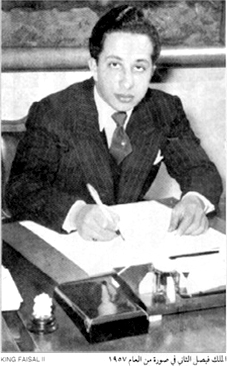
Faisal-II.jpg

Faisal was first betrothed to Princess Kıymet Hanım, a descendant of the last Mamluk dynasty of Iraq, in January 1958. This engagement was called off three months later. Faisal then asked for the hand of Princess Shahnaz Pahlavi, daughter of the Iranian Shah Muhammad Reza Shah, but was turned down by Shahnaz. At the time of his death, King Faisal was engaged to be married to HH Princess Sabiha Fazila Hanım Sultan, the only daughter of HE Damat HH Prince Muhammad ‘Ali Ibrahim Beyefendi of Egypt and HIH Princess Zahra Hanzade Sultan.
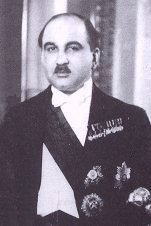
Major-General-Prince-Amir-Zeid.jpg

Head of Royal House: 1958 – 1970

Prince Zeid bin Hussein, GCVO, GBE (Arabic: الأمير زيد بن الحسين‎) born (February 28, 1898 – October 18, 1970) was a member of the Hashemite dynasty and the head of the Royal House of Iraq from 1958 until his death and had issue*. Prince Zeid was the only son of King Hussein of Hejaz and his third wife Adila Khanum. He was educated at Ghalata Serai (Galatasaray High School) College, Constantinople College and Balliol College, Oxford. From 1916 – 1919, Prince Zeid was the Commander of the Arab Northern Army. In 1918 T. E. Lawrence suggested that he be made King of a truncated Syria. The advent of French rule resulted in his 1923 assignment to the Iraqi Cavalry and he was promoted to Colonel. Zeid was also Iraqi ambassador in Berlin and in Ankara in 1930s and in London in the 1950s. On July 14, 1958, Prince Zeid was appointed Head of the Royal House of Iraq, following the assassination of his great-nephew King Faisal II by General Muhammad Najib ar-Ruba’i, who proclaimed Iraq to be a Republic. Zeid and his family continued to live in London, where the family resided during the coup, as Zeid was the Iraqi ambassador there. Prince Zeid died in Paris on October 18, 1970, and is buried in the Royal Mausoleum at Raghdan Palace, Amman, Jordan. His son Prince Ra’ad succeeded him as head of the Royal House of Iraq.

*HRH Prince Ra’ad bin Zeid – born February 18, 1936, married to Margaretha Inga Elisabeth Lind, now Majda Raad.
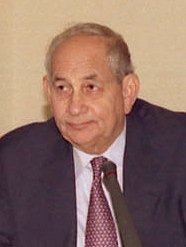
Prince-amir-Raad.jpg

Head of Royal House: 1970-

Prince Ra’ad bin Zeid (Arabic: الأمير رعد بن زيد‎) (born 18 February 1936 in Berlin where his father was Iraqi ambassador at the time) is the son of Prince Zeid of the Hashemite House and Princess Fahrelnissa Zeid (Fakhr un-nisa), a Turkish noblewoman. Upon the death of his father on October 18, 1970, he inherited the position as head of the Royal Houses of Iraq and Syria. Ra’ad has lived in London and Paris. The Kingdom of Jordan has confirmed his style as His Royal Highness and Prince and has issue.
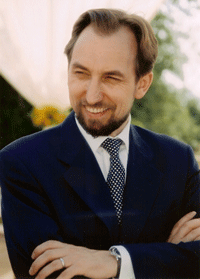
  • HRH Prince Zeid bin Ra’ad – born January 26, 1964, married to Sarah Butler. (Now HRH Princess Sarah Zeid.) They have 2 children, HH Prince Ra’ad bin Zeid (Born: 17 May 2001.) and HH Princess Hala bint Zeid. (Born: 13 March 2003.)
  • HRH Prince Mired bin Ra’ad – born January 11, 1965, married to Dina Khalifeh. (Now HRH Princess Dina Mired.) They have 3 children, HH Princess Shirin bint Mir’ed. (Born: 19 May 1993) HH Prince Rakan bin Mir’ed (Born: 20 November 1995) and HH Prince Jafar bin Mir’ed. (Born: 4 September 2002.)
  • HRH Prince Firas bin Ra’ad – born October 12, 1969, married to Dana Toukan. (Now HRH Princess Dana Firas.) They have 2 children, HH Princess Safa bint Firas (Born: 26 July 2001.) and HH Princess Haya bint Firas. (Born: 7 March 2003)
  • HRH Prince Faisal bin Ra’ad – born March 6, 1975, graduated from Brown University, and married to Lara Sukhtian. (Now HRH Princess Lara Faisal.) She worked with MSNBC news in Baghdad covering the Iraq war. She’s the daughter of Munjid Sukhtian. They have 2 children, HH Princess Hanan bint Faisal (Born: 3 September 2006) and HH Princess Mariam bint Faisal. (Born: 25 July 2008)
  • HRH Princess Fakhrelnissa bint Ra’ad – born January 11, 1981, married to Sharif Hajjar. They have 2 children, Radwan Hajjar (Born: 8 August 2006.) and Faisal Hajjar. (Born: 14 December 2007)
  • HRHPrinceZeidbinRaad.gif

    Heir to Headship of Royal House:

    Prince Zeid Ra’ad Zeid Al-Hussein was born 26 January 1964 in Amman, Jordan to Prince Ra’ad bin Zeid head of the Royal Houses of Iraq and Syria and pretender to the Iraqi throne and his Swedish-born wife Margaretha Inga Elisabeth Lind, henceforward known as Majda Raad. He is Jordan’s Permanent Representative to the United Nations, a post he already held previously for six and a half years (2000-2007). From 2007-2010 he served as Jordan’s Ambassador to the United States and non-resident Ambassador to Mexico. Prince Zeid was married on the 5 July 2000 at Amman to Sarah Butler and has issue.

  • HH Prince Ra’ad – born 17 May 2001
  • HH Princess Hala – born 13 March 2003
  • We use cookies to personalise content and ads, to provide social media features and to analyse our traffic. We also share information about your use of our site with our social media, advertising and analytics partners. View more
    Cookies settings
    Accept
    Decline
    Privacy & Cookie policy
    Privacy & Cookies policy
    Cookie name Active

    Privacy and Cookie Policy Last updated: 11 August 2026

    Neue Gotha respects your privacy and is committed to handling personal data lawfully, fairly, and transparently. This Privacy and Cookie Policy explains who is responsible for personal data, what information we process, why we process it, how long we retain it, who may receive it, and the rights available to individuals under the General Data Protection Regulation (EU) 2016/679 (“GDPR”) and applicable national data-protection and electronic-communications law.

    1. Who is responsible for your personal data?

    The controller responsible for the processing described in this policy is:

    • Legal name: Neue Gotha Historical Register gUG
    • Trading or project name: Neue Gotha
    • Postal address: Musterstraße 12, 10115 Berlin, Germany
    • Email: editor@neuegotha.de
    • EU/EEA representative: Not applicable (the controller is established in Germany).
    • Data Protection Officer: No Data Protection Officer has been appointed. Privacy enquiries are handled through editor@neuegotha.de.

    Questions about this policy or requests concerning personal data may be sent to the email or postal address above.

    2. Scope of this policy

    This policy applies to personal data processed through https://neuegotha.com, correspondence with the Neue Gotha editorial office, material submitted for editorial consideration, and editorial or archival records concerning identifiable living individuals.

    It does not govern independent third-party websites or services linked from this website. Those providers are responsible for their own privacy practices.

    3. Personal data we process and why

    Processing activity Personal data Purpose Legal basis Retention
    Website delivery, logging, and security IP address; date and time of access; requested page or file; referring page; browser, operating-system, and device information; error and security-event data Deliver the website, maintain availability, diagnose faults, prevent abuse, and protect the website and its users Article 6(1)(f) GDPR — our legitimate interests in operating a secure and reliable website. Where processing is required by law, Article 6(1)(c) GDPR may also apply. Routine access and error logs are retained for 14 days. Records isolated for investigation of a suspected security incident may be retained for up to 90 days after the incident is resolved, or longer where required for legal claims.
    Editorial correspondence and enquiries Name, contact details, message content, correspondence history, and any documents or other information voluntarily provided Respond to enquiries, assess corrections or submissions, maintain editorial records, and protect legal rights Article 6(1)(f) GDPR — our legitimate interests in conducting editorial work and responding to correspondence; Article 6(1)(b) GDPR where processing is necessary to take steps at an individual’s request before entering into a contract; Article 6(1)(c) GDPR where retention or disclosure is legally required Correspondence is ordinarily retained for 24 months after the matter closes. Material required to document an editorial decision, resolve a dispute, meet a legal obligation, or establish, exercise, or defend a legal claim may be retained for the applicable limitation period.
    Editorial, genealogical, and archival records Names; titles and styles; dates and places associated with public or genealogical events; family relationships; jurisdictions, offices, and public roles; images; biographical information; source and citation information; and correspondence relating to accuracy or provenance Research, document, preserve, verify, correct, and publish material concerning dynastic, genealogical, heraldic, and institutional history Article 6(1)(f) GDPR — our legitimate interests and those of readers, researchers, and institutions in maintaining an accurate historical and genealogical reference work, subject to a documented necessity and balancing assessment. Applicable national rules implementing Article 85 GDPR concerning freedom of expression and information may also apply. For as long as the information remains relevant to the legitimate editorial or archival purpose, subject to accuracy review, correction, restriction, erasure, and applicable archiving or legal requirements
    Cookie-consent and language preferences Consent choice, language preference, cookie identifiers, and related technical information Remember privacy choices, demonstrate consent where required, and provide the language selected by the visitor Article 6(1)(f) GDPR for strictly necessary preference and consent-management functions; Article 6(1)(a) GDPR for optional storage, access, or associated processing based on consent As stated in the cookie table below
    Optional external services IP address, page URL, device and browser information, language choice, and service-interaction data, depending on the provider Provide optional translation, embedded content, analytics, or similar features actually enabled on the website Article 6(1)(a) GDPR — consent. Non-essential services remain disabled until consent is given. As described for each service and by the relevant provider

    We do not use personal data for solely automated decisions that produce legal effects or similarly significant effects concerning individuals.

    4. Editorial and archival information obtained from other sources

    Neue Gotha is an editorial and historical reference project. Some information in the register may concern identifiable living individuals and may not have been collected directly from those individuals.

    Depending on the record, information may be obtained from official gazettes and public registers; archives and libraries; published books and scholarly works; institutional publications; reputable news sources; publicly accessible websites; submissions from the individual concerned or their authorised representative; family representatives; and other documented sources.

    The categories of information may include the categories listed under “Editorial, genealogical, and archival records” above. The material may be made available to website visitors and may be indexed by search engines. Neue Gotha seeks to use relevant, proportionate, and appropriately sourced information and to distinguish documented fact from uncertainty or editorial interpretation.

    Individuals may contact the editorial office to request access, correction, contextualisation, restriction, or erasure. Requests are assessed under the GDPR and applicable national law, taking into account accuracy, source integrity, the public interest, freedom of expression and information, archival considerations, and the rights and freedoms of other people. No provision of this policy removes a right granted by applicable law.

    Neue Gotha does not intentionally publish special-category personal data or information concerning criminal convictions about living individuals unless a specific lawful basis and any additional legal condition have been identified and documented.

    5. Cookies and similar technologies

    Cookies are small text files stored on, or read from, a visitor’s device. Similar technologies may perform comparable functions. Some are strictly necessary for a website or a service expressly requested by the visitor. Others, including many analytics, advertising, social-media, translation, or embedded-content technologies, require prior consent under applicable EU electronic-communications rules.

    Neue Gotha does not place or access non-essential cookies, or activate non-essential external services, before valid consent has been given. Visitors may accept or reject optional purposes separately and may withdraw consent at any time by selecting the permanently available “Cookie settings” control. Withdrawing consent does not affect processing that was lawful before withdrawal. Strictly necessary technologies cannot be disabled through the consent tool, but they may be controlled through browser settings where technically possible.

    The following table reflects the technologies currently deployed on the website. It is updated whenever a plugin, host, analytics tool, embedded service, or cookie configuration changes.

    Name Provider Purpose Category Duration Third-party access
    _scc_session Neue Gotha / managed hosting and site-control provider Maintains a short-lived session for website security and site-control functions Strictly necessary Browser session The contracted hosting or site-control provider may access the identifier when providing technical support
    _tccl_visit Neue Gotha / managed website-analytics provider Distinguishes a single website visit and reduces duplicate counting within the same session Analytics — disabled until consent 30 minutes Yes; the contracted analytics provider processes the identifier on Neue Gotha’s behalf
    _tccl_visitor Neue Gotha / managed website-analytics provider Assigns a pseudonymous visitor identifier used to produce aggregated website-usage statistics Analytics — disabled until consent 12 months Yes; the contracted analytics provider processes the identifier on Neue Gotha’s behalf
    googtrans Neue Gotha / Google Translate Stores or applies the visitor’s language selection for the translation feature Functional — disabled until consent 12 months Google may receive technical and service-interaction data when Google Translate is activated
    ng_gt_default_applied Neue Gotha / website translation plugin Records whether the website’s default translation setting has been applied Functional — disabled until consent 24 hours No direct vendor access is assumed; Google may receive data if activation causes Google Translate to load
    eu_cookies_bar_consent Neue Gotha / locally hosted EU Cookies Bar plugin Stores the visitor’s cookie choices and prevents the banner from being shown unnecessarily Strictly necessary 6 months No, provided the consent plugin remains locally hosted and does not transmit consent records to its developer
    wordpress_test_cookie Neue Gotha / WordPress Checks whether the browser supports cookies when an authorised user visits the sign-in page Strictly necessary Browser session No; the cookie is processed by Neue Gotha and its contracted host

    Authorised editorial users may receive WordPress authentication, security, or preference cookies when they sign in. wordpress_logged_in_[hash] maintains an authenticated session for up to two weeks when “Remember Me” is selected; wordpress_sec_[hash] protects administrative access for the session; and wp-settings-[user_id] stores an editor’s interface preferences for up to one year. These internal cookies are processed solely for editorial access and site administration.

    6. Google Translate, web fonts, and other external content

    Where enabled with the visitor’s consent, Neue Gotha may use Google Translate to provide machine-generated translations. Activating the service may cause the visitor’s browser to connect to Google and disclose technical information such as the IP address, requested page URL, browser or device information, and language or service-interaction data. Machine translations may contain errors and do not replace the original editorial text.

    Website fonts are hosted locally by Neue Gotha and do not require a connection to Google. Google Translate remains an optional external service that is activated only after the visitor provides consent.

    Information about Google’s processing is available in the Google Privacy Policy and Google’s explanation of how it uses information from sites and applications that use its services.

    Embedded material from another website may allow that provider to process personal data as if the visitor had visited the provider directly. Non-essential embeds remain blocked until consent is obtained. Each enabled provider is identified in this policy and in the consent interface.

    7. Recipients of personal data

    Personal data may be disclosed only where necessary to:

    • hosting, content-delivery, backup, website-maintenance, email, security, and consent-management providers acting under contract;
    • translation, analytics, media, or other external-service providers selected by the visitor through the consent interface;
    • professional advisers, insurers, auditors, or other specialists where necessary to protect legal or operational interests;
    • courts, regulators, law-enforcement bodies, or public authorities where disclosure is required or permitted by law; and
    • the public and search engines where personal data form part of a lawfully published editorial or archival record.

    8. International data transfers

    Some service providers may process personal data outside the European Economic Area. Where the GDPR restricts such a transfer, Neue Gotha relies on an applicable European Commission adequacy decision or appropriate safeguards under Article 46 GDPR, such as the European Commission’s Standard Contractual Clauses, together with supplementary measures where required.

    Cloudflare and Google may transfer limited technical information to recipients in the United States. Where the recipient is validly certified, the transfer is based on the European Commission’s adequacy decision for the EU–US Data Privacy Framework. Where that mechanism is unavailable or does not cover a transfer, the relevant provider’s European Commission Standard Contractual Clauses and supplementary technical and organisational measures are used. Information about the applicable safeguards, including how to obtain a copy, may be requested from editor@neuegotha.de.

    9. How long we retain personal data

    We retain personal data only for as long as necessary for the purposes described in this policy, including security, editorial integrity, source verification, dispute resolution, and compliance with legal obligations. The specific periods or criteria are stated in the processing and cookie tables above.

    When a retention period ends, information is deleted or anonymised unless continued retention is required by law, is necessary for legal claims, or is justified by a documented editorial or archival purpose. Encrypted rolling backups are retained for 35 days and are then overwritten automatically, unless a backup has been isolated for incident recovery or a legal hold.

    10. Security

    Neue Gotha uses appropriate technical and organisational measures designed to protect personal data against accidental or unlawful destruction, loss, alteration, unauthorised disclosure, or access. No method of internet transmission or electronic storage is completely secure, and absolute security cannot be guaranteed.

    11. Your data-protection rights

    Subject to the conditions and limitations in the GDPR and applicable national law, an individual may have the right to:

    • obtain confirmation as to whether personal data concerning them are processed and request access to those data;
    • request correction of inaccurate or incomplete personal data;
    • request erasure of personal data;
    • request restriction of processing;
    • object, on grounds relating to their particular situation, to processing based on legitimate interests;
    • receive personal data they provided in a structured, commonly used, machine-readable format and transmit those data to another controller where the right to portability applies;
    • withdraw consent at any time, without affecting the lawfulness of processing carried out before withdrawal; and
    • lodge a complaint with a competent data-protection supervisory authority.

    To exercise a right, contact editor@neuegotha.de. Please identify the information or record concerned and the nature of the request. We may request information reasonably necessary to verify identity and protect personal data from unauthorised disclosure. Requests are normally answered within one month, subject to any extension permitted by law.

    Where a request concerns published editorial or archival content, applicable rights may be limited where necessary and proportionate to reconcile data protection with freedom of expression and information or other rights recognised by law. Each request will be assessed individually.

    12. Complaints

    We encourage individuals to contact us first so that we can try to resolve a concern. Individuals also have the right to complain to the supervisory authority in the EU or EEA country of their habitual residence, place of work, or the place of the alleged infringement.

    For this Berlin-based controller the supervisory authority is the Berliner Beauftragte für Datenschutz und Informationsfreiheit, Alt-Moabit 59–61, 10555 Berlin, Germany; telephone +49 30 13889-0; email mailbox@datenschutz-berlin.de; website https://www.datenschutz-berlin.de/.

    13. Children

    The website is intended as a general historical and reference resource and is not directed specifically at children. We do not knowingly request personal data directly from children for an online service requiring parental consent. If you believe a child has provided personal data inappropriately, please contact us.

    14. Changes to this policy

    We may update this policy when our processing activities, service providers, technologies, or legal obligations change. The current version will be published on this page with a revised “Last updated” date. Where required, we will provide additional notice or request renewed consent before introducing a new processing purpose.

    Decline All
    Save settings Accept All
    Cookies settings