
Formerly Sovereign House
Kingdom of Hannover – House of Welf – Guelph
Kingdom of Hannover – House of Welf – Guelph
- Jurisdiction
- Hannover
- Dynasty
- House of Welf
- Entry type
- House
- Editorial status
- Reviewed - Verified
Königreich Hannover
House of Guelph – Welf
The Kingdom of Hanover (German: Königreich Hannover) was established in October 1814 by the Congress of Vienna, with the restoration of George III to his Hanoverian territories after the Napoleonic era. It succeeded the former Electorate of Brunswick-Lüneburg (known informally as the Electorate of Hanover), and joined with 38 other sovereign states in the German Confederation. The Kingdom was ruled by the House of Hanover, in personal union with the United Kingdom of Great Britain and Ireland until 1837, before being conquered by Prussia in 1866. Briefly revived as the State of Hanover in 1946, the state was subsequently merged with some smaller states to form the current state of Lower Saxony.
History of the Kingdom of Hannover
The territory of Hanover had earlier been a Principality within the Holy Roman Empire; before being elevated into an electorate in 1708. Hanover was formed by the union of several dynastic divisions of the Duchy of Brunswick-Lüneburg, with the sole exception of the principality of Brunswick-Wolfenbüttel. Between 1714 and 1837 it was joined in a personal union, first with the Kingdom of Great Britain and the Kingdom of Ireland, and then, from 1801, with the United Kingdom of Great Britain and Ireland. In 1803 the electorate was occupied by French and Prussian troops, and following the Treaties of Tilsit in 1807, its territories together with territories ceded from Prussia was created into the Kingdom of Westphalia ruled by Napoleon’s brother Jérôme Bonaparte. French control lasted until October 1813 when the territory was overrun by Russian cossack troops, and the Battle of the Nations at Leipzig later the same month spelled the definitive end to the Napoleonic client state as well as the entire Confederation of the Rhine, after which the House of Hanover was restored as rulers.
The Prince-Electors, formerly vassals within the Holy Roman Empire, were elevated to monarchs of an independent kingdom at the Congress of Vienna in 1814. This was conducted under the supervision and advice of Baron Münster, head of the German Chancery in London. Hanover was also greatly expanded, becoming the fourth-largest state in the German Confederation (behind only Prussia, Austria and Bavaria) and the second-largest in north Germany. During the British Regency and the reigns of the kings George IV and later William, their younger brother Prince Adolphus, Duke of Cambridge officiated as Viceroy of Hanover (1816-37), representing the King usually living in England. When Adolphus’s niece, Queen Victoria, daughter of his late elder brother Prince Edward, Duke of Kent and Strathearn, succeeded to the British Throne on 20 June 1837, the 123-year personal union of the crowns of Great Britain (or the United Kingdom of Great Britain and Ireland from 1801, respectively) and Hanover (or the Electorate of Brunswick-Lüneburg before 1814, respectively) ended. Salic law, which requires succession by exclusively male inheritance, operated in Hanover but not in Great Britain; Victoria could not become Queen of Hanover. Adolphus’s other elder brother, therefore, became King as Ernest Augustus I of Hanover and Adolphus returned to Britain.
During the Austro-Prussian War (1866), Hanover attempted to maintain a neutral position, along with some other member states of the German Confederation. Hanover’s vote in favor of the mobilisation of Confederation troops against Prussia on 14 June 1866 prompted Prussia to declare war. The outcome of the war led to the dissolution of Hanover as an independent kingdom and it was annexed by Prussia, where it became the Province of Hanover. The German-Hanoverian Party, which at times supported secession from the Reich, demanded a separate status for the province in the Reichstag. The party existed up until it was banned by the Nazi government. After George V fled Hanover, he raised forces loyal to him in the Netherlands called the Guelphic Legion. They were eventually disbanded in 1870. George refused to accept the Prussian takeover of his realm and claimed he was still the legitimate king of Hanover. His only son, Ernest Augustus, Duke of Cumberland, inherited this claim upon George’s death in 1878. Ernest Augustus was also first in line to the throne of Brunswick, whose rulers were distant cousins of the House of Hanover. However, since he still claimed to be Hanover’s rightful ruler as well, a regency took over the government of Brunswick until the Duke’s son, also named Ernest Augustus, married one of the German Emperor’s daughters in 1915 and renounced his claim to Hanover.
Revival and modern History
In 1946, Hanover was revived as a state, named the State of Hanover. The state saw itself in the tradition of the kingdom. Its Prime Minister, Hinrich Wilhelm Kopf, played a central role when the state of Lower Saxony was founded just a few months later by merging Hanover with several smaller states, with the city of Hanover as its capital. The former territory of Hanover makes up 85 percent of Lower Saxony’s territory, and the state continues to use the old Hanover coat of arms.
Territory and administrative subdivisions
The Congress of Vienna instituted a territorial exchange between Hanover and the Kingdom of Prussia, in which Hanover increased its area substantially, gaining the Bishopric of Hildesheim, East Frisia, the Lower County of Lingen and the northern part of the Prince-Bishopric of Münster. It gained territories, partially ruled earlier in personal union, such as the Duchies of Bremen-Verden and partially ruled by others, to whit the County of Bentheim. It lost those parts of Saxe-Lauenburg to the northeast of the Elbe, which was assigned in personal union to Denmark, except the Amt Neuhaus. Further small exclaves in the east were lost.
Hanover thus comprised a number of territories, which had been Imperial Estates within the Holy Roman Empire. Their respective governments, now called provincial governments, were organised according to partially very old traditions, including different levels of estate participation in rule. In 1823 the kingdom was reorganised into high-bailiwicks (German: Landdrosteien, singular: Landdrostei), each led by a high-bailiff (German: Landdrost) according to unitary standards, thus doing away with the inherited provincial peculiarities. The high-bailiwicks were subdivided into bailiwicks (German: Ämter, singular Amt), presided by a bailiff (Amtmann, plural Amtleute). The high-bailiwicks, named after their capitals, were the following:
- Aurich, comprising former East Frisia
- Hanover, comprising about the former Principality of Calenberg in the Duchy of Brunswick-Lüneburg
- Hildesheim, comprising the former Brunswick-Lüneburg Principality of Grubenhagen and the former Prince-Bishopric of Hildesheim
- Lüneburg, comprising the former Brunswick-Lüneburg Principality of Lüneburg and the remainder of Saxe-Lauenburg areas
- Osnabrück, comprising the former County of Bentheim, the former Lower County of Lingen, and the former Prince-Bishopric of Osnabrück
- Stade, comprising the former Duchies of Bremen-Verden
The Hanoverian subdivisions into high-bailiwicks and bailiwicks remained unchanged until 1 April 1885, when they were replaced by Prussian-style provinces (Regierungsbezirke) and districts (Kreise).
House of Hanover – Welf – Guelph
The House of Hanover (the Hanoverians) is a deposed German royal dynasty which has ruled the Duchy of Brunswick-Lüneburg (German: Braunschweig-Lüneburg), the Kingdom of Hanover, the Kingdom of Great Britain, the Kingdom of Ireland and the United Kingdom of Great Britain and Ireland. It succeeded the House of Stuart as monarchs of Great Britain and Ireland in 1714 and held that office until the death of Victoria in 1901. They are sometimes referred to as the House of Brunswick and Lüneburg, Hanover line. The House of Hanover is a younger branch of the House of Welf, which in turn is the senior branch of the House of Este.
Queen Victoria was the granddaughter of George III, and was an ancestor of most major European royal houses. She arranged marriages for her children and grandchildren across the continent, tying Europe together; this earned her the nickname “the grandmother of Europe”. She was the last British monarch of the House of Hanover; her son King Edward VII belonged to the House of Saxe-Coburg and Gotha, the line of his father, Prince Albert. Under semi-Salic law, Victoria could not inherit the German kingdom and duchies unless the entire male line became extinct; those possessions passed to the next eligible male heir, her uncle Ernest Augustus I of Hanover, the Duke of Cumberland and Teviotdale-the fifth son of George III. The current head of the House of Hanover is Ernst August V, Prince of Hanover.
Line of succession to the former Hanoverian throne
The Kingdom of Hanover was abolished in 1866 and the Duchy of Brunswick in 1918. The Hanoverian royal family was also deprived of the Dukedom of Cumberland in 1919. The current senior male-line descendant of George III of the United Kingdom and head of the House of Hanover is Ernst August V, Prince of Hanover, titular King of Hanover, Duke of Brunswick, and Duke of Cumberland and Teviotdale. The Succession Law is Salic, only allowing males to succeed to the throne.
- Prince Ernst August of Hanover (born 1983)
- Prince Christian of Hanover (born 1985)
- Prince Otto Heinrich of Hanover (born 1988)
- Prince Heinrich Julius of Hanover (born 1961)
- Prince Albert of Hanover (born 1999)
- Prince Julius of Hanover (born 2006)
- Prince Georg of Hanover (born 1949)
List of the Kings of Hanover
In 1813, George III was restored to his Hanoverian territories, and in October 1814 they were constituted as the independent Kingdom of Hanover at the Congress of Vienna. The personal union with the United Kingdom ended in 1837 on the accession of Queen Victoria because the succession laws in Hanover, based on Salic law, prevented a female inheriting the title if there was any surviving male heir (in the United Kingdom, a male takes precedence only over his own sisters). In the Austro-Prussian War of 1866, Hanover was annexed by Prussia and became the latter’s Province of Hanover.
| Image | Name | Date | Notes |
|---|---|---|---|
| George III | 1814-20 | ‘George III’ was mentally unfit during these years, and power was exercised by George, Prince of Wales (the future George IV) according to the British Regency. In Hanover, Prince Adolphus, Duke of Cambridge officiated as Viceroy from 1816. | |
| George IV | 1820-30 | Son of predecessor. Regent 1811-1820, represented in Hanover by Viceroy Adolphus. | |
| William I | 1830-37 | Brother of predecessor. Last monarch to rule both Hanover and the United Kingdom, represented in Hanover by Viceroy Adolphus. | |
| Ernest Augustus I | 1837-51 | Brother of predecessor. His accession separated the crowns of Hanover and the United Kingdom, as the latter passed to Queen Victoria. | |
| George V | 1851-66 | Son of predecessor. Lost his territories to Prussia in the Austro-Prussian War. |
Titular Hanoverian claimants, 1866-present
- George V 1866-1878
- Ernest Augustus II 1878-1923
- Ernest Augustus III 1923-1953
- Ernest Augustus IV 1953-1987
- Ernest Augustus V 1987-Present
- Crown Prince Ernest Augustus (born 1983) Heir apparent
The Family Titles and Styles
The members of this family bear the title Prince or Princess of Hannover, of Great Britain and Ireland, Duke/Duchess of Braunschweig-Lüneburg, Royal Highness. The British titles are due to their male-line descent from King Ernst August I of Hannover, son of King George III of Great Britain and Ireland, and are used by the family in spite of the British Crown stripping the family of their British titles, including the Dukedom of Cumberland and Teviotdale, during the First World War.
The Genealogy of the Royal House
Ernest Augustus Pr of Great Britain, Ireland and Hannover, Duke of Braunschweig-Lüneburg, Duke of Cumberland and Teviotdale (see Great Britain), succeeded his brother William as King ERNST AUGUST I of Hannover 20 Jun 1837; he was b. Queen’s House, St. James’s Park 5 Jun 1771 and d.at Herrenhausen 18 Nov 1851); he m.at Strelitz 29 May 1815 and at Carlton House 29 Aug 1815 Friederike Dss of Mecklenburg-Strelitz (Hannover 2 Mar 1778-Hannover 21 Jun 1841)
- 1a) GEORG V Friedrich Alexander Karl Ernst August, King of Hannover, Pr of Great Britain and Ireland, Duke of Braunschweig-Lüneburg, Duke of Cumberland and Teviotdale, etc, lost his throne as a result of annexation by Prussia 20 Sep 1866 (Berlin 27 May 1819-Paris 12 Jun 1878); m. Hannover 18 Feb 1843 Marie Pss of Saxe-Altenburg (Hildburghausen 14 Apr 1818-Gmunden 9 Jan 1907)
- 1c) Marie Louise Victoria Caroline Amelia Alexandra Auguste Friederike (Gmunden 11 Oct 1879-Schloß Salem 31 Jan 1948); m. Gmunden 10 Jul 1900 Maximilian Pr of Baden (Baden-Baden 10 Jul 1867-Konstanz 6 Nov 1929)
- 2c) Georg Wilhelm Christian Albert Edward Alexander Friedrich Waldemar Ernst Adolf (Gmunden 28 Oct 1880-k.in car accident at Nackel, Brandenburg 20 May 1912)
- 3c) Alexandra Luise Marie Olga Elisabeth Therese Vera (Gmunden 29 Sep 1882-Glücksburg 30 Aug 1963); m. Gmunden 7 Jun 1904 Friedrich Franz IV Grand Duke of Mecklenburg-Schwerin (Palermo 9 Apr 1882-Flensburg 17 Nov 1945)
- 4c) Olga Adelheid Luise Marie Alexandrine Agnes (Gmunden 11 Jul 1884-Hubertihaus, nr Gmunden 21 Sep 1958)
- 5c) Christian Friedrich Wilhelm Georg Peter Waldemar (Gmunden 4 Jul 1885-Gmunden 3 Sep 1901)
1b) ERNST AUGUST Wilhelm Adolf Georg Friedrich, Crown Pr of Hannover, succeeded his cousin as Duke of Braunschweig in 1884 but was stopped from reigning by the Imperial Diet in 1885; he renounced his rights to Braunschweig in favor of his son 24 Oct 1913; Duke of Cumberland and Teviotdale, etc; during and immediately after the First World War he was stripped of his British titles (Hannover 21 Sep 1845-Gmunden 14 Nov 1923); m. Christiansborg 21 Dec 1878 Thyra Pss of Denmark (Copenhagen 29 Sep 1853-Gmunden 26 Feb 1933)
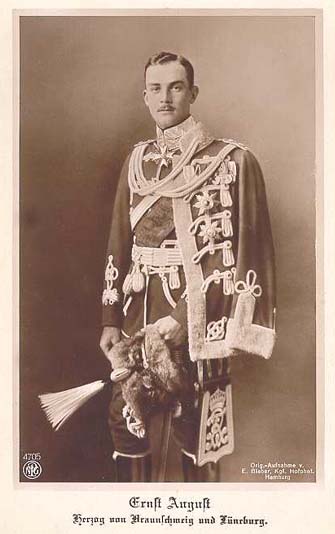
6c) ERNST AUGUST Christian Georg, Prince of Hannover, etc, reigning Duke of Braunschweig 1913-1918 (Penzing, nr Vienna 17 Nov 1887-Schloß Marienburg 30 Jan 1953); m. Berlin 24 May 1913 Viktoria Luise Pss of Prussia (Marmorpalais, nr Potsdam 13 Sep 1892-Hannover 11 Dec 1980)
- 1d) ERNST AUGUST Georg Wilhelm Christian Ludwig Franz Joseph Nikolaus Oskar, Prince of Hannover, etc (Braunschweig 18 Mar 1914-Hannover 9 Dec 1987); m.1st (civ) Schloß Marienburg 31 Aug 1951 (rel) Hannover 4 Sep 1951 Ortrud Pss of Schleswig-Holstein (Flensburg 19 Dec 1925-Hannover 6 Feb 1980); m.2d Laubach (civ) 16 Jul 1981 (rel) 17 Jul 1981 Monika Gfn zu Solms-Laubach (b. Laubach 8 Aug 1929)
- 1e) Marie Viktoria Luise Hertha Friederike, b. Hannover 26 Nov 1952; m.(civ) Pattensen 4 Jun 1982 (rel) Schloß Marienburg 5 Jun 1982 Michael Gf von Hochberg Frhr zu Fürstenstein (b. Züllichau 5 Dec 1943)
- 2e) ERNST AUGUST Albert Otto Rupprecht Oskar Berthold Friedrich-Ferdinand Christian-Ludwig, Pr of Hannover, etc, b. Hannover 26 Feb 1954; m.1st (civ) Pattensen 28 Aug 1981 (rel) Schloß Marienburg 30 Aug 1981 (div 1997) Chantal Hochuli (b. Zürich 2 Jun 1955); m.2d Monaco 23 Jan 1999 (rel) Marienburg 27 Jan 1999 Caroline Pss of Monaco (b. Monaco 23 Jan 1957)
- 1f) Ernst August Andreas Philipp Constantin Maximilian Rolf Stephan Ludwig Rudolph, b. Hildesheim 19 Jul 1983
- 2f) Christian Heinrich Clemens Paul Frank Peter Welf Ernst-Wilhelm Friedrich Franz, b. Hildesheim 1 Jun 1985
- 3f) Alexandra Charlotte Ulrike Maryam Virginia, b. Vöcklabruck 20 Jul 1999
- 3e) Ludwig Rudolph Georg Wilhelm Philipp Friedrich Wolrad Maximilian (Hannover 21 Nov 1955-Gmunden am Traunsee 28 Nov 1988); m. Bleiburg 4 Oct 1987 Isabella Gfn von Thurn u. Valsassina-Como-Vercelli (Klagenfurt 12 Feb 1962-Gmunden 28 Nov 1988)
- 1f) Otto Heinrich Aripard Georg Johannes Ernst August Vinzenz Egmont Franz, b. Gmunden 13 Feb 1988
- 4e) Olga Sophie Charlotte Anna, b. Hannover 17 Feb 1958
- 5e) Alexandra Irene Margitha Elisabeth Bathildis, b. Hannover 18 Feb 1959; m.(civ) Amorbach 5 Oct 1981 (rel) Gmunden 11 Oct 1981 Andreas Pr zu Leiningen (b. Frankfurt 27 Nov 1955)
- 6e) Heinrich Julius Christian Otto Friedrich Franz Anton Günter, b. Hannover 29 Apr 1961; m. Teistungen 30 Apr 1999 (rel) 19 Jun 1999 Thyra von Westernhagen (b. Oldenburg 14 Aug 1973)
- 1f) [by Desirée Saskia Nick (b. Berlin 1960)] Oscar Julius Heinrich Ferdinand Nick (b. Berlin 1996)
- 2f) Albert Thilo Ludwig Arndt (b. Göttingen 14 Dec 1999)
- 3f) Eugenia Friederike (b. Göttingen 19 Jul 2001)
- 4f) Julius Eduard Emanuel (b. Göttingen 22 Feb 2006)
- 2d) Georg Wilhelm Ernst August Friedrich Axel (Braunschweig 25 Mar 1915-Munich 8 Jan 2006); m. Salem (civ) 23 Apr 1946 (rel) 24 Apr 1946 Sophie Pss of Greece and Denmark (Corfu 26 Jun 1914-Neuhaus bei Schliersee 24 Nov 2001)
- 1e) Welf Ernst August Andreas Philipp Georg Wilhelm Ludwig Berthold (Schloß Marienburg 25 Jan 1947-Poona, India 10 Jan 1981); m.(civ) Munich 23 May 1969 (rel) Essen-Bredeney 25 May 1969 (div 1979) Wibke van Gunsteren (b. Lübbecke 26 Nov 1948)
- 1f) Tanja Saskia Viktoria-Luise, b. Duisburg 24 Jul 1970; m.1st London 6 Jul 1990 (div) Michael Naylor-Leyland (b. London 14 Jul 1956); m.2nd 27 Jan 2007 Edward Hooper (b. London 10 Apr 1966)
- 2e) Georg Paul Christian, b. Salem 9 Dec 1949; m. Schliersee 20 Aug 1973 (rel) Rottach-Egern 17 Sep 1973 Victoria Ann Bee (b. New York 6 Mar 1951)
- 1f) Vera Alice, b. Munich 5 Nov 1976; m. Chiemgau 12 Aug 2006 Manuel Dmoch (b. Barcelona 20 May 1977)
- 2f) Nora Sophie, b. Munich 15 Jan 1979; m. Schliersee 13 May 2006 (rel) Aschbach 3 Mar 2007 Christian Falk (n. Halle a.d. Salle Jan 1972)
- 3e) Friederike Elisabeth Victoria Luise Alice Olga Theodora Helene, b. Salem 15 Oct 1954; m. Vancouver 17 Aug 1979 Jerry William Cyr (b. Port Alberni, British Columbia 16 Jan 1951)
- 3d) Friederike Luise Thyra Viktoria Margarete Sophie Olga Cecile Isabelle Christa (Blankenburg, Harz 18 Apr 1917-Madrid 6 Feb 1981); m. Athens 9 Jan 1938 King Paul of the Hellenes (Athens 14 Dec 1901-Tatoi 6 Mar 1964)
- 4d) Christian Oskar Ernst August Wilhelm Viktor Georg Heinrich (Gmunden 1 Sep 1919-Lausanne 10 Dec 1981); m.(civ) Salzburg 23 Nov 1963 (rel) Brussels 25 Nov 1963 (div 1976) Mireille Dutry (b. Chelsea 10 Jan 1946)
- 1e) Caroline-Luise Mireille Irene Sophie, b. Wels, Upper Austria 3 May 1965
- 2e) Mireille Victoria Luise, b. Uccle 3 Jun 1971
- 5d) Welf Heinrich Ernst August Georg Christian Berthold Friedrich Wilhelm Louis Ferdinand (Gmunden 11 Mar 1923-Büdingen [Frankfurt?] 12 Jul 1997); m. Büdingen (civ) 20 Sep 1960 (rel) 21 Sep 1960 Alexandra Pss zu Ysenburg u. Büdingen (b. Frankfurt 23 Oct 1937)
- 2b) Friederike Sophie Marie Henriette Amalie Therese (Hannover 9 Jan 1848-Biarritz 16 Oct 1926); m. Windsor Castle 24 Apr 1880 Alfons Frhr von Pawel-Ramingen (Coburg 27 Jul 1843-Biarritz 20 Nov 1932)
- 3b) Marie Ernestine Josephine Adolfine Henriette Therese Elisabeth Alexandrine (Hannover 3 Dec 1849-Gmunden 4 Jun 1904)